Here and Now
A Movement to Connect Generations Takes on a Crisis of Care
Clip: Season 2400 Episode 2438 | 6mVideo has Closed Captions
Communities in Wisconsin create intergenerational care programs for adults and children.
Struggles for families to provide support for both older adults and young children is inspiring several communities in Wisconsin to create intergenerational care programs that benefit both age groups.
Problems playing video? | Closed Captioning Feedback
Problems playing video? | Closed Captioning Feedback
Here and Now is a local public television program presented by PBS Wisconsin
Here and Now
A Movement to Connect Generations Takes on a Crisis of Care
Clip: Season 2400 Episode 2438 | 6mVideo has Closed Captions
Struggles for families to provide support for both older adults and young children is inspiring several communities in Wisconsin to create intergenerational care programs that benefit both age groups.
Problems playing video? | Closed Captioning Feedback
How to Watch Here and Now
Here and Now is available to stream on pbs.org and the free PBS App, available on iPhone, Apple TV, Android TV, Android smartphones, Amazon Fire TV, Amazon Fire Tablet, Roku, Samsung Smart TV, and Vizio.
Providing Support for PBS.org
Learn Moreabout PBS online sponsorship>> Yeah.
The pavilion, I can see it.
>> Reporting from Appleton.
I'm Zac Schultz for here and.
>> Now in the ongoing struggle for more care programs for older adults as well as young children, some communities in Wisconsin are turning to an approach that combines the two different age groups into the same programs.
As Steven Potter reports, the result has benefits for both old and young, and the idea is gaining traction.
>> Hi, how are you today, Owen?
Remember me?
Yes you are.
>> Like elsewhere in the country, Wisconsin is facing a crisis of care on two fronts.
First, the need for child care continues to outpace availability.
Providers say families of 30,000 children across the state can't find childcare.
This problem is particularly bad outside of larger cities, around 70% of rural Wisconsin is classified as a child care desert.
>> Textbook of a broken market.
It's just not working.
>> There's also a significant need for more care and more social connection for older adults.
>> Social isolation can increase someone's risk for dementia, for heart disease, diabetes, depression.
>> Already under strain, the elder care industry in Wisconsin is bracing for increased demand as the number of residents 75 years old or older is expected to grow by more than 40% by the end of the decade.
>> You need some help?
>> Yeah.
>> Given that both the child care and elder care industries in Wisconsin are facing similar struggles, largely based on employee shortages, several communities are bridging those gaps with something called intergenerational care.
>> Intergenerational care.
generations coming together under one roof.
You know, sometimes it might be in a more health care based setting where there's a nursing home and there's younger generations, like a preschool in the same facility, or it can kind of be a little bit less formal and be in community centers.
>> Or Suzanne Morley of the Wisconsin Institute for Healthy Aging says intergenerational care programs and facilities are increasing around the state.
>> In the past five six years, maybe even more and longer.
There's been a lot of interest in intergenerational programing.
There's a lot of research out there that's been coming out about the benefits of intergenerational programing and the benefits not only for older adults, but also for younger generations.
>> Intergenerational care activities vary from place to place.
One program may have older adults visiting young children for reading time, and another program may have high school students helping seniors with technology.
All of these programs bring these groups together for social connection, play, and learning.
>> I think there's a lot of momentum and excitement around intergenerational programs.
>> Paula Drew of the Wisconsin Early Childhood Association has also noticed an uptick in interest in intergenerational care, and for good reason.
>> Yeah.
>> I think both our youngest and our oldest tend to sort of live in the moment more than us, sort of in the middle.
Our seniors have a lot to give in terms of their skills, and they can put those skills to to use with young children who really are starving for that one on one attention.
And that does so much for their brain development.
>> And the older set also sees a boost.
>> For older adults.
There's lots of health benefits.
There's research that shows that can improve cognition.
So helping with things like staving off dementia and cognitive impairment, it can also increase their self-confidence and their self-efficacy if they're interacting with younger generations, it can improve health outcomes.
It can actually lower blood pressure.
>> There are several programs across Wisconsin already, and new ones are on the way.
>> I think this effort is really just an extension of what we already know works, and we already know has all these benefits.
>> In Walworth County.
Maddie Sweetman is with the Groundswell Collective, a grassroots organization pushing for combined daycare and older adult facility in an empty wing of a county run nursing home.
>> We all sort of know what it feels like to have that isolation and be sort of stuck where we are, and I think rural communities can suffer extra from that.
And so intergenerational care like this would bridge some of those gaps.
>> The small rural community of Plymouth in Sheboygan County has seen these benefits for more than a decade.
>> It's really about bringing people together and creating connections between people.
>> Meghann Weeden runs generations, a nonprofit community center.
They're geared towards seniors that partners with a daycare center on site.
>> Creating a community inside the community where people can get support and feel valued and seen and heard.
It gives people a reason to get out of bed in the morning.
>> And then you are going to make a Stein.
>> Doreen Salkowski is a retired teacher who now volunteers at Generations Community Center.
>> I love it, I'm.
I feel like I'm back in the classroom again.
Everybody benefits.
The community benefits.
They're able to see the young people as they're growing, interacting more with the older people, respecting them more.
>> Isolation and loneliness is a nationwide, worldwide issue.
So by creating more intergenerational locations, we're breaking down those barriers and just helping everybody find those connections.
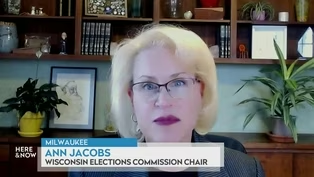 New
NewAnn Jacobs on a Nationalized Voter List and Mail-in Ballots
Video has Closed Captions
Clip: S2400 Ep2438 | 6m 15s | Ann Jacobs on an order to create a national voter list and restrict mail-in ballots. (6m 15s)
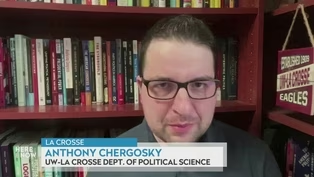 New
NewAnthony Chergosky on the 2026 Wisconsin Supreme Court Debate
Video has Closed Captions
Clip: S2400 Ep2438 | 5m 57s | Anthony Chergosky on the importance of a debate between Maria Lazar and Chris Taylor. (5m 57s)
 New
NewHere & Now opening for April 3, 2026
Video has Closed Captions
Clip: S2400 Ep2438 | 1m 4s | The introduction to the April 3, 2026 episode of Here & Now. (1m 4s)
 New
NewInside Wisconsin Politics: A Voting by Mail Executive Order
Video has Closed Captions
Clip: S2400 Ep2438 | 1m 45s | Inside Wisconsin Politics on an executive order calling for a national voter list. (1m 45s)
 New
NewWisconsin's 2026 Supreme Court Candidates Get Out the Vote
Video has Closed Captions
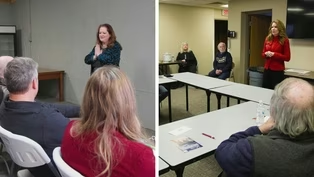
Clip: S2400 Ep2438 | 5m 16s | Partisan efforts in the 2026 race for Wisconsin Supreme Court consider long-term control. (5m 16s)
Providing Support for PBS.org
Learn Moreabout PBS online sponsorship
- News and Public Affairs

Top journalists deliver compelling original analysis of the hour's headlines.

- News and Public Affairs

FRONTLINE is investigative journalism that questions, explains and changes our world.











Support for PBS provided by:
Here and Now is a local public television program presented by PBS Wisconsin