
April 3, 2026
4/3/2026 | 55m 43sVideo has Closed Captions
Gary Sick; Adrien Brody; Lindsey Florentino; McKay Coppins
Former U.S. National Security Council official Gary Sick discusses the murky nature of the U.S. negotiations with Tehran. Actor Adrien Brody and playwright Lindsey Florentino explore wrongful convictions inside the justice system in their play "The Fear of 13." The Atlantic's McKay Coppins enters the world of online sports gambling to try to understand the addictive phenomenon gripping the nation.
Problems playing video? | Closed Captioning Feedback
Problems playing video? | Closed Captioning Feedback
April 3, 2026
4/3/2026 | 55m 43sVideo has Closed Captions
Former U.S. National Security Council official Gary Sick discusses the murky nature of the U.S. negotiations with Tehran. Actor Adrien Brody and playwright Lindsey Florentino explore wrongful convictions inside the justice system in their play "The Fear of 13." The Atlantic's McKay Coppins enters the world of online sports gambling to try to understand the addictive phenomenon gripping the nation.
Problems playing video? | Closed Captioning Feedback
How to Watch Amanpour and Company
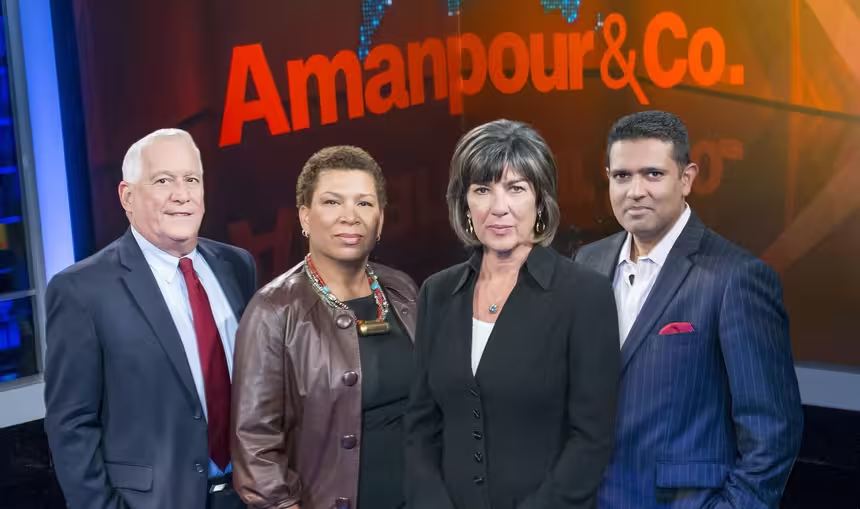
Amanpour and Company is available to stream on pbs.org and the free PBS App, available on iPhone, Apple TV, Android TV, Android smartphones, Amazon Fire TV, Amazon Fire Tablet, Roku, Samsung Smart TV, and Vizio.
Watch Amanpour and Company on PBS
PBS and WNET, in collaboration with CNN, launched Amanpour and Company in September 2018. The series features wide-ranging, in-depth conversations with global thought leaders and cultural influencers on issues impacting the world each day, from politics, business, technology and arts, to science and sports.Providing Support for PBS.org
Learn Moreabout PBS online sponsorshipHello everyone and welcome to Amanpour & Company.
Here's what's coming up.
We are just flouting the laws of war, humanitarian procedure, and there's a cost that goes with that.
As the war with Iran reaches a critical point, a man who advised three US presidents looks back.
Former National Security Official Gary Sick on what Washington got right and wrong then and now.
Plus, to suffer gives you understanding of the suffering of others.
After a wrongful conviction.
A new Broadway play, Fear of 13, tells the story of a man on death row.
Oscar winner Adrien Brody and playwright Lindsay Ferrentino join me.
Also ahead... There was something about the sudden rise of gambling that was changing the culture of America.
America's sports betting boom, journalist McKay Coppins goes inside the world of legal gambling and what it says about the country today.
(upbeat music) Amanpour & Company is made possible by the Anderson Family Endowment, Jim Attwood and Leslie Williams, Candace King Weir, the Sylvia A. and Simon B. Poyta Programming Endowment to Fight Antisemitism, the Straus Family Foundation, the Peter G. Peterson and Joan Gantz Cooney Fund, Charles Rosenblum, Monique Schoen-Warsaw, Ku and Patricia Yuen, committed to bridging cultural differences in our communities.
Barbara Hope Zuckerberg, and by contributions to your PBS station from viewers like you.
Thank you.
- Welcome to the program, everyone.
I'm Christiana Amanpour in New York.
Exactly five weeks ago, Iranian and Omani mediators believed they were making progress on resolving the critical nuclear issue with the United States.
Then came war.
Now President Trump tries to galvanize domestic support for something that has no stated end, something he just admitted he thought would take three days.
In his speech to the nation he seemed to dismiss, retrieving Iran's highly enriched uranium, or even opening up the crucial Strait of Hormuz.
Markets fell and oil prices rose again.
The miscalculations keep piling up.
Thousands have been killed in Iran, including more than 230 children since the start of this war.
Israel is now apparently trying to assassinate diplomats and maybe even diplomacy itself.
The seeds of this current conflict in the Middle East are deep and go back decades.
My next guest has been in the room advising past presidents on crucial foreign policy.
Gary Sick was the principal White House aide for Iran before, during, and after the Islamic Revolution.
He served in the U.S.
National Security Council during the Ford, Carter, and Reagan administrations.
And at 91 years old now, he is still sharing his vital lessons from history.
And he came into our studio to tell us where he sees this all heading.
Gary Sick, welcome back to our program.
So you have served every president practically in a specific era, Ford, Carter, Reagan, and particularly on this issue of Iran.
What would you be telling this current president about how to deal with this thorny subject which has bedeviled every administration for the last nearly 50 years?
Well, I think in the first place he wouldn't hire me.
He doesn't, he's not looking for expertise.
And that's one of the real problems is that people who know a lot about Iran would never have done what he has just done.
And I mean it was clearly done on a whim without a lot of thinking, without a tremendous amount of preparation.
And we're seeing the consequences.
I think that Trump really, he plays a tactical game.
He's got problems and he deals with them impulsively, one after another.
And if something gives him a tactical advantage, he's a deal maker.
He's not a history maker.
- Let me ask you about Trump as deal maker, transactional, tactical kind of guy and not a strategist.
All the things that he's been saying, which appear often to be contradictory, like we're talking to the Iranians when there's no evidence of that.
We want to make sure their nuclear program is never even used again, much less being a threat.
We've won, even if we move out without opening the Straits of Hormuz, that's up to others.
What do you think that public messaging says to Americans, most importantly to the Iranians at this crucial time?
- I think the Iranians don't trust a single thing that they hear from him or the Americans.
I mean, I think Iran's relationship with the United States, I mean, we've been disappointed, they've disappointed us, they've done things that we didn't want them to do and took us by surprise and we've done the same kind of thing and I would say both sides look at this and think the other side is completely untrustworthy and unworthy of even serious attention.
In 2015 in his second term Obama did instruct his experts to engage in serious negotiations with the Iranians and it took a couple of years but they came out with the JCPOA which most analysts say was maybe not perfect but it was good and it was an arms control agreement and nothing more nothing less.
It took two years and in the interim or just before it when Obama addressed the Iranians as the Islamic Republic of Iran, Khamenei, the now assassinated Supreme Leader, responded, told people to stop chanting "Death to America."
"We will judge depending on what this president does."
He said, "You change your behavior and ours will change too."
Was that to you rhetoric or was it real?
No, no, it was real.
Actually, Iran wanted people to acknowledge who they were, what they were, the Islamic Republic.
We laughed at that.
And I remember from the very first day I was walking out of the State Department while this was going on, the revolution was just over.
And I ran into a very senior Washington know-it-all type guy.
And he said, "Look, this group isn't going to last six weeks."
And he took, and these guys, it's about as much attention as he would give to them.
So 47 years later, they're still here.
And given that they are the military underdogs, they are still fighting their corner.
- Basically, Iran has mastered, in many ways invented, the whole business about asymmetrical fighting, about dealing with somebody who's bigger and tougher than you are, which is basically everybody else in the world.
I mean, every major power.
I must say, if I can just stop for a second, I was taught in the U.S.
government, I was an intelligence officer for years and years in the Navy, and we were told unequivocally that the United States is not in the business of assassination.
We do not kill senior leaders and the like under any circumstances.
And I thought that was a very sensible position because in the first place you kill somebody at a high level and then you can be sure you've created a whole body of people who are going to come after you or come after your country forever and they're never going to go away and just anyway never mind but plus you have nobody to negotiate with but a fascination is not an answer let's get back to the history now you served Carter Reagan Ford on this particular issue right the revolution president Carter who you served went to Iran famously on the Christmas Eve New Year's Eve 77 into 78 state visit in Tehran and declared the Shah was the guarantor of an island of stability in the Middle East those were his words and eight days later the revolution started bubbling you guys you're an intelligence official clearly got it wrong the cables that were going back and forth from the embassy in Iran to Washington were like no no there's no sign of revolution on the horizon how badly did you all disservice your government I've spent now 40 more years looking at that and thinking about it and considering what really went on and I would say unequivocally that this was one of the greatest intelligence failures in American history.
You've got to start with Kissinger and Nixon who came to Iran and talked to the Shah just before all of this started.
The Shah told them, "I will be happy to act as your representative in the Gulf and take care of your interests, but don't go looking over my shoulder.
If you want to know what's going on in Iran, ask us.
Ask me, and I'll tell you."
And of course, he didn't know what was going on in Iran part of the time, but more than that, he wouldn't tell us if it was really a crucial issue.
- Of course not, it wasn't in the Shah's interest.
Did you meet the Shah?
- I met him.
- What impression did you have of him?
Why do you think he said no?
- When he was operating according to a script, he was very reliable and really quite good.
When he departed from the script, he was really uncomfortable.
He didn't know what he was doing and he didn't trust his own instincts at all.
- So let's just hold a second because the massive wall of distrust between Iran and the United States, there'd be many occasions, for instance, during the revolution, the hostage crisis, before that, the US coup that brought basically the Shah back against a kind of democratically appointed Mossadegh.
And that was partly because Mossadegh nationalized the oil, the Brits didn't like that, they involved themselves in the coup, partly because the US was very concerned about Iran toppling and therefore a real ally in the Cold War disappearing.
Opening it up to the Soviets.
So they bring the Shah back and that almost creates... But you have to go back before that.
When it looked as if things were really going to pot, what did the Shah do?
He just picked up and ran.
He went off to Italy.
And it was only after we and the Brits stirred up the revolution on his side that he came back and was put into place.
So you paid people, essentially, on the ground to do... -Sure.
-...to shout for the Shah and bring him back.
I mean, that sense of grievance that the Iranians had of our interference with their form of government and with their way of thinking was really, uh, considered beyond the pale.
And if you look at some of the things that are going on now about, you know, the assassination campaign that is underway, plus destruction of things.
And I think about just mistakes.
I mean, in the first day of the war, we sent a missile in to a girls' school.
This was in Minab, in the South.
The U.S.
hasn't admitted it, by the way, even though initial forensic investigations say it was a tomahawk.
It's pretty clear that that was... And it says that it was based on old maps.
It was an old map that they used, that it wasn't accurate anymore.
But in the process, we killed over 100 schoolgirls.
And that's 100 families that will never forgive us for what we did.
And regardless of your strategic objectives or anything else, that's a high price to pay.
It really is.
- Talking about the attack on the girls' school and Trump's apparent pivot to actually war and military intervention, whether it's in Venezuela, whether it might be in Cuba, whether it's in a big way now in Iran, how does that sit with you?
Because there's been no legal effort to get consensus around going to war.
War seems to be now the default action or some kind of military intervention seems to be a default action for the United States.
I think with everything we do, we are undercutting the laws of war and the, basically over the past several centuries, we've gradually been accumulating and growing laws of war about how you behave in a war.
And it's, it doesn't keep us from going to war, but it does mean that you only do it under certain circumstances.
When there's an imminent threat, there was Jimmy Carter had an imminent threat.
If he had wanted to go to war with Iran, he had an excuse.
He had a reason to do it.
Trump had no such excuse.
And we are just flouting the laws of war, humanitarian procedure, and there's a cost that goes with that.
We're the superpower.
We're the strongest country in the world, and we are supposedly a country of laws.
And yet we're the ones that are just battering away at these rules that have grown up over years for very good reasons.
I mean, they aren't there just casually.
You don't attack somebody just out of the blue.
You have to have a reason to do these things.
You don't act disproportionately.
So if you get hit and two of your people get killed and you wipe out a village, that's not proportional and it's against the laws of war.
And there's a whole series of things and we're breaking those laws every day.
- You're 91 years old.
You've had a lifetime of public service.
Did you ever think that you would see your country in this position?
No.
I would have... No.
I'm not... I've been around enough to know that you can't predict the future and that it surprises you.
But I would never have believed that we would find ourselves in the position that we're in as the rogue nation in the world.
There have been a lot of miscalculations.
We talked about Iranian mistrust of America, American mistrust of Iran because of the hostage crisis and other things.
But Iran, and it showed up even after 9/11, has been historically the most pro-American country in the entire region.
Even now, the people of America's Arab allies are not pro-American, by and large, even though the leaders may be.
What could America have done to capitalize on the fact that this massive country of almost 100 million were pro-Western and pro-American, even under this theocratic regime?
- I have to say that Obama got it just about right.
He addressed them in a form that made them look good or at least recognized their sovereignty and their individual government.
He negotiated with them directly over a long period of time.
He sent probably the best nuclear team that the United States has ever assembled and he put them to work for more than a year talking to the Iranians.
Look at any other president and you don't see any of that.
It was how do we get rid of Iran?
How do we stop them?
How do we make them look bad?
And unfortunately it just doesn't work.
They desperately appreciated the fact that Obama took them seriously.
But of course Obama paid a big price for it in the United States.
First and foremost no matter how Iran negotiated with the US finally in the JCPOA.
It has demonstrated that it is a great threat to its own people and most recently with the massacres after the last serious set of protests.
How can the United States deal with a country like that?
Well it's exactly the problem that Obama faced and he waited until his second term.
He knew he was taking a chance.
He paid a high price for it politically and people are still giving him a hard time.
Obama I mean for trying to open up in some form to Iran.
But in reality there we deal with a lot of governments that we don't agree with.
And we even make friends with them.
And you realize the Vietnam War was going on at roughly the same time as the Iranian Revolution.
And there we lost more than 50,000 Americans who were killed as a result of it.
And within a few years afterwards we were dealing with them, we had full relations with them, developing close relationships, not because we loved them or that we appreciated what they had done, but because it was to our advantage to do that.
The same thing could have happened.
Basically, if you want the idea of historic mistakes, and I think we're in one right now, the fact that Iran took the American hostages and held them and humiliated us over a period of more than a year, it actually entered the American psyche in a way that we can't escape it.
And so we hate Iran more than we should probably and more than it's good for us.
We would be smart to find a way to deal with them the same way we deal with Vietnam and other countries, not to mention Russia and China, where we've had developed relationships because we needed to for strategic reasons.
But they did that to us and nobody had ever And I can't forgive them either.
That it was a stupid, stupid thing to do.
They got a tactical advantage out of it.
They won elections in the country, carried their revolution forward.
But it was a stupid thing to do and hugely costly.
It has cost them in ways that we can't even imagine.
Including right now.
Including.
Gary Sick, thank you so much for your unique perspective.
Thank you.
Great to see you again.
Now to the U.S.
justice system, and this is a story of injustice, memory, and the fragile line between truth and conviction.
The Fear of Thirteen tells the real-life story of a man who spent more than two decades on death row for a crime he insists he did not commit, only to be exonerated by DNA evidence.
[dramatic music] - Now even the truth sounds like a lie.
- The play has traveled from London's West End to Broadway, and it brings this story to life through an intimate portrait of survival, belief, and failures.
I sat down with Oscar-winning actor Adrien Brody, who takes on the role, and playwright, Lindsay Ferrentino, who wrote it.
Lindsay Ferrentino, Adrien Brody, welcome to the program.
Thank you.
You're a very serious dude.
Can I just start by asking you something a bit funny that I read?
I didn't see it.
First of all, I was gonna say, am I?
Was there a Super Bowl ad that you did when you kind of made fun of your own serious self?
Yes, yes.
How, what, when?
I thought it was brilliant.
When they submitted that to me-- What do you say yourself?
I didn't create it, but I thought it was conceptually quite fun to come up with that idea, but also to have the opportunity to laugh at a certain perception, not only of myself, but of serious actors.
Can you give us just one line?
From the commercial?
Yeah.
I can handle that for you.
I'm sure they're gonna be thrilled Just plug them.
But the funny line was can I cry?
because just looking for an opportunity to find some drama and there is no drama and that's the no there isn't because it's a product Anyway, we won't go into the product placement, but this is now drama and we're talking about serious.
Now you're serious.
And I saw this play in London at the Donmar, I believe it was, right?
Amazing.
What is it about the character of Yaris that drew you in and made you want to play this?
Well, it's Nick Yaris' story and who is the man that I portray, who is a man who'd served over two decades on death row, incarcerated for a crime that he had not committed.
So that alone speaks to not just his individual plight and the grave injustice that he's experienced, but this pervasive sense of injustice, which references an even greater injustice that you're very privy to in the world of news and what we experience.
And for me as an artist or in an artistic capacity to be able to explore and help open the conversation and consider these grave issues and ailments within our society are very important and meaningful.
Lindsay wrote an incredible play, incredible work.
It is incredible.
And the words were so moving that they pulled me out of my own apprehension of doing theatre for many years and getting back up on the page.
And this is your first Broadway, yes?
First time on Broadway.
How does it feel?
It's very exciting.
I'm enjoying it.
I find it exhilarating.
It's exhausting.
You're on all the time and sometimes more than once a day.
Yeah, we just had two shows.
It's very alive and I love communing with an audience and I love the relationship that ensues and every night it's different and certain things they find amusing and certain things they gasp and find shocking and it's really a wonderful exchange.
And Lindsay, you wrote it, as Adrien's talking, you know, obviously in the United States people know, especially through the news and documentary of this massive and pervasive injustice and the whole idea of DNA exoneration is not new.
So how do you see audiences react differently?
'Cause maybe they're not as, you know, maybe they don't know as much about this in the UK as they do here.
Do you see a difference reaction?
- Yeah, we've been talking about this a lot, is that I feel like in the UK, when the play was done, you got a lot of gasps because the audience doesn't have the death penalty.
with a sort of critical distance and go, "Isn't it crazy, the justice system in America?"
Whereas the audience reaction here, there are shocks, you know, shocks in the play and gasps, but there's also a sort of knowingness to the audience response and an anger and a complicity, I think, in the part of the audience that we're all sort of complicit in a system, in a culture, in a country that produces stories like Nick's.
That's so interesting to use the word complicit, actually.
And I understand from Lindsay that there was quite a lot of rewrites from the London version that I saw to this one.
What do you think needed to be adjusted and why were there rewrites?
It's... I think it's just a... Why were there rewrites?
Why?
That's what I've been asking.
I've been asking that question.
Why?
There are opportunities to discover things.
Night after night you discover things, even as a performer.
And I think Lindsay's had time to... Adjust.
Well, not just adjust, but to hone in on details, storytelling approaches, things that work differently with different settings.
I mean, this is a new iteration of the play.
It's not, you know, entirely new cast, wonderful work, and every individual's own sensibilities crafts a different call and response.
And certain things may have been comedic in London or certain things shouldn't quite be as comedic and they're landing quite comedic here.
And that's not wonderful for where we are in the story.
And so we'll all discuss that and Lindsay.
And yet when we read about it I'm going to ask you just give us a brief synopsis for our viewers.
You know, it's obviously very dramatic, very sad, but darkly humorous.
Yeah.
Tell me about Nick Yaris and why the dark humor?
What was it about him?
Well, he exudes.
He exudes and so do you.
I think, you know, Nick was a man who was wrongfully incarcerated on death row for 22 years and was able to exonerate himself through his love of storytelling and his ability to articulate his own story, which he learned in prison from reading books and finding his own voice.
But I think also when you talk to anyone who's been incarcerated, they don't want their incarceration to be the only thing that defines their existence.
And so I think it was important in the telling of the story that we capture, and it's something that I'm so grateful to Adrien also has helped pull out all of these different sides of this person.
That he was a romantic and an adventure seeker and he's hilarious.
And he has a gallows sense of humor about his time in prison.
And that you want the character to contain those multitudes.
20 years is a huge, long, long time.
Did he come out bitter or did he come out grateful?
Or what was...?
I, you know, I don't... I'm sure it's very complex.
And, um, what I admire about Nick is that he... the man that I understand today and the man who presents himself to the world is someone who's incredibly empathetic, genuinely interested in others.
He's worked tirelessly to other former inmates.
And he has-- you're very aware of the harrowing circumstances that this man has endured in his life.
Yet all the edge and everything that is within him that has kept him alive and he kind of expresses a great deal of grace and a great deal of human-ness and and an understanding, you know, to suffer gives you understanding of the suffering of others you know, and you can find great depths of suffering within the world around you if you have a glimpse of it and if he's had more than his share.
And he's obviously quite deep.
You say that he read a lot and the fear of 13, the word... Tell me where that comes from, because it's a word he discovered as he was reading.
There's some Greek version.
Can you pronounce it?
Oh, Triskidekaphobia?
Sure.
Oh, there you go.
What was it again?
Triskidekaphobia.
It's actually a real phobia, but it's less about that as much.
Why did you use it as a title?
Well, it is the title of the documentary.
And Nick, which in the documentary, in prison, he learns all of these words and he self-educates him.
That's one of the words that he learns.
And sort of a passing reference in the documentary.
But in the play, we've taken it and he had a very, I won't go into detail about it, a traumatic experience at a young age.
a sort of symbolic metaphor for becoming a man.
And you also said that he was a romantic and that comes through.
And we know that he had a romantic relationship with the other character in the play, who is the activist who basically comes to try to figure out if she can help him with his case.
Tell me a little bit about that relationship.
So in the play there's a woman named Jackie who comes in to visit him with an abolitionist group looking to abolish the death penalty and they come into prisons regardless of guilt or innocence and just sit across from someone and say tell me your story and I'm just here to witness your story and in doing that they develop a sort of deep friendship which turns into love which turns into him reigniting his spark to fight for his own innocence.
And they get married?
They do get married.
Are they still married?
No.
No?
Okay.
Alright, I won't go there.
But he's still alive, Nick, right?
Yes, he's at the show every day.
So you met him.
Was he in the writer room?
He's very much alive.
Yes.
Yeah?
Yes.
And what was it like meeting him?
Oh, oh.
Does he have a say in how his story is told?
He's been very involved, you know, and very, um... It's been very helpful to have Nick's approval, and it's beyond approval.
I really... No I really love what this feels like for Nick.
It's quite freeing and healing in a lot of ways, as I can only imagine.
To have all your hardships and story and to be such a wonderful storyteller yourself.
To have someone like Lindsay to find the eloquence of weaving his poetic language and gregariousness and then to offer it to someone to conjure up every night and share it with people.
And it is quite moving.
So I think it's been quite healing for him.
It's been wonderful for me to see his response to it.
And the people's response to him and his story.
You are both New Yorkers as far as I gather.
You were born and raised here and went to school here and now you're treading the boards for the first time on Broadway for sure.
For both of you, what does it mean to be New Yorkers delivering this work of art here in New York at this stage in your career?
For you first.
Well, you know, I started acting very young.
And my first work as a boy started in the theater, off Broadway, Lower East Side, in Brooklyn at BAM.
That's quite something.
BAM, to be your first.
Yeah, I did a workshop with Elizabeth Suedos at 11 or 12.
Yes, it was wonderful.
I don't recall.
I was so young.
It was a long time ago.
But I do remember her very well.
And I remember a similar bond that I always say that I loved in London and I love here.
When you get to work with a troop of actors on a play, and you all have to lift each other up every day.
It's such a lovely thing.
It's very different from film.
You can get that with one or two actors that you gel with, but film is quite compartmentalized.
The process, the relationship with others, and you know, it's so beautiful to be up, again, lifting each other up, responding from each other every night and relying on one another.
And I think it forms this quite intimate and you're vulnerable and it's so beautiful.
that from those days.
I remember sitting around, we all eat our cheap Chinese food and talk and have fun.
I was so young and I just loved camaraderie but also sharing this love of acting and expression with others who were gifted and finding inspiration and all of that.
And there's stuff every night that I look at certain things people do and I just, they're so nuanced and fun and alive and their own and it's beautiful.
And so it's such a treat to watch people.
Tessa's wonderful and each actor on the stage with me every night is bringing something that's so special.
That has never left and that's I guess the beauty of it.
Of course the privilege and the honor of overcoming my own fear of getting up and doing Broadway because it is quite a task.
But it's a beautiful thing.
I'm very honored and I've always admired the Broadway community and the community of actors who are capable and brave enough to present work on a stage night after night, 8 shows a week for an audience.
And Lizzie, for you, both of your plays, The Queen of Versailles and this one, have been taken from documentaries.
Do you think you'll do the reverse?
Have you done the reverse before?
Done documentaries and film?
- No, but I think I used to write only fiction, but I always did an extreme amount of research and was always looking for a true story that I then fictionalized.
And I think during COVID, when things were so uncertain, I was just looking for grounding in truth, so started doing these true stories.
I don't know if it will continue that way, but it's an amazing, it's an invitation to bring people into your life when you're doing a true story about someone who actually exists in the world and sort of expands your awareness in a more real way, which is so thrilling.
Yeah.
Well, it's out there.
It got great reviews in London, and I'm sure it will here.
It's in previews right now, right?
Yeah.
Okay.
Lindsay Ferrentino, Adrien Brody, thank you very much indeed.
Thank you.
Thanks for having us.
Pleasure to see you.
The Fear of 13, as produced and acted by our two guests, is currently on Broadway now.
Now a different spectacle as March madness grips America and huge sums are wagered on college basketball, one journalist decided to step inside the frenzy.
McKay Coppins of The Atlantic spent a year as what he calls a "degenerate gambler," placing bets throughout the American football season to understand the explosive rise of legalized sports betting and the hold it now has on millions of Americans.
He's joining Michel Martin to discuss what the normalization of betting reveals about modern American culture.
Thanks, Christiana.
McKay Coppins, thanks so much for joining us once again.
Happy to do it.
You know, we think of you as a political journalist.
You know, you do these deep dives into complex policy issues.
You did this great biography of Mitt Romney.
What made you think of gambling?
How did that start?
You know, I was talking to my editor sometime last year about something that I think we've all noticed if we're, you know, watch sports or frankly just live in America, which is the sports gambling industry has just exploded in popularity, right?
And it's impossible to watch a game without being bombarded with these kind of neon soaked ads for sports books.
But I also felt like there it was something more pervasive was happening like there was something about the sudden rise of gambling that was changing the culture of America and it was leaking into every other facet of American life, sports, culture, politics, geopolitics, and that's really what piqued my interest.
And it was it was not my idea to start gambling myself my editors idea but but it led to some interesting places.
Well yeah exactly because you didn't just sort of do kind of the usual outside in journalistic approach like interview people that the Atlantic spotted you some some dough and said gamble this kind of become part of this world you know and see how it goes and that presented a problem for you ethically right because of your faith practice you're a member of the Church of Jesus Christ of Latter-day Saints and gambling is not something that is approved of you know by the church so what did you do to kind of sort that through well I you know I took the experiment to my bishop and had a very awkward conversation with him which I write about in the piece.
Basically I told him look my editors want to stake me $10,000 to gamble with for journalistic purposes which right off the bat you know that sounds like a preposterous thing to tell your bishop and I kind of watched as a look of pastoral concern bloomed across his face and you know ultimately he gave his kind of tacit blessing for the experiment he recognized that gambling with my employer's money versus my own was different but he also said look I've seen this vice ruin enough people's lives that I can't let you leave without a word of warning and he told me some cautionary tales and he talked about how this can become a slippery slope and what starts out as sort of a modest habit can really come to consume your life and the last thing he said to me before I left his office was "Ne careful," and at the time I will admit that I kind of shrugged him off a little smugly you know I said look this is a gimmick for a magazine article it's not going to affect me you know personally spiritually it's not gonna be a big deal and and I have to say in retrospect his his warning was actually kind of prophetic you write that since legalization in 2018 Americans have wagered more than half a trillion dollars on sports and roughly half of men aged 18 to 49 have online betting accounts it's almost like it's like in the air now it's a more about that like why is that yeah I mean there were a bunch of things that changed kind of all at once in the last really decade and I think it's easy to forget that this new kind of wild west era we're in is very new right as of 10 years ago people were gambling around five billion dollars a year on sports legally last year it was a hundred and sixty billion the the average person if they wanted to gamble on sports either had to go to Las Vegas or one of a handful of other jurisdictions where it was allowed or they had to seek out a bookie or call an offshore sportsbook in Antigua and you know I really put some work in what's changed is that one state started to legalize it the online sportsbooks just exploded in popularity right they they all of a sudden almost overnight we took what was widely seen as a pretty dangerous vice that we need that should be regulated and stigmatized and put it on everyone's phone and eliminated all the friction that once existed to access that vice, right?
And so that when you when you say it feels like it's in the air, I agree with you.
I mean, I feel like you can't watch sports, you can't talk about sports, you can't listen to a sports podcast without just finding yourself in the middle of a conversation about gambling.
All the sports analysis, the punditry now, is about point spreads and money lines and prop bets and parlays.
And, you know, one statistic I came across that I thought was really alarming was that almost a third of 11-year-old boys say that they have gambled in the past year in America.
you had an early win you were up what was it 20 bucks 20 bucks on the first night yeah which maybe the worst worst thing that could have possibly happened to me because I was all of a sudden filled with irrational confidence that I could win a ton of money as a gambler oh my god but but it kind of went south pretty fast yes you want you you won just three out of your first 14 bets but then somehow you had irrational exuberance and you still thought you could gain the system.
Why is that?
That's kind of funny.
Well, you know, I think this is something inherent to the psychology of gambling, right?
Which is the these, this industry thrives on people believing that they are the exception, right?
That they are the ones that are going to be able to beat the odds, beat the house, make money doing this when almost nobody does.
And I think this is important to know.
Early on in my gambling experiment, I called up Nate Silver, a famous statistics wonk, who has done a lot of polling analysis, and more recently, he has done a lot of gambling stuff.
He plays poker professionally, he gambles on sports.
I asked him, if I'm starting with $10,000, how much would I have to win to count this as a good season?
Right?
Like what would be an impressive season for my gambling experiment?
And he was almost kind of confused by my question.
He was like, no, you don't understand.
If you win one penny, that makes you better than 98% of gamblers.
Almost nobody wins at this, and yet we all believe we're gonna be the exception.
- Yeah, how is that possible?
How is it that nobody can win?
- Well, the whole kind of economy of online sports betting in particular is very deliberately rigged against the recreational better, right?
For one thing, for every bet that you make, the sportsbooks essentially charge you 4.5%, which means that after you pay that and you pay taxes on your winnings, you actually need to win 55% of your bets to break even.
It's not just enough to win most of your bets.
And then there are all these other little things that the sportsbooks do to kind of make sure that the average gambler is losing.
So for example, you can bet on live games as they're happening.
If you watch any given NBA game, NFL game, the line on your app on that game is constantly moving fluctuating based on what's happening on the field or the court.
But if you're watching from home on TV, you might not realize that you're watching on a 20 to 30 second delay.
The sports books have a live data feed on what's happening in the game.
And so you're essentially betting against somebody who lives 30 seconds in the future.
And so there are a hundred little things like this where, you know, that ensure that the industry is almost always winning.
And yet again, they're so good at making you think that you're going to be able to defy the odds.
And they do it in insidious ways, right?
So like if you go a couple of days, for example, without gambling, they will send you something called a reload bonus or a no sweat bet, basically enticing you back to the app saying, "Hey, we'll give you free credits on our app to keep you gambling."
Right?
Or if you lose your next bet, we'll just refund you with more credits that you can use for your next bet.
When did you realize, "Oh, you know, Bishop might have had a point here.
Maybe this is not the fun, detached intellectual exercise that I thought this might be."
When did you start to notice?
I mean, honestly, it was just within a few weeks that I realized it was bleeding into my personal life.
I mean, I very quickly was hiding in the bathroom or in the kitchen pantry to put my bets in so that my kids wouldn't see me gambling on my phone.
I was routinely staying up well past midnight to watch the games that I was betting on and then staying up even later looking through DraftKings or FanDuel for more bets, which meant that I was then sleeping in later, I was less present with my family, my wife started to get annoyed that I wasn't, you know, available in the mornings to help with the kids.
And we got into an argument, I think, around October.
And that was one of the first moments where I realized, oh, this isn't just affecting me, it's affecting the people around me.
And it really just got worse from there.
The truth is, even as I recognized that it was having an effect on my relationships, that it was making me more distracted, more irritable, less present.
I also didn't want to stop.
I mean, you could have told you could have told me right then.
We're calling off the story, you know, the assignments over, and I would have been I would have wanted to keep going.
It pretty quickly that this was not just a journalistic exercise anymore.
It was becoming more of an obsession.
It sounds like an addiction.
It sounds like you know it's having a harmful effect on you, but you keep doing it anyway.
You keep thinking you can stop anytime I want.
And you need more and more of the thing in order just to feel okay.
That definitely happened to me.
I remember when I first started, I was putting about $100 on any given game.
But what happens is, after a while, you need more action to feel the kind of adrenaline rush of the bet.
So then it was $200.
Then it was $300.
By the end, I was betting $500 on a game.
And I was doing increasingly reckless bets, multi-leg parlays, crazy long-shot prop bets that had very little chance of paying off.
But the fact that it was so risky made it more exciting, right?
And most studies suggest that around 3% to 5% of people who gamble online will eventually become gambling addicts.
A much greater number will exhibit compulsive behaviors like I was, and it will start to bleed into their lives.
- Well, let me just bring in what the companies say about themselves.
This is the, these are statements that we pulled from their sites.
The FanDuel says it's, "Committed to ensuring that every customer has access to the right tools and support," and that it encourages users to, "Be aware of their betting habits and monitor their spending."
DraftKing says, "It's more fun when it's for fun," and urges people to only bet what you can afford.
And it says, they say they offer tools like limits and self-exclusion.
And when you hear those statements alongside your reporting, how do you assess that?
Are those effective?
The tools are effective if the customers use them, but they're not required to use them.
And I will say that even as somebody who came to this as a complete novice, signed up for these apps, I wasn't even aware that these tools existed until several months into my reporting.
Once I was really looking into it, I interviewed some executives at FanDuel and DraftKings.
I was made aware of all these tools and they're great.
I would not say that they lead with them.
I would not say that if you pull up the app on any given day, it's telling you to slow down, to be careful.
And look, I don't want to be too cynical here.
I actually think that these companies do want to be good corporate citizens.
What they told me was that they don't want money from gambling addicts, that they do just fine with just regular people who are having fun as recreational gamblers.
And I think they believe that, but running up against a basic economic reality of sports betting, which is that the overwhelming majority of their profits and revenues come from the 10% of people who gamble the most.
And so what that means is that they don't have a super strong economic incentive to kick people off their platforms who are gambling a lot maybe to excess because that's how they make all their money.
It sounds to me though, then that's a regulatory problem.
Are policymakers kind of catching up to this?
Yeah, I think they are, finally.
I mean, it's been a while.
I interviewed a member of Congress named Paul Tonko, he's a Democrat from New York, who has been on this issue for four or five years at this point.
And he came at it through the lens of addiction.
He is on the Addiction Recovery Caucus in the House of Representatives.
and what he said to me was, "Look, these gambling companies are delivering a known addictive product.
They should be regulated as such.
We shouldn't, you know, rely on them to self-regulate when they are making money off an addiction."
Now, not everybody who uses these apps are addicted, of course, but there are a whole menu of regulatory options that could be embraced to tackle these issues.
So let's talk about you again.
How deep in the hole did you wind up at the end of it?
I mean, the Atlantic Center are going to spot you 10 grand.
How much did you really lose?
I returned to them about $120.
The morning after the Super Bowl, I sat down at my desk and I looked through all my wagers and realized I had basically lost everything.
And realizing that I didn't want to stop gambling that even though the experiment was supposed to be over, I was now looking at the March Madness odds.
And I was looking at, you know, the predictive markets like Kalshi and Polymarket, I realized that the temptation was not going to go away.
And so I actually signed what's called a self exclusion form, which is available in pretty much every state that has online gambling.
And if you sign it, you submit it to the state and they cut off your access to online sports books, the sports books shut down your account, they are legally not permitted to take your money, and so yeah, I put yourself on the wagon.
That's right.
And I, you know, I've often wondered if I had won that night, if I had ended up $5,000 up, which is what would have happened if the Patriots had won.
Would I still have signed a self exclusion form?
I like to believe that I would, but I honestly don't know.
You mentioned Kalshi, and Polymarket.
People can essentially bet on everything from elections to the weather.
Do you think that there's something that needs to happen there?
Yeah, no, to me, the prediction markets are in some ways kind of the logical end point of the sports betting explosion in America, right?
That we have taken the logic of gambling and the ease of online gambling and now extended it to everything else in American life, right?
Culture, art, politics, war.
And I think it's really dangerous.
I think that the fact that you can gamble on whether a nuclear bomb will be detonated somewhere in America before the end of the year or how many people will be deported or whether Gaza will experience a famine or, you know, all these kind of very serious grave life or death issues is, is I think, morally repugnant, but also, the danger is that it kind of invites corruption, right?
It invites people with insider knowledge, military insiders, political insiders, to cash in on their insider knowledge.
And maybe even more dangerously, they could start manipulating public events to cash in on poly market bets.
And, you know, who's to say that some military insider won't place a bet on poly market that a missile will strike somewhere in Tehran on a certain date and then make sure that that happens, right?
That this is where I think we need the most urgent regulation is on these prediction markets because it is truly a wild west.
They're completely unregulated.
And I think they're kind of a disaster in the making.
- McKay Coppins, thank you so much for talking with us.
- Thank you.
- So beware the Ides of March madness.
And that's it for our program tonight.
If you want to find out what's coming up every night, just sign up for our newsletter at pbs.org/amanpour.
Thanks for watching and goodbye from New York.
>>Amanpour & Company is made possible by The Anderson Family Endowment, Jim Attwood & Leslie Williams, Candace King Weir, The Sylvia A.
& Simon B. Poyta Programming Endowment to Fight Antisemitism, The Straus Family Foundation, The Peter G. Peterson & Joan Gantz Cooney Fund, Charles Rosenblum, Monique Schoen Warshaw, Ku & Patricia Yuen, Committed to Bridging Cultural Differences in Our Communities, Barbara Hope Zuckerberg, and by contributions to your PBS station from viewers like you.
Thank you.
You're watching PBS.
♪ ♪ ♪
 New
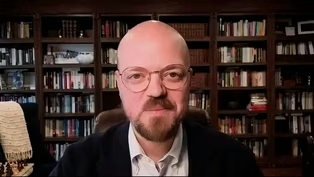
New“My Year as a Degenerate Sports Gambler:” The Atlantic’s McKay Coppins
Video has Closed Captions
McKay Coppings discusses the popularity of online sports gambling. (18m 6s)
Providing Support for PBS.org
Learn Moreabout PBS online sponsorship
- News and Public Affairs

Top journalists deliver compelling original analysis of the hour's headlines.

- News and Public Affairs

FRONTLINE is investigative journalism that questions, explains and changes our world.












Support for PBS provided by: