Roots, Race & Culture
Connecting Food & Wellness
Season 6 Episode 2 | 26m 45sVideo has Closed Captions
Explore how conscious food choices impact physical and mental health.
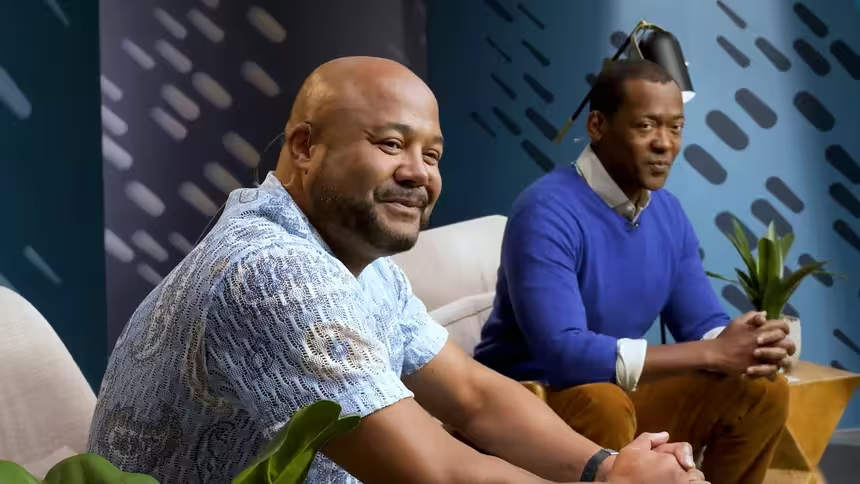
Diet can make a difference in how we feel and think. What’s best for our bodies? Learn how conscious food choices impact physical and mental health. Omar Abou Ismail, founder of Rawtopia restaurant, and Debbie Dworkin, founder of Dr. Mushroom teas, discuss the benefits of food and its connection between body and mind.
Problems playing video? | Closed Captioning Feedback
Problems playing video? | Closed Captioning Feedback
Roots, Race & Culture is a local public television program presented by PBS Utah
Roots, Race & Culture
Connecting Food & Wellness
Season 6 Episode 2 | 26m 45sVideo has Closed Captions
Diet can make a difference in how we feel and think. What’s best for our bodies? Learn how conscious food choices impact physical and mental health. Omar Abou Ismail, founder of Rawtopia restaurant, and Debbie Dworkin, founder of Dr. Mushroom teas, discuss the benefits of food and its connection between body and mind.
Problems playing video? | Closed Captioning Feedback
How to Watch Roots, Race & Culture
Roots, Race & Culture is available to stream on pbs.org and the free PBS App, available on iPhone, Apple TV, Android TV, Android smartphones, Amazon Fire TV, Amazon Fire Tablet, Roku, Samsung Smart TV, and Vizio.
Welcome to Season 7
Bold and honest conversations tackled with humor, insight, and empathy.Providing Support for PBS.org
Learn Moreabout PBS online sponsorship(gentle music) - [Announcer] Funding for "Roots, Race & Culture" is provided in part by the Norman C. and Barbara L. Tanner Charitable Support Trust and by donations to PBS Utah from viewers like you.
Thank you.
(upbeat music) - Hey, everyone, and welcome to "Roots, Race & Culture," where we bring you into candid conversations about shared cultural experiences.
I'm Lonzo Liggins.
- And I'm Danor Gerald.
The top two causes of death in the United States are heart disease and cancer according to the CDC's website in 2022.
- And only 10% of cancer cases are hereditary.
Hereditary causes of heart disease vary according to the cancer.gov as of August 8th, 2024.
The one thing we do know is that diet and exercise can make a difference in how we feel, think, and sometimes how long we live.
Joining us today are two guests to talk about the healing benefits of food.
Welcome, you guys.
- Yeah, nice to have you here.
Thank you for joining us.
First we have Omar Abou-Ismail, who is the owner and chef at Rawtopia.
- Yep.
- And Debbie- - Debbie Dworkin.
- Dworkin.
- The one and only.
Debbie, tell us about yourself.
- Oh, so I am the founder and owner of a brand of teas, mushroom tea, called Dr. Mushroom.
- Nice.
- Awesome.
- And Omar?
- I'm the owner and chef of Rawtopia.
It's a restaurant in Millcreek, Utah.
And originally I'm Lebanese and grew up in West Africa, and here I am.
(chuckles) - And here you are, absolutely.
(Omar laughs) - Nice.
That's a long way- - Yeah.
- From home.
(Danor laughs) - Yep, yep.
- Yeah, you know, there's a little bit about your story, 'cause I wanna get into your story in a second, but I wanna start with you, Omar.
Tell us a little bit about your journey, how you got from, you know, Lebanon into Utah, and, you know, how you got into Rawtopia and you know, this world of sustainable foods.
- Yeah, well, so I grew up in Nigeria, West Africa, and I also used to, we used to go to Lebanon a lot.
And then from Lebanon, I decided to continue my education and go to college here in United States.
So I studied geophysics at the University of Utah and then- - Geophysics?
- Yeah, geophysics.
I worked as a geophysicist for, I would say, 2 1/2 years.
And then my dad had cancer, and that propelled me to, after he passed away, to open the first raw food restaurant in Utah.
It was a healthy food restaurant, all organic food restaurant.
And that's my story.
That's how I started back in 2004.
- Wow, okay, that's a journey.
Can you tell us a little bit about your story?
What brought you to where you are with Dr. Mushroom?
- Well, I just love mushrooms.
So, this was quite a few years ago.
I went down to the market in Salt Lake City and saw this mushroom called lion's mane.
Now, today, everybody, not everybody, but a lot of people know what lion's mane looks like.
It's just a beautiful mushroom, very intriguing.
There's something mysterious in general about mushrooms.
So I just love mushrooms.
And I decided to start learning how to grow mushrooms.
And from there, growing mushrooms, then I started learning about the benefits of mushrooms.
And after learning of the benefits of mushrooms, I started brewing mushrooms.
And then I realized, well, okay, so there's more we can get, these wonderful benefits of mushrooms, and we can spread it like spores.
We can get it out there.
And it's much easier if you drink it.
I mean, you can eat it a lot.
You can do a lot of things with mushrooms.
- Yeah, and bear in mind we're not talking about like the psychedelic type of mushrooms also.
I mean, even though there's benefits I'm sure to that, but we're talking about just simple mushrooms 'cause there's tons of different types of mushrooms.
- Exactly, we're talking about gourmet mushrooms, edible mushrooms.
There are some other medicinal mushrooms like a reishi.
You can't eat it.
It looks like a shelf.
You know, if anybody has gone into the forest, and you've seen these mushrooms that kind of grow like a shelf on a tree.
So that's not a gourmet mushroom.
It's considered a medicinal mushroom.
- Ah, gotcha.
Yeah, so Omar, tell us... You know, you were geophysicist, and then all of a sudden, you know, you decided that you wanted to switch over to being a chef.
Was there a specific... Was it because of your father's cancer that made you wanna do that, or what's the story behind that?
- I come from a family of chefs.
Like my mom is the head chef of Mazza, used to be the head chef of Mazza- - [Lonzo] Great restaurant.
- For a very long time.
And she learned a lot from her grandmother.
And back in the day when I was going to school, I remember she had to leave to DC for a while with my brother to live there, and I really missed her cooking, you know?
So I would always call her on the phone and be like, "Hey mom, how do we do this?
How do you do that?"
'cause I really missed, you know, Lebanese food a lot when she was gone.
And so she would tell me how she made it, and I remember I would start making all these foods.
And naturally, she's really good with herbs and spices, and I'm sort of the same way where I'm very good with spices as well.
And so I started learning a lot from her.
And I remember even when I was working as a geophysicist, I would make food for myself, and all my coworkers would want to, you know, eat my food.
And then they would ask me (Danor laughs) to make them food the next day, you know?
So when I made myself food, I would make them food and sell my food that I made to them (laughs) the next day.
So food has always been with me.
But then when I was living in Maui, working as a geophysicist, I remember reading a book called "The Food Revolution," and my awareness of food really heightened at that moment in time I remember.
And the environment was a pressing issue for me, and so I wanted to really understand how am I impacting the environment and how can I live, you know, sustainably so that I'm able to eat food and nourish myself at the same time, support the planet that I live on.
- All right, well, let's go ahead and see Omar in his restaurant.
Let's see Omar in Rawtopia.
(energetic percussion music) (blender whirring) (energetic percussion music continues) - Looks amazing to me.
- Wow.
- That's a nice restaurant.
- Yeah, I'm telling you.
And I gotta say, you said you were good with spices, and he's not kidding.
I had a meal there, and as soon as I put it in my mouth, I was like, "Oh my gosh.
That is an explosion of flavors."
And I just want to kind of make some things clear.
When you mentioned raw food, people kind of have a perception of that, and then but you're also talking about sustainability.
And I wanna hear how would you define that.
I wanna hear from both of you, but let's start with you, Omar.
- So, raw food is meaning everything is made from scratch.
Obviously, when you make food, the basic ingredients is like a raw garlic.
Nowadays, when people buy already peeled garlic, there's a processing involved where, first of all, they peel it, and then they pasteurize it, and then they bag it, and then they sell it.
I'm all about the raw garlic.
So basically you take the garlic.
You peel it yourself from the skin and then you use it in the food.
That's what raw is to me, is making everything from scratch.
We support growers and farmers that are actually growing biodynamically and organically.
Also, we have our own gardens as well.
So, yeah, we harvest a lot of our food in the summers, and we dry it, and we can it, and we use it in the wintertime in the restaurant.
- Yeah, how about you, Debbie?
I mean, when you think of sustainability, what do you think of?
- Well, I think in context with mushrooms, so to grow a million pounds of mushrooms, you need a few acres.
- [Lonzo] Oh.
- However, if you want to grow the same quantity of produce, some other produce, you need thousands of acres of land.
To grow seven pounds of mushrooms, you need one square foot of land for seven pounds.
It doesn't take that much water to grow mushrooms, and it doesn't take that much light.
So that in itself is sustainability.
- And you also have a drink.
It's Dr. Mushroom.
- [Debbie] Yes.
- Tell us a little bit about that drink, like the different types of drinks that you have and just about your product in general.
- Oh, okay, so it's in a can, so it's ready to drink.
The whole idea is to be available, to have mushrooms available for everybody, not only the people that are very discerning about what they put in their bodies, but anybody looking for a delicious tea that has the benefits of mushrooms.
So we have three different flavors.
One is with hibiscus and with chaga, which is one purpose.
And then another one is with lion's mane, and lion's mane is great for your brain, and it's with ginger, lemongrass.
And the third one is reishi chai.
And reishi is relaxing.
So the idea is that, first of all, you get a tea that you like.
You have to like the taste.
- Sure, sure.
- And then it comes with the extra benefits.
At the beginning, I thought my customer, our typical customer, would be a certain type of customer.
I thought it would be a woman that does yoga that's looking into keeping her body fit and that.
- All the sort of things you expect for that customer base in Utah.
- Especially in Park City.
- Right, Park City.
(Lonzo laughs) - It's not that at all.
Actually, I have a lot more male customers, a lot of people that are construction workers, that are teachers, that are...
I mean, I have everything.
You can't just say, "Oh, it's only this kind of person."
It's basically everybody.
We're going through a wellness renaissance now.
- Yeah, and for the record, I can't stand mushrooms, but I do love her drinks, and I was amazed by the benefits of mushrooms.
But you know what?
I just realized we are in the midst of someone who has just absolutely been kind of a celebrity here, Omar.
- What?
- Yeah, so Omar has been featured in "Martha Stewart Show" how many times?
- Once.
I did a show with her- - Once is enough.
- Yeah.
- Once is enough, right?
(Lonzo and Danor laugh) - Tell us about that experience.
- She came to my restaurant, you know, two springs ago.
And she came to my restaurant and really loved my food and posted about me on her Instagram story.
And then her producers contacted me a few days later and asked me to go to New New York and film with her.
So she did an episode featuring my restaurant Rawtopia on "Martha Cooks" on Roku.
Just because of, you know, the scent that comes in the flavors- - Is it tabbouli or tabboulah?
- Tabouleh.
- Tabouleh.
- Tabouli.
- Yes.
She's amazing.
- Parsley.
- I love her.
- Mints.
Gorgeous, gorgeous romaine lettuce.
- So we did an actual episode there.
I went to New York and filmed with her, and it was a lot of fun.
- That is fun.
- Yeah.
So was she in town just for like Sundance or something, or did she specifically come to check out your restaurant?
- Well, no, she was in town, I think, to talk in a conference.
So she went to Rawtopia, and I happened to be there, and unfortunately I didn't recognize her when she was there.
- That might be good, I don't know.
- I mean, she asked me.
She was like, "Your food is really good," and she asked me if she can have more samples of different foods, and I told her she needs to order it on the menu, and I walked away.
And then my server came after me, and he goes, "Hey, this is Martha Stewart, you know?"
So I went back to her and, and she looked at me, and she was like, "I'm Martha Stewart."
And I said, "Yeah, I know.
I heard.
(laughs) I got the message."
- I got the message.
(laughs) - And then I was like, "Please let me serve you," you know?
So I go back to the kitchen, and I whip up a bunch of things, and I brought it to her, and I was surprised.
I mean, I had no idea that she would come to my restaurant.
And every bite she was taking, it was like she was closing her eyes, and she was enjoying the flavors.
And she was enjoying the food so much and taking pictures of everything and talking to me about how my restaurant would do really well in Vegas, or it would do really good in New York.
And she was just so happy about it and couldn't stop talking about it.
- That is a fun story, I'm telling you.
That is very cool.
Martha Stewart is a successful and unique person, so I bet it was a lot of fun to hang out with her.
So let me ask you this.
You're telling us about mushrooms, and you're making this amazing tea.
You mentioned some of the properties of the different brands of tea, but help us understand what all mushrooms have to offer.
Are there some other benefits that people are just not aware of that they can benefit from?
- Well, in general, all mushrooms have vitamin D, and vitamin D is good.
- Vital.
That's great.
- Vital, yes.
And then there are anti-inflammatory properties.
There's antiviral properties, so that's good for infections in that or to prevent infections.
Then there are mushrooms that have more properties that are for mental.
- Cognitive function.
- Cognitive functioning, that kind.
- There's a lot of benefits there that a lot of people are struggling with in, you know, modern society and culture, at least Western culture and society, with the pace and the lifestyle that we have.
A lot of people struggle with, you know, emotional health and with that feeling of resilience and being able to relax.
I mean, so many people struggle to sleep because they can't turn their mind off, right?
- You touched on a word there, Danor.
You said resilience.
So Omar and I, we had a conversation.
We were talking about the dandelion.
So you have a dandelion salad specifically that's at your restaurant, and a lot of that plant is based on resilience.
Can you tell us a little bit more about the dandelion salad?
- Yeah, well, dandelion is known in Utah to be a weed, and everyone wants to get rid of it.
It's like a really hard weed to get rid of.
- [Danor] Yes, it is.
- And it's because it's resilient.
And the matter of fact, in a lot of places in Europe, they use dandelion for food.
I mean, dandelion is like one of their delicacies.
And you could use the dandelion flower.
You could use the green leaves, and you can use the root.
Dandelion is very, very, very powerful in its medicinal components, including also like all its benefits and the nutritional value of it and of course the flavor of it.
It has this bitterness to it.
And so the greens are mostly eaten, you can cook it or eat it raw.
In Lebanon, we do both.
We eat it raw, and we cook it, and we make it into salads.
The flower, people make wine out of it, yep, and then they also make different tinctures and extracts with it.
And the root is boiled normally, and you can drink the root of the dandelion, and it's excellent for the liver and kidneys.
Also, the dandelion leaves is actually very, very good for prebiotics.
Now, a lot of people are under the awareness that we need probiotics, but no one talks about prebiotics.
You sort of need that prebiotic in order for the probiotic to work.
- Ah.
- And mostly, greens have a lot of prebiotics in it that help the gut.
And it's in the world we live in today where everything is highly processed, we're omitting that fiber.
We're omitting that nutrition, the bioavailability of all the foods.
And therefore, our guts and microbiome are struggling to survive, and therefore sickness thrives in our body.
And that's why as simple as dandelion can get, which grows in your own backyard, is something magical for your stomach and for your microbiome.
And I think it's extremely important to understand that nature provides you with everything you need in front of you.
- Right in front of your face.
So you're saying that, you know, don't put any of the weed killers on there.
- No.
- But if you just, you know, keep it fresh without doing weed killers, you can pull these dandelions.
- [Omar] Yep.
- Rinse 'em, clean them.
- And then put them in your smoothies.
You could take the root and dry it so that you can have it in your cabinet for a tea.
You know, take the flowers and put them in honey, and then you can make, you know, honey with dandelion flowers in it.
- And that's before it turns into the puffy white thing or?
- No, yeah, the flowers are yellow.
The puffy white is normally the seeds.
- [Danor] The seeds, right.
- And normally when you take it, and you blow on it, the seeds all fly with an umbrella.
- Right, right.
- It's really cool.
And then they just go everywhere, and people hate them.
- [Danor] Yeah, right, right, right.
- Yeah, and with Debbie, you're trying to bridge the gap, right, between people eating processed foods or processed drinks, whatever they are, getting into more of the healthier drinks.
Can you explain that a little bit?
- Well, like I said, we're going through a renaissance, and I think it's really helpful that we have a restaurant like Rawtopia.
So it's all about everything tasting good.
If your food doesn't taste good, then you're not gonna wanna go there.
Food is pleasure.
So thanks to a restaurant like Rawtopia, where the food tastes good, people wanna go there, they wanna to eat, and then they'll learn about it, about the food.
We aim to do the same thing with Dr. Mushroom.
- Yeah, and I wanna ask you the same question that I asked Debbie.
I'm the type of person who does eat processed foods, but I do like to occasionally blend in, you know, healthier foods as well.
What would you recommend to like the average person who's maybe eating a little bit unhealthy to slowly make the transition into eating more raw foods?
- Well, I say stay away from bad seed oils.
That's number one.
- For example?
- Processed foods in general, stay away from that.
And the more you can eat whole foods, the better.
I feel like whole foods is where it's at.
And you know, also read your ingredients.
You know, look at the packet and look at the ingredients.
If it's ingredients you can't pronounce, or you don't understand, don't get it.
Yeah, maybe you're spending a little bit more money, but in the long run, your health is a lot more important than anything.
I mean, what's the use of having all the wealth in the world but being unhealthy?
- You can't enjoy it.
- And how are you going to enjoy your life then?
And what's the use of growing older and always being in pain and suffering?
Food affects our mental health too.
You know what I'm saying?
I mean, they did the research where they took a bunch of children, and they fed them a bunch of processed foods.
And the childrens that ate a lot of, children (laughs) that ate a lot of processed foods, they were angry.
They were fighting.
They were feisty.
They were screaming.
But then they fed a bunch of children healthy food, like, you know, bananas and apples and oranges and vegetables.
- Organic stuff.
- And organic stuff.
And these kids exhibited peace.
They were happy.
They were loving towards one another.
They weren't crying and screaming.
It was wild how that happened.
- Let me talk real quick about... You spoke about health.
You know, for over 30 years, medicinal mushrooms have been approved, you know, for cancer treatments in Japan and China.
I know that mushrooms have a real effect, or at least the research that I've done, they do have an effect with cancer.
Can you speak a little bit on that, like how they're used in cancer treatments?
- I don't know much about that, honestly.
I can just tell you that I know that they use turkey tail as an adjunct to chemotherapy.
That's in Western medicine.
In Chinese medicine, they've been using, or Asian, not only Chinese, any kind of ancient medicine, they've been using mushrooms for thousands of years for all different diseases and situations.
We, Dr. Mushroom, tend to encourage using mushrooms just to be better.
I really cannot talk about healing.
All I know is it's good for you, and why not put in your body something that is good for you?
- Once you get past a certain age, it's almost mandatory that you should start eating healthy, you know, as- - Should be definitely part of your lifestyle.
- Yeah, it should just be incorporated in that, you know, in my opinion.
- Ah, it's true.
- Omar, I wanna just to ask you, how can people get more locally sourced foods?
Because you mentioned a little bit about farmers' market.
- Yeah, I think farmers' market is where it's at.
In the summertime, take advantage of farmers' markets.
In the wintertime, there's winter markets, and there's also Utah Natural Meats that is in South Jordan.
They have specific hours, but you can get local dairy.
You can get local eggs.
You can get local meat.
And they're all grass-fed and grass-finished.
And I think it's, you know, worthwhile to look into.
Winter farmers' market, you can find all kinds of animal products as well in winter farmers' market and certain vegetables that are grown hydroponically.
And then in the summertime, of course you have a lot of farmers' markets everywhere, from Park City to downtown Pioneer Market to Wheeler Farm Market to Daybreak Farmers Market.
I mean, there is farmers' markets everywhere.
There's something beautiful about that.
And also take advantage of your freezers, you know, and freeze a lot of your fruit.
I mean, we have a lot of fruit in the summertime in Utah.
- [Danor] Yeah, we do.
- So take advantage of that.
Dry it.
You know, I make my own trail mix with all the dried fruit from the summertime.
Herbs, I grow a lot of herbs, marjoram, thyme, rosemary, oregano.
There's a lot of that growing perennially.
You can always harvest it and then dry it and then make your own spice mix with it.
This is what sustainability is all about.
- You just need to have a cooking show.
- I know, I know, I know.
(Lonzo and Danor laugh) That's what Martha Stewart told me.
She's like, "You act like you're already having your own cooking show."
But yeah, I mean, I'm hoping to do more of that to help educate people and teach them how to utilize what they can grow in the garden and how they can use it in their spice cabinets and how they can make amazing delicious food with it.
- That's awesome, the next steps for Rawtopia.
- Yeah, you've certainly educated us and our audience.
- University.
- Rawtopia University.
You guys have definitely been great, Dr. Mushroom with Debbie Dworkin and Omar, Rawtopia.
Thank you so much for having you guys on here.
It has been a pleasure.
(Omar speaks faintly) Yes, absolutely.
- Yes, we appreciate it.
And from all of us at PBS Utah, thank you for joining the conversation.
As always, other episodes can be found on our website, pbsutah.org/roots, or on the PBS Utah YouTube channel.
- And if you have any feedback or ideas for other episodes, be sure to give us a shout-out on social media.
Until next time, for "Roots, Race & Culture," y'all, we are out.
- [Announcer] Funding for "Roots, Race & Culture" is provided in part by the Norman C. and Barbara L. Tanner Charitable Support Trust and by donations to PBS Utah from viewers like you.
Thank you.
(upbeat music)













Support for PBS provided by:
Roots, Race & Culture is a local public television program presented by PBS Utah