Here and Now
Data Centers and Wisconsin's 2026 Candidates for Governor
Clip: Season 2400 Episode 2432 | 5m 17sVideo has Closed Captions
Candidates in the 2026 race for governor on regulating the development of data centers.
Republican and Democratic candidates in the 2026 race for governor of Wisconsin share their perspective on the state's role in regulating the development of data centers and their demand for energy.
Problems playing video? | Closed Captioning Feedback
Problems playing video? | Closed Captioning Feedback
Here and Now is a local public television program presented by PBS Wisconsin
Here and Now
Data Centers and Wisconsin's 2026 Candidates for Governor
Clip: Season 2400 Episode 2432 | 5m 17sVideo has Closed Captions
Republican and Democratic candidates in the 2026 race for governor of Wisconsin share their perspective on the state's role in regulating the development of data centers and their demand for energy.
Problems playing video? | Closed Captioning Feedback
How to Watch Here and Now
Here and Now is available to stream on pbs.org and the free PBS App, available on iPhone, Apple TV, Android TV, Android smartphones, Amazon Fire TV, Amazon Fire Tablet, Roku, Samsung Smart TV, and Vizio.
Providing Support for PBS.org
Learn Moreabout PBS online sponsorshipcan.
>> All right.
We leave it there.
Grant Sovern, thanks very much.
>> Thank you.
>> What do the leading candidates running for governor think about data centers?
Here and now?
Senior political reporter Zac Schultz asked them as part of our continuing series on the biggest issues in the race for governor.
>> Wisconsin's utility companies are asking the Public Service Commission to approve the largest rate hikes in history.
And that's before we see any impact from the data centers being proposed around the state.
So we asked the candidates what role the state should play in approving or facilitating these data centers.
>> Exciting new technology.
I think we need to make sure, on the energy side of it, that we do not harm existing ratepayers.
So residential ratepayers and manufacturers, it would be unfair to existing manufacturers for them to pay much higher electricity rates just because a new industry came in.
So we're going to probably have to find a new template.
If AI and the data center specifically come into Wisconsin, we're probably going to have to find a new template of how we deal with energy and the data centers.
>> There shouldn't be any corporations that are coming in and jacking up prices for ratepayers.
And I'm not interested in the state providing subsidies and handouts for large corporations that are coming in who are really going to impact our clean lakes, our air.
And so the subsidies that folks might be proposing and support are really concerning to me.
And I think right now we are seeing democracy at its core strength with people who are speaking out and defending their communities and talking about why they do or do not support data centers.
to our party, if they want to be here, let's invite them.
But let's be at the table making sure that they are good partners for the state and making sure that we are negotiating the best deals that we can for the state.
I'm somebody who's been at that table.
I've had those conversations.
I've worked with the big data centers and the big providers.
I've worked with many big companies in negotiating for Wisconsin, and I have that experience that I would bring to the table, and I would be very hands on in making sure that we're doing everything we can to protect Wisconsin ratepayers, Wisconsin's environment, but also take advantage of the opportunity that's offered by the investment we're seeing in technology.
>> This is a huge issue, and we need a statewide strategy to deal with data centers because they're coming into local communities and kind of steamrolling them.
And I think that people deserve to have a voice in what happens in their need to really know what the impact is going to be on our environment, on the water and land usage, as well as the impact on ratepayers for these data centers.
I've sponsored legislation along with my colleague, Senator Jodi Habush Sinykin, to ensure transparency as these data centers are coming in and trying to negotiate.
>> So data centers, it's important for us if they are going to be built here, there has to be a community benefits agreement.
If they are to come.
That means ensuring that there is local hiring.
That means ensuring that utility rates are not going up for customers.
It also means ensuring that community input is prioritized.
There shouldn't be data center construction if there's mass opposition from the communities that they are going to go in.
And this also means addressing concerns like water quality.
>> We all have a little anxiety about that, and you see that at the local level with these things.
But I think the responsibility that we have fundamentally is to just ensure that these conversations, some that are happening at the state level, a lot that are happening at the local level, that they are the main thing that we have with them is that there is transparency around them and that the users of this are accountable and that, you know, the benefits accrue to all of us and that the responsibility for the costs aren't borne by taxpayers.
In the state of Wisconsin.
be a conversation with the community, and we want to make sure that those data centers are in a community that wants them.
But what we have to do on the front end is to make sure, contractually, that the energy uses are not going to be borne on the back of taxpayers, that they are going to be investing, particularly in renewable energy, and that they are going to be bearing those costs for those energies, because we certainly don't want it to be on the backs of taxpayers.
for us to utilize new technology, leverage the legacy industries that we have here locally.
When you think about manufacturing and agriculture and and water technology and things of that nature, to really make it a community benefit, you know, bringing in a tech tech centers and data centers and AI can be good, but we have to make sure that we have those protections in place, while also making sure that there's community benefits that are going to be tied to this level of development.
How do we utilize this for our schools?
How do we utilize this to expand broadband?
How do we utilize this to to to expand the access that our entrepreneurs have in every corner of the
 New
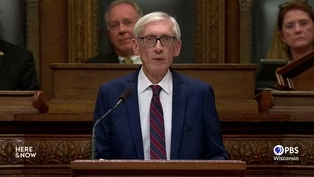
NewEvers, LeMahieu Address Schools, Taxes at State of the State
Video has Closed Captions
Clip: S2400 Ep2432 | 1m 50s | Tony Evers and Devin LeMahieu speak to K-12 school funding and property taxes. (1m 50s)
 New
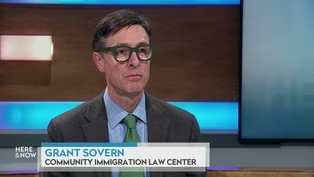
NewGrant Sovern on Changes to The US Immigration System's Rules
Video has Closed Captions
Clip: S2400 Ep2432 | 8m 48s | Grant Sovern on changes to the immigration system and for people applying for citizenship. (8m 48s)
 New
NewJudge Upholds Permit to Reroute Enbridge's Line 5 Pipeline
Video has Closed Captions
Clip: S2400 Ep2432 | 1m 13s | A judge rejected a challenge by the Bad River Band's to permits for rerouting Line 5. (1m 13s)
 New
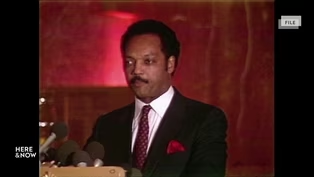
NewThe Political Legacy of Rev. Jesse Jackson in Wisconsin
Video has Closed Captions
Clip: S2400 Ep2432 | 58s | Civil rights leader and presidential candidate Rev. Jesse Jackson died at 84 years old. (58s)
 New
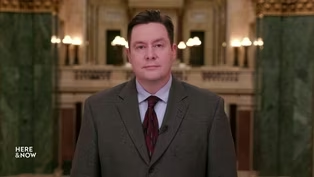
NewZac Schultz on Speaker Robin Vos Retiring From The Assembly
Video has Closed Captions
Clip: S2400 Ep2432 | 4m 35s | Zac Schultz on Assembly Speaker Robin Vos announcing he will not run for another term. (4m 35s)
 New
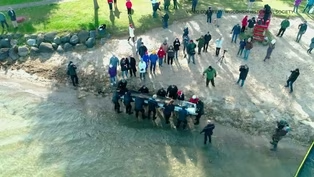
NewThe Epic History of Ancient Native Canoes in Lake Mendota
Video has Closed Captions
Clip: S2400 Ep2432 | 4m 27s | Ancient canoes are inspiring collaboration to preserve Indigenous history. (4m 27s)
Providing Support for PBS.org
Learn Moreabout PBS online sponsorship
- News and Public Affairs

Top journalists deliver compelling original analysis of the hour's headlines.

- News and Public Affairs

FRONTLINE is investigative journalism that questions, explains and changes our world.











Support for PBS provided by:
Here and Now is a local public television program presented by PBS Wisconsin