
Global Flavors Shaping Nashville
Episode 19 | 26m 46sVideo has Closed Captions
Three restaurants, three stories — shaping Nashville through food and community.
An intimate look at three Nashville restaurants where global influences shape local identity. From Middle Eastern tradition to Thai legacy and South Indian home cooking, each story reveals how food fosters connection, preserves culture, and reflects a city evolving through community, creativity, shared experience, and a deep sense of belonging.
Problems playing video? | Closed Captioning Feedback
Problems playing video? | Closed Captioning Feedback
Next Door Neighbors is a local public television program presented by WNPT
Support provided by:

Global Flavors Shaping Nashville
Episode 19 | 26m 46sVideo has Closed Captions
An intimate look at three Nashville restaurants where global influences shape local identity. From Middle Eastern tradition to Thai legacy and South Indian home cooking, each story reveals how food fosters connection, preserves culture, and reflects a city evolving through community, creativity, shared experience, and a deep sense of belonging.
Problems playing video? | Closed Captioning Feedback
Where to Watch Next Door Neighbors
Next Door Neighbors is available to stream on pbs.org and the PBS app.
Providing Support for PBS.org
Learn Moreabout PBS online sponsorship(moody music) (food sizzling) (pan scraping) - [Niroop] What I've learned living in this country for this long is there are so many restaurant.
The one thing that's lacking in the hospitality industry right now is hospitality.
My thing is when somebody walks into my restaurant, he or she is a celebrity.
Thank you, I will see you soon.
Okay?
- [Child] I don't want you go.
- [Niroop] Yeah, you don't want me to go?
Okay.
(laughs) Okay.
Okay.
- Don't want you to go.
- [Server] 112 and 63.
- [Hrant] Food is very communal, it's to be shared with people and it's a good way to to break down barriers and to get to know other people.
You know, it's fun.
- Service, please.
- [Server] Happy hour spice fry, happy hour shumai, happy hour fritter and a fried pineapple.
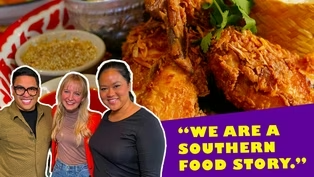
- [Arnold] We are a Southern American food story that happens to serve Thai food in Tennessee.
(utensil tapping) (relaxed music) - In a landscape peppered with chain restaurants, originality isn't always on the menu.
But here in Nashville, there's long been a taste for one-of-a-kind culinary creations, think hot chicken or Goo Goo Clusters.
So thanks to curious customers and hungry tourists, international cuisine has found a home in Music City, and they're serving up some local staples, including bold flavor.
- Cheers.
- Cheers.
Rich legacy.
- Because of this, we call it the breaking of the bread.
- And unwavering hospitality.
That's incredible.
And the spice is not too much, but it's definitely there.
- Okay, good.
(food sizzling) - If you've spent much time near Belmont University in Nashville, you know about International Market.
They opened their doors in 1975, a time when there wasn't a proven demand for international cuisine in this town.
But Win and Patti Myint had a vision.
They were both from Thailand but met in Nashville.
- And when he met mom, she kind of gave him an ultimatum.
- Oh.
- I think she's the one that proposed, right?
- Basically.
- So she was like, so basically she was like, "I'm basically the best thing that's ever gonna happen to you, and if you don't marry me now, I'm gonna go back to Thailand."
- Oh wow.
- And so a deal was made.
(all laughing) And she ended up getting married to my father in 1975, the same year they opened up International Market.
So really, my dad kind of had a vision as well.
He wanted to introduce some kind of commerce in the Asian community that was not yet existent in Tennessee.
And my mother was like, oh, this is my background.
This is what our family did in Thailand.
- [Meg] Okay.
- [Arnold] I know how to do this, let's go.
- What was the service like at that time, with the market and the steam table and everything?
- So the service back then, it was called International Market for a reason, right, in market being in the name.
So a big part of this was the products that you could get at International Market that weren't common in American grocery stores.
A big battle of that was that they couldn't sell the products because people didn't know what it was.
So our mom started cooking the food, putting it on a steam table, made it approachable in a way, kind of like how a meat and three is in Southern cuisine, which isn't uncommon in Thailand, actually.
It's actually a way of eating in Thailand called Khao Gaeng, where you get rice, and you scoop some curries and stews on top.
So a very similar business model as a meat and three, but she just did it with Thai food.
- Oh, that makes sense.
So people who already have that meat and three culture are just like, oh, different meat and threes, but I love it.
- Exactly.
- That makes total sense.
- And people would buy the cans of stuff that she brought in.
- And it also opened up people's palates to trying new and different flavors, because if they could see it, then they had an idea of what they might be trying.
- Totally, whereas if you just hand someone a menu though, I'm not sure what I like.
- Exactly.
- It's like tasting the ice cream at the store.
- Yes.
- Like you get 10 samples and you finally buy one, right?
(all laughing) - I love it.
(cheerful music) How did both of you start getting involved in the business?
Were you pretty young?
Were you just kind of watching Mom and team and wanting to get in there?
- Most kids wanna leave the nest quickly and do summer jobs, but for us, it was kind of grandfathered in that our summer jobs were in the restaurant.
We had no choice.
(laughs) - It was summer camp.
- Yeah, it was our summer camp.
- That's what we did.
- We both experienced it, having to work the cash register.
- Even like going out to eat, like the same thing about the math.
My friends would always just be like, "Figure it out," like tax and tip and everything because I could do it so quick, early on.
- Yeah, so that's the business-savvy side of how we were raised, which kind of translates into this, but also like the food side, for me specifically.
I was born a couple years after the restaurant was open, and the ladies in the kitchen basically raised me.
I spent every moment after school there.
I built forts and tents in the market side, climbing rice bags.
Every birthday party was there.
I played with food mostly as a kid, mainly because I was bored of the food she was serving.
So I would get in the kitchen and kind of explore myself.
I always was exposed to this world at a very young age.
- And then I was born 10 years later, after the restaurant opened.
And unlike Arnold, he was like very interested in the food.
I was interested in the business and the money.
- Okay.
- And it kind of explains a lot of our relationship here because I loved staying up front, I loved dealing with the customers, I loved making the change, I loved counting money and making stacks, I loved going to bank with my mom.
It just translates so well to how we are as adults now, is that he's the chef and I'm the business side of the restaurant.
And I also deal with all the customers and the people because I truly love it.
And he truly loves what he does in the kitchen.
- That's amazing, so complimentary.
- Yeah.
- Yeah.
- [Meg] The Myints sold their original location to Belmont University and the restaurant closed its doors in 2019.
But after working as a buyer at Macy's and living in New York City for years, Anna realized that what she enjoyed about this work in retail, she could get at International Market.
So Anna and her mom developed a plan to work together for the next iteration of the restaurant.
Unfortunately, Patti Myint passed away in 2018, never saw it come to fruition.
But she knew Anna had a vision to carry on the legacy.
During this time, Arnold had become a celebrated chef, so naturally Anna tried to lure him back.
- Now what sold me to come back initially was the fact that we're opening up International Market again.
And I'm the one in the family that knows the recipes and that cooked.
So for her to be able to do the money was one thing, but we had to have the proof in the product.
- I mean, there was also negotiation, 'cause he wanted to do more than Mom's hotline.
And he was like, "I can do so much more."
- It's evolved.
- I can be more creative.
And I was like, fine, because International Market is the hotline, so we'll keep that as lunch, and then International Market too can be dinner, and that can be your baby.
(food sizzling) And so that was the negotiation to really get him, hooked him, hooked him in.
- Yeah.
- I have no doubt at all that your parents were incredibly proud of you, and would be blown away by what you've built here.
What has it meant to you to be able to carry on their legacy and make it your own?
- It means a lot.
The stories are stories I never heard before from customers that still come in.
We have families from different generations coming in.
Like the grand mom brings their daughter, who we were their first Thai food experience, and now they're bringing their daughter.
And so it's just been really sweet to see that we're introducing this cuisine to the whole family, kinda makes us feel like we're part of their family.
And when we first opened, it was actually kind of tough because I was hearing every, the stories were flooding in.
When we first opened, we were busy.
I couldn't stop what I was doing to have, hear a conversation.
And also these conversations, 'cause again, I'm in the front of the house, so I'm taking it all, it would make, they would start crying, I would start crying.
And then I was like, "What am I doing?
I can't do this."
My therapist suggested I get a sheet of paper and just hand it to everybody and have them write down their story.
So that's what we did.
The first couple months we were open is on their receipt, their bill, we handed them like, "What's your International Market story?"
So now we have a stack of stories that, if I'm ever wanting a little pick me up, I get to go read, and I actually get to listen and hear it versus someone telling me and me just kind of like blanking.
- Oh that's beautiful, what a gift to have too, to be able to pass down.
- Yeah.
(relaxed music) - Tell me more about certain popular dishes.
What would you say are kinda the top ones that people order and what do you think they love about them?
- That's a trick question.
- Oh, I didn't even know.
- So what do people order the most isn't exactly what we most pride ourselves on.
(Arnold laughing) - Okay.
Well, I'd like to hear both then, yeah.
- So you think of a Thai restaurant and you have some go-tos.
So obviously we have a dish, that's number 30 on my menu, right, the way I design it.
But it's the number one on the order list, which is kind of, it's a little bit of a struggle, but that's okay, I get it, it's pad Thai.
I don't really advocate for that.
It's just a gateway dish.
- It's a gateway dish.
- It really is, if you dig deeper, it was a government kind of propaganda.
- Oh.
- From Thailand, to introduce Thai food to the world.
So for me, it's one of these, I call it the pumpkin spice latte of Thai food.
But because you're in our walls and you came in, we have other things to offer.
Now our signature dishes that we're most proud of, I mean we're in Nashville, right?
And I think it's pretty ballsy to say that I have a fried chicken on the menu, that why would you put a fried chicken on a Thai restaurant in a city that's known for fried chicken?
Well, truth be told, there's fried chicken in almost every country.
And there's actually a city in Thailand called Hat Yai that serves and is known for their Thai fried chicken.
So that's kind of our new signature move, is that Thai fried chicken.
The things that we're doing and playing with within these walls are definitely Tennessee cooking traditions with high flavor.
We do a lot of braising and smoking, like barbecue of our meats.
We have a beef dish and a duck dish that's basically a slow-stewed Thai-flavored soy braise, but then we throw apple wood smoke onto it.
So it almost gives you that barbecue hint with a Thai sass.
I also love that in the work that we've done with media and press publications, like Southern Living shouted us out for being one of the top Southern restaurants, my cookbook even being a top five Southern Living cookbook, but I'm not making ham biscuits with mento and cheese, I'm doing Thai food, and also when the James Beard Foundation gave us a shout out as a significant restaurant in the South.
Are we a definition of Southern cuisine, or the landscape of what Southern food is?
And for me that is really cool because we are.
We are a Southern-American food story that happens to serve Thai food in Tennessee.
So for us to have that identity, more so than the accolades and the trophies, is so significant to what, maybe my mother unintentionally put out there in the world, but unquestionably deserves.
(food sizzling) (feel good music) - It's hard to wrap your head around the number of International Market stories Nashvillians have accumulated over the past 50 years.
But there's another place in town where I also see stories racking up pretty quickly, and that's 615ChuTNey.
They celebrated five years in Bellevue in 2026.
The owner is Niroop Prabhakar.
He's a southerner now, living in Tennessee, and he was a southerner in his home country, India, growing up in Tamil Nadu, the country's southernmost state.
- 615ChuTNey is more than a restaurant.
It's a cultural experience around food.
And Niroop is your tour guide.
- I came here the first week they were open to get takeout, and I came back in for a sit-down meal about two and a half months later, and Niroop greeted me by name.
- I'm not a huge lover of heavy spice.
And Niroop took that to heart.
He gave me a nickname, he affectionately calls me Baby Spice, so.
(laughs) And so he always takes care of me.
- Niroop's created this community where we come together and share the good things in life, not only food, but also art, and music, and great conversation.
- How is your menu different from what Tennesseans might imagine when they think Indian food?
- I said, "Okay, let's have our cuisine, focus on just the South Indian items."
- 'Cause that's where you're from is South India.
- That's where I'm from.
And living in the United States since 2007, I've always noticed that every restaurant that you go to, it's the same tikka masala, it's the same butter chicken, and the very, very basic usual menu items were not.
Our cuisine is, being from the south, the curries, by default, are dairy and gluten free.
So we do not add heavy cream to mellow down the spice at all, so even a mild curry will have a little bit of a sting to it.
So the moment you take dairy out, automatically you'll get flavor.
I would say Indian food being spicy is a myth.
- Whoa.
- Yes, it is flavorful.
It has direct impact of cinnamon, it'll have ginger, it'll have cardamom in it.
It'll have black pepper, it'll have cloves in some items.
So when that is there, automatically, everybody thinks- - Yeah.
- That it's too spicy, so they order a chicken tikka masala.
Back in the day when nobody was exposed to South Indian food, this was the only go-to, because if somebody says, "Oh my food is spicy," chicken tikka masala is given with heavy cream added to it, sugar added to it, to make it a little sweeter and less spicier.
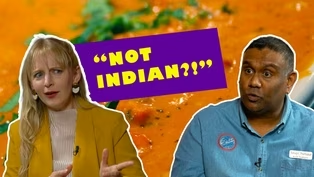
So everybody was like always into chicken tikka masala, which is basically from Scotland.
(record scratching) Yeah.
- Tell me more about that real quick.
- Yeah.
We know that chicken tikka masala is not from India.
So chicken tikka- - I don't think most people do know that in Tennessee.
So this is- - Not everybody knows that.
- We're clarifying a misconception right now.
- Oh yeah.
(light-hearted music) The story about chicken tikka masala is it was invented by an Indian out of Scotland.
Yeah, so even in my menu, there are a lot of items where I'll have the name of the origin of that particular item.
For chicken tikka masala, it'll say, "Scotland."
- It says, "Scotland," 'cause it is from an Indian person.
- Yes.
- But not from India.
- Yes.
- Okay.
- And people who come and ask for chicken tikka masala, we do give them chicken tikka masala.
My team offers them chicken tikka masala.
But that'll be the first and the last time they'll eat chicken tikka masala in 615ChuTNey.
So we try to do a lot of our own curries, and then make them- - So you're kinda broadening the palates- - Broadening the palate.
- And what people think of when they think of Indian food.
- Yes, and then we are a certified non-naan-Indian restaurant, so that's another thing.
- Tell me about that.
- Which you would not expect.
- Yeah.
- So our restaurant, since it focuses on South Indian cuisine, the bread that we focus on is called parotta.
- Parotta, not naan, okay.
- Non-naan.
- My friendly name for my parotta is non-naan.
- Non-naan, yeah.
- Yeah, so.
- I'll have to try that.
- [Niroop] The naan, it kind of came into the Indian subcontinent when the Mughals invaded the country.
So that came from a different region of the world, from the Middle East, from Afghanistan, from Iran.
So that's where they have naan being cooked in a clay oven.
So our cuisine kind of is from the south, and it originated from Sri Lanka.
The bread came from Sri Lanka.
The Tamils, the people who speak our language, they moved from Sri Lanka up to Tamil Nadu in India, they spread that bread out.
And that is not cooked in a clay oven.
- Okay.
- That is grilled.
(food sizzling) - And the texture, I mean, it's different.
- And the texture is a, it's a flaky bread that has a texture of a croissant, and it's completely vegan.
I can guarantee you, even now, that after you eat my bread, you're not gonna eat naan for the rest of your life.
And if you still do- - Oo, big words.
- I will give you my bread free for life.
- Oo!
- Yes.
(Meg laughing) - I like how this deal is working out for me.
(diners chatting) Oh man.
Chicken tikka masala who?
We don't know her anymore.
- I've got some paneer ready fresh.
The whole thing, when I do 615ChuTNey, a very Indian affair, it means that I'm serving food which you do not get anywhere else.
And it sticks to the cuisine.
- Gotcha.
- So every curry comes with rice and bread.
That's literally how we eat at home.
No, we do not garnish the food.
Our food is not camera friendly, but it's tummy friendly.
- I love it.
(laughs) (twangy music) - Niroop wanted to fully embrace being in Music City.
So he had a stage built at 615ChuTNey, and he invites artists from various genres to come play on the weekends.
He has regular bingo, paint and sip, and trivia days.
And to support the local arts community, he's created a gallery space where you can see and purchase original works of art.
It seems like you're always thinking about ways to add value and just make it a really unique experience, in addition to great food.
- Absolutely.
- And I wanted to talk to you about your approach to hospitality, because I know that's so important to you.
And what does it mean to you to really offer a spot with rich hospitality and how do you go about it?
- Service comes from the heart, and what I've learned living in this country for this long is there are so many restaurants, the one thing that's lacking in the hospitality industry right now is hospitality.
- And it seems, just from having watched you, that you know a lot of the folks that come in, and they're regulars, and you know a lot about their story and have engaged with them, they know you, and it's kind of a, I don't know, a familial or friendly vibe around here.
- Yes, when somebody walks into my restaurant, he or she is a celebrity, which means that I should know them personally.
Not being nosy, (Meg laughing) but in a way that I'm thanking them for the time that they've spent researching about 615ChuTNey, driving to this place.
So it's all about respecting their efforts to come and support me.
I get to know them as a family, so everybody who comes in gets a hug.
Everybody who gets in here gets service like they're being treated at home.
It's a guest who walks into my home, and that's how I welcome them, so that's why they come back.
Bye.
Love you.
(child laughing) (Niroop laughing) (food sizzling) (upbeat music) (upbeat music continues) - Nashville's food scene is the best it's ever been.
And that's all thanks to the talent and creativity of people like her Hrant Arakelian and Elizabeth Endicott.
This husband and wife duo have been adding flavor and class to the city's culinary landscape for years, so it's no surprise how they met.
- So we had a friend that did some catering, and she always wanted the two of us to date, but Hrant had another girlfriend, and life was just moving along, until they finally broke up, and she put us on two of the same catering gigs, 'cause it was kind of a side hustle for us.
We had full-time jobs, but we would just work for her because she's a friend and it was just help.
And the whole time she was like, "Hrant, ask her out, ask her out."
And then he finally did.
And that was that.
- Yeah.
- [Meg] She knew something that you all hadn't discovered yet about compatibility there.
- Oh, for over a year, she was ready to put us together.
- I love that.
So you mentioned Middle Eastern cuisine, obviously that's the focus here.
Hrant, would you tell us a little bit about your background and cultural heritage?
- Yes, my dad's side of the family is Armenian from Lebanon.
My mom was from East Tennessee, and they met in college, and moved overseas, and had my sister and I over there.
My dad's side of the family, being Lebanese-Armenian, originally from, it used to be called Western Armenia, which is Southern Turkey.
So there was a lot of this influence of different cuisine, Armenia and Turkish, Lebanese, Syria, and all this kind of in our house.
And then my mother who, from east Tennessee, had never seen this before, like really fell in love with it.
And so when we would make meals at home, that would be the food that we would cook, predominantly.
She's also German-Irish, so we had a lot of that food as well.
- A lot of variety then.
- Yeah.
- So it sounds like with both of your backgrounds, and experiences, and so many diverse restaurants that you've worked in, you could have opened a business or restaurant with any kind of food.
Why was it important to you to go back to your Middle Eastern roots with this place?
- Aside from the fact that we think it's the best food and everybody should enjoy it.
- Okay.
- There wasn't a lot of Middle Eastern restaurants in Nashville at the time, and we felt like that would be a good way for us to kind of make a name for ourselves.
- So when you all first opened then, was it kind of success right off the bat, or did it take a while to ramp up?
Tell me about those early days and what you tried.
- It was rough, since we had both worked in Nashville for so long, we knew so many people, we just felt like there would be a little bit more buzz and excitement.
But it wasn't very busy in the beginning.
I don't think people really understood what modern Middle Eastern was.
- Yeah.
- And we had a lot of people come in, thinking that they were gonna get a kebab platter with rice and their tzatziki sauce, and not that that isn't delicious, but that's not what we do.
And then in about a year and a half, we really noticed that every night had a lot of energy, and the weekends were really great.
We started doing these fancier dinners, and those would sell out really fast, Feast of the Middle East dinners.
- I wanna hear more about Feast of the Middle East.
- Yeah.
- Tell me about what that is, how it's grown, some of your most noteworthy nights, in your opinion.
- [Hrant] We draw influence from so much of the Middle East, and so much of our menu is kind of combination of these different culinary traditions.
And we thought it would be fun to do a night where we just focused on one culinary tradition of one country or one region.
- I think it's just really important to come together in community, and share what's really beautiful about this culture, and see that there's so much more to this than what we hear in the news.
And I'm so grateful that Chef Hrant loves to bring these cultures to life on these nights of the Middle East.
- [Meg] And it's family style, right?
- It's all family style.
- So people are coming in who don't necessarily know each other, and they're sitting at the same table.
- Yeah.
- Yeah.
- [Meg] And that's part of the experience too, then.
- It really is.
- Yeah, definitely.
- It's nice to sit at a table and break bread with people that you don't necessarily know.
You can build some relationships and learn different things from people that you're kind of- - Yeah.
- Forced out of your comfort zone.
- Yeah.
- And actually, I mean, I do know of several of our regulars that have become friends because of the Middle East dinners, didn't know each other before, and now go out to dinner once a month with each other.
- Wow, you're really making community connections through food then.
- Yeah, yeah.
You know, food is very communal.
It's be shared with people, and it's a good way to break down barriers and to get to know other people, when you're sharing a common interest, a nice meal, and it's fun.
- It's amazing and yeah, really a beautiful event, and love that you all are doing that.
And feel like, thinking about the competition in Nashville, that's not something that I see many other people doing in this city, so it's really nice.
- Well, one thing about two owners working in a restaurant is we're here all the time.
We can do fun special things without having to go up a food chain to get permission.
- Ah, yes.
- Going up to corporate.
- We can do what we want.
- [Hrant And Elizabeth] Yeah.
Yep.
- While the Feast of the Middle East meals are only available for the event, Lyra's menu is seasonal and constantly evolving.
So you're very busy, I know, but you opened another restaurant.
Would you tell us about that- - We did.
- And how it's similar to and different from Lyra.
- Yeah.
About a year and a half ago we opened up Vega Shawarma.
It's kind of like a sandwich shop, so very classic shawarma, and got chicken and beef and lamb.
A little bit more of a casual kinda spot, but everything's still made fresh daily, in-house.
Fantastic bread.
- Equally delicious in its own way.
- Yeah.
But just a little bit more of a casual spot.
- Elizabeth, you shared a little bit already about some misconceptions that maybe folks have, they're expecting kebobs or whatnot, but are there other misconceptions, or just preconceived notions folks have about Middle Eastern cuisine that maybe we could clear up on the program today?
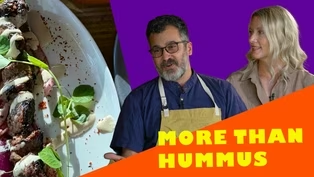
- You know, one of the misconceptions is that it is a very monolithic cuisine, that it's just hummus and bread and kebabs and rice.
But it's not, there's a lot of variety to it, and there's a lot of, you have nuance in the food.
It's very, very detailed, and can vary so much, depending on where it's coming from in the Middle East.
You're gonna come in and find something that you probably haven't had before, and you'll be very pleasantly surprised by it.
- What comments have you heard from folks who maybe are trying their first Middle Eastern dishes about surprise or what stood out to them?
- One of my favorite comments of somebody who was very off base but enjoyed it nonetheless, said he didn't really know Indian food very well, but this was the best Indian food he ever had.
- Oh no.
(Elizabeth and Meg laughing) - Which is a compliment, so.
- Right, right.
We don't expect people to come in and know the cuisine.
A lot of times we'll see people, like secretly trying to Google things on their phone- - Yeah.
- Because they don't understand the terms, and we don't expect them to.
A lot of the food is relatable.
We have a fatayer on the menu that is, it's kinda like a calzone, it's a stuffed bread, but the name kind of throws people off at first.
Or there's just different things like that that, it's just food that's delicious and warm, spiced, and it's comfort food for sure.
- When folks come into either Lyra or Vega Shawarma, what do you hope that they leave with?
- Full belly and a smile.
- A full belly.
- Yeah.
- Yeah.
- [Hrant] Can't ask for much more than that.
- [Meg] These are just three of the remarkable restaurants helping shape Nashville's culinary landscape.
And maybe that's the real story, how fortunate this city is to be filled with people willing to share their culture, their traditions, and a little piece of home with their neighbors.
(feel good music) (food sizzling) (feel good music continues) If you enjoyed "Next Door Neighbors: Global Flavors Shaping Nashville," you can check out all our "Next Door Neighbors" content on the free PBS app.
Later, neighbor.
(gentle music)
Pad Thai: the “Pumpkin Spice Latte" of Thai Food
Video has Closed Captions
Clip: Ep19 | 9m 12s | Chef Arnold Myint on why pad thai is Thai food’s pumpkin spice latte. (9m 12s)
Biggest Misconceptions About Middle Eastern Food
Video has Closed Captions
Clip: Ep19 | 2m 30s | Lyra’s owners share how Middle Eastern food surprises and connects with diners. (2m 30s)
Global Flavors Shaping Nashville Trailer
Preview: Ep19 | 1m | Three restaurants, three stories — shaping Nashville through food and community. (1m)
Wait... Chicken Tikka Masala Isn’t Indian?
Video has Closed Captions
Clip: Ep19 | 2m 30s | South Indian chef in Nashville reveals tikka masala isn’t Indian. 🤯 (2m 30s)
Providing Support for PBS.org
Learn Moreabout PBS online sponsorship












Support for PBS provided by:
Next Door Neighbors is a local public television program presented by WNPT