
Innovative Thinking
10/15/2026 | 26m 46sVideo has Closed Captions
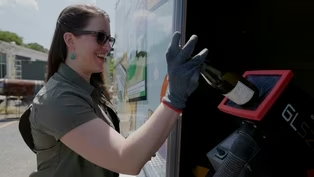
Transforming glass waste into cement, the science of bourbon and training an A.I. robot to “think.”
A mobile glass-crusher in Charlotte transforms waste materials into cement, and the science behind a small-batch bourbon made in Durham. Plus, researchers at UNC-Chapel Hill train an A.I. robot named Fetch to “think.”
Problems playing video? | Closed Captioning Feedback
Problems playing video? | Closed Captioning Feedback
SCI NC is a local public television program presented by PBS NC
Sci NC is supported by a generous bequest gift from Dan Carrigan and the Gaia Earth-Balance Endowment through the Gaston Community Foundation.
Innovative Thinking
10/15/2026 | 26m 46sVideo has Closed Captions
A mobile glass-crusher in Charlotte transforms waste materials into cement, and the science behind a small-batch bourbon made in Durham. Plus, researchers at UNC-Chapel Hill train an A.I. robot named Fetch to “think.”
Problems playing video? | Closed Captioning Feedback
Where to Watch SCI NC
SCI NC is available to stream on pbs.org and the PBS app.
Related to This Episode
Providing Support for PBS.org
Learn Moreabout PBS online sponsorship- Coming up on Sci NC, how yesterday's wine bottle could become tomorrow's sidewalk.
The chemistry behind a great bourbon that looks like a magic trick.
And AI robots learning faster than you'd think.
Next.
- Quality public television is made possible through the financial contributions of viewers like you, who invite you to join them in supporting PBS NC.
- Sci NC is supported by a generous bequest gift from Dan Carrigan and the Gaia Earth Balance Endowment through the Gaston Community Foundation.
(gentle music) ♪ - Hi again, and welcome to Sci NC.
I'm Laura Smith.
The next time you finish off a bottle of wine or toss any glass from out of the back, it might just end up in the concrete you're walking on.
Right now, Charlotte ships its glass all the way to Atlanta to be recycled, but a local group is working to convince city and construction leaders that crushed glass could be an important part of cement.
Here's Sci NC's Michelle Lotker.
- [Michelle] This might seem like a regular sidewalk, but it's no ordinary concrete.
It's got an invisible ingredient that could have a big impact on sustainability, recycled glass.
Recycling is one way to reduce the amount of waste going into landfills, but recycling glass presents some unique challenges.
- Every city has challenges with glass for a couple reasons.
It's heavy, it breaks, so a lot of municipalities have stopped even taking glass.
The other thing that's happened over the years is there's been a consolidation of recycling of glass.
So right now, Charlotte ships its glass to Atlanta.
It costs more to ship there than it's worth.
So we looked at what can we do with glass.
Well, glass is sand, so if you crush glass back into sand, you can use that sand back into concrete as a replacement for natural sand.
- [Michelle] Envision Charlotte's Innovation Barn in Charlotte, North Carolina hosts a slew of sustainability projects, including working to compost food waste, repurpose waste plastic, and dial in closed-loop systems to grow food.
And it's also home base for the Crush Truck.
- So in this compact box, we've got 15 hammers spinning violently, crushing the glass and turning it into the sand.
- [Michelle] This compact machine can process four to five tons of glass per day and is set up to run off of two three-kilowatt-hour batteries that are charged via solar panel, making it possible to run completely off-grid.
All right, let's crush some glass.
- Let's crush some glass.
I'll just show you the general, like... - OK, do a demo.
[machine clanking] - Yeah (Michelle laughs) I'm gonna need to get more glass, 'cause she's gonna be here for a while.
- This is very cool.
Ready?
- Excellently done.
- Oh, this is a nice, nice dark green.
[clank] [clank] [clank] Oh, yeah, that's pretty addictive.
[laughs] Empty wine, beer, and liquor bottles are easy to collect because they're concentrated at bars and event venues.
But the Crusher doesn't discriminate.
If it's glass, it crushes.
And the result, a mix of different sizes of crushed glass and paper label scraps.
- With this humble little trailer, we're creating a mini-MRF, a micro-MRF, if you will.
- [Michelle] MRF stands for material recovery facility.
Industries speak for a place where recyclables from mixed waste streams are sorted by type and prepared for resale.
The resulting crushed glass can be sifted into varying sizes for reuse.
- This is one of the sizes, which is basically like sand you get at a beach.
- Yeah, so this is actually crushed glass bottles, crushed by the crushing machine.
- Yeah, mm-hmm.
- And it's really even the color of this one looks like sand, which is kinda cool.
- It does, yes.
- It's not sharp, it's like-- - Nope.
- You can hold it and play with it and it's not scratching you.
That's so cool.
At the Innovation Barn, the crushed glass they've collected in partnership with the nearby Spectrum Center is stored in repurposed grain bags sourced from breweries, waiting for its full circle journey back to the Spectrum Center as a component of concrete needed for a construction project.
But how does all of this crushed glass become part of new concrete?
- Concrete is the most widely used human-made material in the world.
Every concrete recipe is a different recipe depending on what it's being used for.
- [Michelle] There are four basic ingredients, rock or aggregate, sand-- - And then in the buckets we have some cement, water.
In this recipe, we're going to actually replace some of the cement with some fly ash, which is in one of the buckets.
And then we're going to actually use a portion of the sand component of the mixed design and replace it with, in this recipe, 40% ground glass.
And that is glass that has been collected from the city of Charlotte, some from the Spectrum Center.
- [Michelle] This glass is the raw, unscreened crushed glass that comes straight out of the crusher.
- So we get a wide range of particle sizes.
We get everything in there, the labels, the sugars, all the good and the bad.
- Ooh, I can almost like smell the beer a little bit.
(laughs) There's a little beer smell.
- Ideally, if we can figure out how to make it work in this state, it's the lowest impact, easiest to process.
And that's kind of what this initial proof of concept is, is to see if we can take the raw feed and make a quality concrete mix with it.
- So it's all about finding the right recipe.
- Correct, correct.
Whenever we're coming up with a new recipe, we start off in a controlled environment in small batches.
We call these trial mixes.
The analogy everybody uses, it's like making cookies.
Flour would be the same as the cement.
Maybe the chocolate chips and nuts is your coarse aggregate and the sugar is your sand.
And then your eggs and butter is kind of like your water and some of the admixtures we'll be using.
And certainly if you add too much or too little, you may not get the result you like.
And even if you bake it too long, once we mix the cement and water together, it's an exothermic reaction.
And we only have so much time to deliver that concrete.
So just like you bake a cookie too long in the oven, if that concrete stays on the truck too long, you're not gonna get to what you want 'cause it's gonna start setting up and you got a bigger mess on your hands.
We certainly don't want to just guess and send concrete out that we know may or may not work.
So we go through the process in the lab.
- [Michelle] That process includes measuring the amount of air in the mix, performing something called a slump test to make sure that the concrete will be workable for different applications.
- We're gonna measure the slump against the original height, which is 12 inches.
I was looking for about a five to a six inch slump.
Can you see that?
- Yeah.
- Can you do that again for me?
- Looks like about closer to six, actually.
- Six?
- Yeah.
- Okay.
- [Michelle] And finally, pouring cylinders that will be cured for different amounts of time before being put to the test to see how much force they can handle.
- So this is a hydraulic press, basically, is what this is.
The machine will press down until we get an actual break.
(machine clanking) (bang) (bang) (clanking) (bang) - [Michelle] The machine measures the pressure at which the cylinder breaks, and that tells the lab how strong the concrete is, while the shape of how it broke tells them about the mix structure.
For the concrete industry, improving sustainability isn't a new concept.
- From the carbon footprint of concrete, a large portion of the CO2 associated with a yard of concrete comes from the production of Portland cement.
So if we can figure out how to make concrete with less cement, we can lower the overall carbon footprint of the concrete.
- [Michelle] One of the ways to reduce the amount of cement needed is to replace some of it with materials that act in the same way.
- And a number of these materials that we use are actually waste products from other industries.
So instead of putting them in landfills, we're actually able to reuse them and use them in concrete.
- [Michelle] Fly ash from coal-fired power plants can be used to replace a percentage of cement in the mix, and preliminary testing is showing that recycled glass ground into a similarly fine powder can be used in the same way.
The glass does have to be ground really fine to replace cement, which adds more steps to processing.
And there are some additional challenges to sort out when ground glass bottles are used to replace sand in the recipe.
- A lot of it comes with the labels still mixed in with it.
You've got the natural sugars, which if you have too much sugar, it can actually delay the set of the concrete.
So that's something we gotta be conscious of.
- [Michelle] There's also a chemical reaction they look out for that can happen whether or not there's glass in the mix, and it creates an expansive gel in poured concrete, which, as you can imagine, isn't ideal for strength or durability.
They found through lab tests that replacing some of the cement in the recipe with fly ash gets rid of this issue, and smaller glass particles reduce this chemical reaction, while glass ground to a fine powder actually helps to mitigate the problem, just like fly ash.
- It's probably a matter of determining what type of concrete we wanna put it in and what that material does to the concrete itself and what kind of risk reward we have in terms of where we're gonna use that going forward.
- [Michelle] One of the goals of all of this testing is to get to the point where concrete plants are able to mix up big batches of concrete containing recycled glass for different uses.
Incorporating a new material like ground glass into the workflow of a concrete plant like this one will require more experimenting with storage and flow through the plant to control for things like moisture.
- Being off by one smidge can mean a truck being rejected or pumped out, so it's a lot more that goes into it than most people think.
- [Michelle] Amy is excited to see more crushers in use in Charlotte and beyond.
Rather than scaling up the size of a crushing facility, she says a network of smaller crushers actually makes more sense.
- If you start scaling up and you start getting the bigger crushers, you're gonna need a huge facility.
You're gonna have to start bringing in glass from all over the southeast to feed the beast and to make the economics work.
- [Michelle] By making the crusher mobile and working with event venues like the Spectrum Center and local festivals, Envision Charlotte is hoping to spread awareness of the possibilities of crushing and reusing glass waste more locally.
- One of the things with the circular economy is really keeping things local.
So being able to take our glass, turn it into sand, and then replace that natural sand back into concrete.
I mean, we're one of the fastest growing cities in the country.
So we have a lot of concrete projects going on.
- Concrete's not going anywhere.
We build everything out of it.
So, you know, the fact that it's such a high volume material that we use means we have a lot of opportunity to do better.
- Not going to lie, I wanna crush a glass now.
Michelle did a great job, learned so much in that story.
Well, we just talked about recycling the bottle.
Now, what about what goes in it?
Some of the world's best small batch bourbon comes from right here in Durham, North Carolina.
The secret, water that flows over rocks 240 million years old, and chemistry that almost looks like a magic trick.
Here's Sci NC's Evan Howell.
- [Evan] Long before anyone can taste whether a whiskey is any good, somebody has to smell it.
Amazing.
This is raw whiskey that will eventually become bourbon here at Mystic Farm and Distilling Company in Durham.
At this stage, the smell isn't a promise.
The flavor comes later.
This raw stuff isn't just one smell.
It's hundreds of compounds with each one evaporating at its own unique speed.
But it's at the still where smelling your hand looks less like science than a magic trick.
Jonathan Blitz walked us through it.
- Okay, so you've got us doing a test here.
We're not technically supposed to be drinking this yet, are we, right?
- No, we're in an early fraction now.
But what we're going to do is experience about five hours of distillation in about 30 seconds on our hand.
- Okay.
- So what we're gonna do is put out one hand, and when I tell you, we're gonna pour this whole thing all over our hand, we're gonna smell it right away.
We'll start shaking our hand a little bit, and I'll talk you through it.
Are you ready?
- Go.
- One, two, three, all of it.
Okay, smell it right away.
Sort of a chemical smell, right?
Chemical nose, now shake your hand.
- You can call it that.
- Feel your hands getting cold?
- Uh-huh.
- Those are the heads, or early fractions, evaporating.
That's what makes the whiskey kind of bitey.
So that's gonna evaporate during the aging process.
Now that's gone, smell it again.
Now we get some perfume, some floral notes, right?
- It is a little different, isn't it?
- Shake your hand a little bit.
Now we're gonna get a little citrus, a little ginger.
- Wow.
- Yeah, quick shake.
Now we'll get some black tea.
Isn't that amazing?
- That is amazing.
- And now we're gonna get the smell of fresh cut hay.
We're going into the later part of the distillation now.
Smells just like we cut some hay, right?
- Unbelievable.
- Okay, now we'll get some whole wheat bread, like real strong whole wheat.
- This is amazing.
- Yeah, and then at the end, you're gonna smell what we call tails, and our tails cut is at the smell of fresh corn tortillas.
So smell your hand, tell me if you... Smell the tortillas?
- Unbelievable.
- So we do our heads cut based on taste, and we do our tails cut based on smell.
So this right now is not quite ready for the heads cut, but we're very close.
- Okay.
- [Evan] What you just watched wasn't a parlor trick, it was chemistry.
Heather Hanna came to one of the many tours this distillery offers, and she just happened to be a geologist.
- I always joke that geology is a way of life, not a career, 'cause I'm so easily distracted by rocks.
- I'm Heather... - She got talking with Blitz about his water, and ended up consulting on his wells, of which he has two.
They sit on what's called the Durham-Triassic Basin, dating back a couple hundred million years.
Around here is a mix of ancient compressed lakebed mud, sedimentary stone, and hardened volcanic magma rock called diabase that shot up through the cracks millions of years ago.
- The chemical properties of these rocks are really different, and water that comes out of this can be good for distilling.
Water that comes out of this is not.
- [Evan] This ancient sedimentary rock has tiny pores in it that slows the water down, but makes it cleaner.
(rocks smash) The other taps directly from the diabase.
The water that goes through its fractures is faster, but that water comes with contaminants like iron.
So, the diabase makes for great non-potable water, and the sedimentary rock is good for distilling and taste.
- And by good for distilling, I mean we want a good amount of calcium, we want very low iron, and we want a pH, a pH being how acidic or basic your water is, and we want that to be right around neutral.
And also the alkalinity, which is how well the water keeps its pH, kind of its resistance to changing its pH.
And these all go into keeping the yeast happy.
- [Evan] The other part of this story grows just down the road on a farm Joe Phelps' parents bought in the 1940s.
- Triticale.
- Yeah, Triticale is a blend between wheat and rye, and this is Triticale right here.
And the combine comes and gets it out, and there's the grain that's left, and it separates the grain from the head.
- [Evan] To be called bourbon, the recipe has to be mostly corn.
- Yeah, you can use a lot of different things, but corn has to be the main ingredient.
- [Evan] Before any of that smell test we did, the grain becomes something closer to beer, cooked, cooled, and handed to the yeast.
- This is a heat exchanger, so that cooked mash is at about 195 degrees when we're done with the cooking process.
We need to cool it down to about 80 Fahrenheit, and then it'll go into one of our fermenters where it'll stay for about 21 days as the yeast does its work.
- [Evan] And those smells from that test at the start, they're born right here, the wood and the spirit reacting for years.
Where are we now?
We're in a different place.
- You're in our rickhouse.
This is one of our areas where we store aging barrels of bourbon.
The spirit that you smelled inside the distillery and that was coming off the still, that will go into a new charred oak barrel, and we use North Carolina white oak.
We source it ourselves up in the mountains, and then it's taken to a place called a cooperage where it's made into these barrels.
So the barrel is made up of about 40 of these staves.
The inside surface is charred.
You can see a lot of the char is falling away, but here's some fresh char.
So this is a high tide line like you'd see on a beach.
So the bourbon is inside the barrel and it's soaking deep into the oak, and then it's being pulled back out.
And the reason this happens so well here in this part of North Carolina is because we have constant 30 degree temperature swings almost every day.
And the bourbon is being pressurized and pushing deep into the oak.
And then when it cools down at night, it's pulling a partial vacuum and sucking that bourbon back into the center of the cask.
- And this blend has 55% corn, 35% wheat, and 10% triticale, which is a rye wheat hybrid grain.
- I looked up the time and so happens she was open at 10 o'clock.
So I come in here to buy at least five bottles of my favorite.
♪ - [Evan] Not a trick, not folklore, just what this ground gives up when somebody knows how to read it.
- Every part of this process relies on the physics of heating and cooling, the chemical reactions that are happening during the aging and distilling and fermentation processes.
And the more of that we understand, the better a bourbon we can make.
- I'll have to go check out Mystic sometime.
UNC Chapel Hill researchers are training artificially intelligent robots to perform a variety of tasks, from mapping spaces to working alongside humans in unpredictable settings.
Sci NC's Evan Howell learns the machines learn quickly and scientists are now working to guide their education responsibly.
- [Evan] Robots have been around for a long time.
Lately, they can mow your lawn, drive you to work or school, even clean your house all without sleep.
But there's a new question now, not how long a robot can work, but how far it can think.
What would happen if you could just give a robot a goal and would figure out how to do it on its own?
- What skills do I need to learn to create this world?
What if we could use code, do things in the physical world, move objects around and assist in tasks that humans don't wanna do?
- Where do you wish the shielding stand, sir?
- Angelos Angelopoulos is a member of a new generation of computer scientists who are helping robots map spaces, recognize objects and adapt to a world that keeps changing.
Meet Fetch.
- So I'm in its way, so then it comes close to me, it's gonna stop.
'Cause it's like, hmm, there's an obstacle.
- It can do all this in a lab by itself.
- Yes.
- It can find out where it's going.
- Correct.
- It knows what each item in the lab looks like.
- Yep.
- And basically almost be a lab colleague, right?
- Yeah, and it's not gonna hit anything.
- That's just amazing.
- [Evan] There are colleagues, but then there are just robots like these in an auto assembly line, for example, which are built to do one thing every minute of every hour of every day.
- Fetch is different.
It was built for more small environments, indoor environments, and it was built to handle uncertainty more.
- Fetch is a research robot built to move, see and think, rolling through real spaces, lifting real objects, and learning to work in the same unpredictable world we do.
16 years ago, Ron Alterovitz left Caltech for UNC Chapel Hill.
Now he leads the university's robotics lab, pushing machines beyond simple instructions towards a deeper understanding of the world around them.
- So the lab automation robot, when we bring it into a new space, the first thing it can do is map out its environment.
It can move through it and then create a map of the room, including where it can navigate as well as all the different instruments that are in the lab.
- [Evan] Recently, Fetch went to the chemistry department to do some work and demonstrated how precise its work can be and how it might actually work alongside its human colleagues.
- We've also developed algorithms that allow the robot to do specific tasks.
So one example task that we've implemented for the robot is that it can use a needle to pick up a sample from one particular instrument and then transport it to another part of the lab and then inject that sample into another instrument.
And these types of tasks are challenging because the robot has to both move through the environment and then perform a highly precise manipulation.
- [Evan] Its seven motor arm is programmed to reach, lift, and place objects where they need to be with the help of a group of four cameras.
It also uses LiDAR technology at the bottom, which shoots lasers out to determine distance and taken all together, it can sense depth in a 3D space.
- This is the primary component.
Here is also a color camera, but this time it's a much more wide lens camera.
So it can capture a much larger field of view compared to the default one.
And it also has 4K resolution.
So this is very useful for essentially perceiving small objects with essentially high fidelity.
- When we interact with a computer, we type something in, we see something back on the screen.
With the robot, the robot can actually change the state of the physical world.
- So looking at this, it looks a bit almost like Fortnite, like a terrain.
Can you talk about this?
I mean, this is what the Fetch is seeing here.
- Correct, yeah.
So this is the map of the room that you see here based on the laser sensors.
These black pixels define where the walls in the map are, but then you can also see these little colored dots here.
And these are essentially where those laser beams from the base hit.
And you can see they're aligned with the walls.
So these are live data and they match our map, which is a good thing.
So these also help the Fetch, like identify things like humans in the space.
Like if we look at other little dots that you see here, this is some person's legs as they move around, right?
- Is that Ron's?
Are those Ron's feet?
- Yes, correct.
And you can see the robot can identify where they are and kind of create these gray blobs around them to mark them as obstacles that it should avoid.
So the basic thing is the robot, in order to navigate around any space, it has to know what that space looks like.
And it has to know where its destination is.
The way this works is when we take the Fetch to a new location, we essentially have it move around and create a map of where all the obstacles are and where's the free space that it can occupy and move through, like the hallways of the lab.
So essentially, if we need to go to a specific instrument, we say, go to this location and then look for essentially what looks like a QR code.
And that QR code essentially allows you to locate exactly what the instrument is.
- [Evan] These QR codes aren't like what you would see in a restaurant that point you to a menu.
These tell the Fetch exactly what the object is.
In this case, it's a gas chromatograph of the UNC Chemistry Lab, which is a machine that analyzes chemical compounds.
- From here, I can essentially have some offset of kind of where this target is.
So move the arm kind of in this location.
This camera would see where that needle is detected and then tell the robot, you're off by this amount, move that way.
So this and this are kind of used together to get that syringe needle inside this port.
These are also used for space applications.
So let's say we want to send the robot to the moon and it has to assemble some shelter for a person that will come after the robot.
Well, you can imagine you can put this, a lot of these on the objects to kind of identify where those holes for the screws should go so the robot can locate.
- So even the non-human construction of a space station, for example.
- Correct.
- [Evan] For now, these machines can only do what we tell them.
Responsibility stays with us, guiding what they learn, laying down guardrails, and making sure they serve our best interests, not the other way around.
- Ultimately, the robots of today are still running programs that were written by humans.
And so we have some level of influence on what our robots can do.
- So it really changes the game from capturing really high quality datasets that have the behaviors that we want the robots to learn, and ensuring that as we scale up those models and make them more intelligent, that they remain aligned with what we train them to do.
But that requires effort.
♪ - And we'll join in on the wave in case Fetch is watching.
That's it for Sci NC this week.
If you want more Sci NC, be sure to follow us online on our website, pbsnc.org, YouTube, of course, Instagram as well.
I'm Laura Smith, thanks for watching.
Have a good one.
(gentle music) ♪ ♪ - Sci NC is supported by a generous bequest gift from Dan Carrigan and the Gaia Earth Balance Endowment through the Gaston Community Foundation.
- Quality public television is made possible through the financial contributions of viewers like you, who invite you to join them in supporting PBS NC.
Video has Closed Captions
Transforming glass waste into cement, the science of bourbon and training an A.I. robot to “think.” (20s)
Providing Support for PBS.org
Learn Moreabout PBS online sponsorship New Episode
- Science and Nature

Explore scientific discoveries on television's most acclaimed science documentary series.
 From My Station

 New Season
 New Season



Support for PBS provided by:
SCI NC is a local public television program presented by PBS NC
Sci NC is supported by a generous bequest gift from Dan Carrigan and the Gaia Earth-Balance Endowment through the Gaston Community Foundation.