
March 10, 2026 - Full Show
3/10/2026 | 26m 48sVideo has Closed Captions
Watch the March 10, 2026, full episode of "Chicago Tonight."
Planning for the future of the Great Lakes. How TSA agents are faring after nearly a month without pay. And a look at why Latino arts organizations fall behind in financial support.
Problems playing video? | Closed Captioning Feedback
Problems playing video? | Closed Captioning Feedback
Chicago Tonight is a local public television program presented by WTTW
WTTW video streaming support provided by members and sponsors.
March 10, 2026 - Full Show
3/10/2026 | 26m 48sVideo has Closed Captions
Planning for the future of the Great Lakes. How TSA agents are faring after nearly a month without pay. And a look at why Latino arts organizations fall behind in financial support.
Problems playing video? | Closed Captioning Feedback
How to Watch Chicago Tonight
Chicago Tonight is available to stream on pbs.org and the free PBS App, available on iPhone, Apple TV, Android TV, Android smartphones, Amazon Fire TV, Amazon Fire Tablet, Roku, Samsung Smart TV, and Vizio.

WTTW News Explains
In this Emmy Award-winning series, WTTW News tackles your questions — big and small — about life in the Chicago area. Our video animations guide you through local government, city history, public utilities and everything in between.Providing Support for PBS.org
Learn Moreabout PBS online sponsorship>> Hello and thanks for joining us on Chicago Brandis Friedman.
Here's what we're looking at.
The standoff in Congress over Homeland Security funding has TSA agents once again working without pay?
We'll look at how they're navigating the situation.
A coalition of local leaders from around the Great Lakes plan for the region's future.
>> So I feel like means so much that need to see these stories on stage, you know, artist and why Latino arts organizations are struggling to stay afloat and what's being done about it.
>> First off tonight, dog spending all day in their cages.
Euthanasia and a shortage of volunteers are just some of the complaints about the city's animal care and control facility and why advocates are calling for a nationwide search to find a new leader.
>> This is a the department that seem pretty much flat funding realize that this is not single issue that's happening with the with the shelter there.
The fact that the hours of the of see ACC have been cut so severely puts other departments at risk burdens as well such as the Chicago Police Department.
>> Chicago, Animal Care and Control is current executive director Susan Capello has been in the role as an interim for the last 3 years recently, Mayor Brandon Johnson has chosen her for the job permanently.
And city council is expected to vote on her appointment later this month.
But shelter volunteers and animal advocates say a wider search is necessary since serious concerns have remained during Capello's leadership.
For more on what Capello told a city council committee today, visit our website.
Hundreds of Chicago officials, attorneys and leaders are expected to call for a special prosecutor to investigate alleged abuses perpetrated by federal immigration agents during operation Midway Blitz.
Attorneys from the firm low below say the group is frustrated with Cook County State's Attorney Eileen O'Neill.
Burke.
>> Whose office has yet to charge any federal agents in connection to the immigration raids.
Burke's office is pushing back, though, saying a special prosecutor would make it more difficult for her office to secure convictions in those cases and that she's implemented new protocols to investigate those alleged crimes.
The Obama Foundation is looking for a few folks to join its new volunteer program.
The Volunteers or ambassadors will help welcome visitors.
Once the Obama presidential center opens this June foundation CEO Valerie Jarrett says, quote, the Obama presidential center is a place where the world meets the best of the city of Chicago and our volunteers will help bring that vision to life every day.
Together, we're building something that inspires service connection and action.
Far beyond our walls.
The first cohort will consist of 75 to 100 people tasked with greeting visitors giving directions and pride providing information on exhibitions and events.
Applications are now open.
Severe weather is moving through the area this evening and tonight bringing with it the threat of damaging hail and winds, flash floods and possible tornadoes south of the I-80 corridor, the National Weather Service Chicago says the main concern will be large hail, possibly more than 2 inches in diameter, potential flooding and wind gusts up to 60 miles per hour.
People south of I-80 are warned to be ready for all severe weather hazards, including tornadoes because they can be hard to predict.
Meteorologist offered this rule of thumb.
It feels like summer outside around 6 or 07:00PM.
You're in the danger zone.
If it feels chilly out, you're north of the threat, the safe.
Up next, it's been nearly a month since TSA agents were paid.
The TSA union official explains how that's affecting travelers right after this.
>> Chicago tonight is made possible in part why the Alexander and John Nichols family.
The Pope Brothers Foundation.
And the support of these donors.
>> Transportation Security Administration agents are caught in the crossfire of a federal debate over reform.
Immigration and Customs Enforcement.
It's left agents without pay since February 14th, following the partial government shutdown at the Department of Homeland Security with congressional Democrats demanding Republicans agreed to a set of reforms and no end game in sight.
Americans are bracing for spring break season without a fully funded TSA.
Joining us via zoom to discuss the shutdown is Daryl English.
The TSA officer at Midway International Airport and president of GE's local, 7, 7, 7, union representing agents in Illinois and Wisconsin.
Darrell, Welcome back.
Thanks for joining us.
This is not the first time we've had this discussion, TSA agents at Chicago's airports working without pay since that DA DHS shutdown, partial shutdown December.
Excuse me, February 14th.
How are you and your colleagues navigating this the second time around in just over 3 months?
>> officers are having a very hard time getting through this time, 3rd shutdown that they're going This will be the first for pay period that they want to miss.
And a lot of these officers are behind on their bills, mortgages and all the other and all personal expenses less pay they receive most members on the We see the few $100.
Some of received $50.
So this is going to be devastating.
coming up to mischief or another for a year.
>> As we mentioned, of course, this is the result of the disagreement between the Democrats and Republicans over Immigrations and Customs Enforcement agent reforms.
Do you feel like TSA agents are being used as sort of negotiating pieces by politicians in Washington?
>> Well, I'm sure as to integrate that it unfortunately these officers that we work for the flying public don't deserve to put this kind of situation.
They paycheck to paycheck.
They have family.
They have children and they have careers that they need to do besides protecting a fine pub public and to have them in the situation is unfair and it's going it could cause a harsh part it that if the city's off so.
>> There have been reports of some significant slowdowns at airports around the country.
So far Chicago's airports have been reported the Slowdowns, but is is that sustainable for you and your colleagues?
At what point do you think we could start to see significant problems?
>> Well, no, it will impact us so that we Chicago and in ovarian other airports as This is just getting part of spring break.
This should be also this will be the first for a year that they're missing coming up this Friday.
So you'll start definitely seen officers and the flight impacted because of that officers don't have finance continue to go to work because of the lack of money and resources that they with system.
So you'll see a breakdown, especially starting next week.
>> Is there anything that you and your colleagues can do to prepare?
>> Well, what we've been doing is it's just, you know, members before also trying to get car pulling into just to to work together, to help support each other.
But again, all these officer officers are in the same situation.
So even though you have a car coding system, these officers been doing it.
So it's not sustainable because both parties are the same situation.
So eventually like I said before, this is something that is unsustainable.
Something have to be done to fix it.
The passengers will have a very long and hard time getting through the security lines as you've seen other areas of this country.
>> How are you and your column colleagues viewing the profession going forward is is this the kind of job now that's to financially unstable to to keep up?
>> Well, the U.S.
with a lot of officers and making that critical decision on being just the 3rd shutdown that they haven't had, that he had the last couple months.
Officer taking a second opinion.
It's second look at other options and understanding that, you know, their family and their livelihood is more important, continue to be caught between the political issues that nickel back and 4th between individuals.
So we are seeing people looking at other avenues possibly moving to something that's more sustainable, something that's more reliable than being part of federal government.
As we see today.
>> Have received any communications from DHS?
Officials are a federal officials related.
All of us.
>> No, we've talked to some.
I talked to some of politicians regarding it they had their concerns about what's going on.
They felt the same way that a lot of lot of stuff off the that they know that they're going to a lot of hardship.
But at the end of the day, nothing has been done prevent this from happening moving forward.
>> Before we let you go, do you and your colleagues you all got back pay from the last government shutdown?
But I understand it took some officers up until January to recede that back pay.
Is that right?
>> That's Is a big, big, big misconception that people were getting that what the government is open, everybody get reimbursed all their money, that they were oversight all at one time just able to.
I think that's the goal offers were made whole.
From the October situation that occurred.
So this another that's bothering officers.
>> So it's taking some time to to be made whole.
And then another another shutdown hits them.
That's what we'll have to leave it English, best of luck to your colleagues.
Thank you for joining us.
>> Thank you.
Take it.
>> Up next, local leaders plan for the future of the Great Lakes.
The Great Lakes provide water to hundreds of cities and tribal nations from Chicago to Duluth to Toronto, local leaders from across this region are realizing they have a lot in common and are joining together to advocate for their shared needs and resources.
The Great Lakes and Saint Lawrence Cities Initiative is a multi national coalition of city and local leaders dedicated to supporting the region last week, a group of these mayors visited DC to bring their priorities to the national stage.
Among the issues they advocated for our renewal of the clean water state revolving fund which provides financing for lead pipe removal shoreline protection, invasive species control and economic development across the Great Lakes region.
So joining us now are Sam Cunningham, the mayor of far north suburban Waukegan, Randi Connor commissioner of the Chicago Department of Water Management and John Altenburg, president and CEO of the Great Lakes and Saint Lawrence Cities Initiative.
Thanks to the 3 of you for joining us and Some air coming in.
want to start with you, please.
You all went to DC last week met with politicians on both sides of the aisle about Sunday's issues.
What makes Great Lakes management, a bipartisan issue.
I think if you take a look 84% of the surface, freshwater.
>> And in North American Legion.
As part of Having and understanding that.
That makes it clear and we can not.
Take for granted that this war cannot be protected by any means.
And having all those legislators with Great Lakes, a part of the reason.
It was clear to me that they understood that this must be not just a bipartisan issue, but issue that protects the region as a whole.
So it was exciting to be there for that.
>> Commissioner Connor, what or Chicago have in common with cities like Waukegan when it comes to Great Lakes Management?
>> You know, so the greatest part about this is that we all have some of the same issues, whether it's funding with some of the major projects that we're trying to do.
But the one greatest thing that we have in common is trying to protect the Great Lakes, the Great Lakes, not only deliver water for our cities but also contribute contributes to work in catoosa jobs contributes to the economy.
Although the times that the if you if you take the Great Lakes and you shut the water off or 24 hours.
It will be devastating.
You're talking just on the hospitality industry along.
You're talking probably close to 2 billion dollars a day that will be lost.
All right.
So the idea will be to just kind of make sure that we protected and make sure that we're doing everything we can to ensure that that source things there.
>> Mary Cunningham did federal lawmakers that you spoke with last week?
They seem like they're listening to the local concerns that you're bringing being a local leader.
Did you feel like you had the ear of the federal people?
I I think there was a sense understanding that.
>> This fresh essential critical water is a need all Americans across this country needs just.
plain fact it was it.
I saw more of an essential need and make that important.
mean, the locals to be there to be honest, they were more excited to see.
local mayors and those who represents that the Great Lakes.
And I think they that we won.
We were that sort of shocked by your are sort of the coalition right but not by the coalition.
>> But the fact that we knew so much and how much it meant to us in the passion that we have.
>> So at that inspired me more than anything else.
they danced to question.
They definitely excited to see U.S.
generals.
And we're going to get you in here because the relationship between the United States and Canada, it has shifted under the Trump administration.
>> The does the work that you Does that affect is the work?
Does that affect the work that you do with local Certainly does.
We have an integrated economy?
We have 19.8 billion dollars worth of trade and we come out of Illinois that exports to Canada.
Thousands and thousands of jobs that are at stake here in the U.S.
and in Illinois.
our mayors cannot sit idle and not worry about trade between the 2 countries.
They have the same at threat.
So, yes, it's extremely important.
the difference between the rest of the country and here in the Great Lakes is that we're an integrated economy, businesses.
There's a bus company that's just across the border in Canada where that bus that get to get manufactured goes across 20 times you can't tax every time they go to cross across the border.
So are in a good economy is is essential.
So it causes great complication.
What impact have tariffs had on the economy of the region?
I mean, it's it's seen the cost of living that's gone up tremendously right.
cost products and services, they're gone up.
We industry products that are being taken off the shelf in Canada.
You can't you can't buy, you know, certain beverages, alcohol beverages that are produced here in the United States.
And can you tells the team or so it's really starting to hurt us and it's hurting.
You know, the auto industry is hurting number of top economic indicators.
Commissioner, what federal policy impact Chicago's lead service line replacement effort, which we know is already.
>> Far behind where I think a lot of folks would like for it to be.
>> So we depend on federal funding for a lot of the work that we do and have to make sure we continue the fight this year alone just the city Chicago, prob probably will sign for the state Illinois over 234 million dollars just to be able to stay on pace placing lead service lines.
At this point, we're probably only getting unstable as probably get about 5% of what we would normally get in the past, which is about a little more than 500 million dollars.
Okay.
>> John, the initiative balances, Environmental Protection and economic development of the Great Lakes region.
Had these goings relate to each other.
Well.
>> In the long term we have to protect this 80 over 80% of the North America's water over 20% of the world's water, that it's in region.
So it's on us up on us to protect the Great Lakes and the fresh water.
And we have economic strategy to turn economy into what we call the fresh Coast Economic corridor with climate changing with temperatures, they are going exceed 12025 degrees in Phoenix.
If you're in telling your manufacturing Phoenix, you have access to fresh water.
You don't the energy that's going to needed to produce keep those those factors cool.
You're going to move into this region.
We know this is going to happen over the next 10 years.
And our plan is to bring over 17 million new jobs to our region and over 500,000 new industries.
So but if we don't do it right, we're going situation that it was in the last turn of the last century.
When we face Kyle.
river right outside of Cleveland was in flames because we didn't take care of our fresh water and then economic boom became a bust.
So they're absolutely essential that we need to make sure the right industries move here.
And so economy and environment, there tight end of him.
>> Mary Cunningham, what have you learned from other mayors who are also part of this that you can bring back to work?
You can.
>> I think what I've learned is that people working across the aisle.
Happens often than we think.
Taking that information back to our local communities, whether they be from mayors from East side of a me and county and state leaders.
Hey, we need to keep our fully strong, unify, collaborative to understand that if we take our messaging and get it to the right people throughout DC they will then transit and make the possess needed.
So this region can continue to prosper as it's supposed to be.
>> Commissioner, as the surrounding communities outside the Great Lakes Basin.
The start to look towards Lake Michigan for water.
What's the responsibility of the city of Chicago to ensure long-term stewardship of that So what I love about choosing the city of Chicago is that we are great part is even with people outside the basin itself.
And what we're trying to do is make sure that we were giving water and providing water, everybody who needs it.
The reality is investigating water infrastructure.
There's no investment in Illinois as an investment Chicago's and investment.
And Detroit is an investment everywhere because we're all drawing from the same water source.
So I think again, as a mayor said, they working across the aisles, understand what that looks like.
Understanding how much funding is coming in.
Things of that nature is how we're going provide water, right?
That's where we'll have to leave it My thanks to the 3 of you, Waukegan Mayor Sam Cunningham, John Altenburg of the Great Lakes and Saint Lawrence Cities Initiative and Commissioner IndyCar think somebody.
>> Up next, a look at how Latino arts organizations are navigating funding challenges.
Latino artists are an important part of Chicago's cultural scene.
Yeah.
organizations often lag behind other groups for federal and philanthropic funding from theater companies to museum exhibitions.
Many struggle to sustain their work in partnership with Northwestern University's Medill School of Journalism.
Chicago Tonight explores how some philanthropic foundations are experimenting with longer-term funding to address this disparity.
>> And, you know, get some credit.
Michael Chernus.
I can spot.
Chicago is known for its diversity its people, its stories, and it's art for actor Camillo performing on stage is an act of cultural expression.
But as Latino artists continue creating their work, supporting organizations, face federal funding cuts and shrinking philanthropic support.
Justino Chicago international Latino Theater Festival is an initiative helping to close the gap.
The festival is organized by the Chicago Latino Theater Alliance or clot blood that was found >> Based on the idea of providing disability and helping uplift Latino theaters and our stories and major states across the city makes stages and across different communities throughout Chicago.
>> According to a 2025 report by the University of Illinois, Chicago, Great Cities Institute Latinos make up about 30% of the city and the majority of CPS students yet only around 6% of philanthropic arts funding is directed toward Latino this year close to award a $10,000 grant to visy on Latino Theater company to stage last putting Kenya a play set in Puerto Rico.
>> What an honor to be able to share that experience with them and have them in the audience just like very endearing.
So I feel like it means so much to Latino community to see these stories on stage to hear this history that it's been kind of like hidden away.
At the federal level.
The National Endowment for the Arts awarded 424 grams to Chicago organizations between 2020 2024.
>> But only 31 or about 7.3% of those grants went to Latino arts or communities.
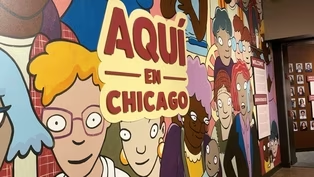
Alana Gonzalez, curator of the Key in Chicago exhibition at the Chicago History Museum says even a major institution like hers struggles to secure consistent federal support.
It >> challenging situation.
Trying to arrange for the funding of this exhibition and then as we worked on starting the building of the project, actually, our federal funding was terminated from the from the federal government.
And then part of it was reinstated.
>> Gonzalez says without adequate funding, many Latino arts organizations may lose the opportunity showcase their work.
She warns that a future without strong art support could limit cultural expression and creativity for future generations in and be on the Chicago area.
Those who support Latino arts to the root of the problem lies and who holds the financial purse strings organizations like the Angel Foundation Hoof and Claw agree.
There aren't large funders who are Latino for groups to be going to.
>> So that means they're having to speak to power.
does not look like represent The Paul Am Angel Foundation shifting its approach moving away from short-term grants and investing more in helping organizations to stay in their work for the long term.
Those arts strategies that we can help them.
gaining assets.
>> Keeping funding unrestricted so that they can utilize the dollars how they see fit to.
>> Try to keep them secure for the future.
>> Yeah, I we've grown our general operating from 2024.
To 2025.
From being like I want to say it was like 30 something percent of our grants given in 2024. to over 50%.
We're general operating grants this year and then multi-year it.
>> Good or even more.
For Wt Tw News and Northwestern's Medill School of journalism.
I'm Juliana prop key in Chicago the exhibition runs at the Chicago History Museum through November.
>> You can read more about Latino arts funding on our website and we're back to wrap things up right after this.
>> Reflecting the people perspectives that make up This story is part of Chicago tonight.
Not the >> And that's our show for this Tuesday night.
Be sure to sign up for our free email newsletter.
The Daily Chicago in at W T Tw Dot Com Slash newsletter and join us tomorrow night at 5, 30 10, the Chicago Stock Exchange building the Yukon Building and Pope Leo, the 14th Childhood home are among the area's most endangered sites.
We examine the list.
>> Now for all of us here at Chicago Brandis Friedman, thank you for watching.
Stay healthy and safe and have a good night.
>> Woes captioning is made possible by Robert a cliff and Chicago personal injury and wrongful death with more than
 New
NewInvesting in Latino Arts as Organizations Face Funding Cuts
Video has Closed Captions
Clip: 3/10/2026 | 4m 46s | Latino arts organizations often lag behind other groups for federal and philanthropic funding. (4m 46s)
 New
NewLeaders From Around the Great Lakes Plan for Region's Future
Video has Closed Captions
Clip: 3/10/2026 | 9m 16s | The Great Lakes provide water to hundreds of cities and tribal nations. (9m 16s)
 New
NewTSA Agents Working Without Pay During Partial Government Shutdown
Video has Closed Captions
Clip: 3/10/2026 | 5m 37s | Agents have been without pay since Feb. 14. (5m 37s)
Providing Support for PBS.org
Learn Moreabout PBS online sponsorship
- News and Public Affairs

Top journalists deliver compelling original analysis of the hour's headlines.

- News and Public Affairs

FRONTLINE is investigative journalism that questions, explains and changes our world.











Support for PBS provided by:
Chicago Tonight is a local public television program presented by WTTW
WTTW video streaming support provided by members and sponsors.