
March 31, 2026 - Full Show
3/31/2026 | 26m 49sVideo has Closed Captions
Watch the March 31, 2026, full episode of "Chicago Tonight."
TSA agents are getting backpay, but the DHS shutdown lingers. And betting on everything, in prediction markets — what you should know.
Problems playing video? | Closed Captioning Feedback
Problems playing video? | Closed Captioning Feedback
Chicago Tonight is a local public television program presented by WTTW
WTTW video streaming support provided by members and sponsors.
March 31, 2026 - Full Show
3/31/2026 | 26m 49sVideo has Closed Captions
TSA agents are getting backpay, but the DHS shutdown lingers. And betting on everything, in prediction markets — what you should know.
Problems playing video? | Closed Captioning Feedback
How to Watch Chicago Tonight
Chicago Tonight is available to stream on pbs.org and the free PBS App, available on iPhone, Apple TV, Android TV, Android smartphones, Amazon Fire TV, Amazon Fire Tablet, Roku, Samsung Smart TV, and Vizio.

WTTW News Explains
In this Emmy Award-winning series, WTTW News tackles your questions — big and small — about life in the Chicago area. Our video animations guide you through local government, city history, public utilities and everything in between.Providing Support for PBS.org
Learn Moreabout PBS online sponsorship>> Hello and thanks for joining us on Chicago tonight.
I'm Nick Blumberg.
Brandis Friedman has the evening off.
Here's what we're looking at.
Tsa agents are getting back pay but the DHS shutdown lingers.
A look at where negotiations in Congress stand.
And what happens when prediction markets allow you to bet on virtually anything.
>> First off tonight, a federal judge rules the Trump administration's move to end federal funding for PBS and NPR was unconstitutional.
Judge Randolph Moss says Trump's executive order last year was unlawful because it directed federal agencies to terminate funding to NPR and PBS because the president believe their news coverage was, quote, left wing.
But the judge says the First Amendment quote, Does not tolerate viewpoint discrimination and retaliation of this type.
The ruling, however, does not reverse the decision by Congress to pull back federal funding for the organizations, but it could impact future future federal dollars for public media.
The White House did not immediately comment.
Family, friends and other first responders gather to lay firefighter Michael Altman to rest.
The 32 year-old member of the Chicago Fire Department was killed earlier this month during a blaze at a Rogers Park apartment building.
His funeral had originally been scheduled for last week but was postponed after his wife went into labor.
The service in Oak Lawn was private, but supporters gathered along the funeral procession route.
Altman was a 4th generation member of the Chicago Fire Department.
The suspect has been charged with homicide and arson in connection with the fire that claimed Altman's life.
It's not an April Fools.
Joe.
Tomorrow marks the beginning of Chicago Street sweeping schedule.
So if your street parking be sure to be on the lookout for those bright orange, no parking signs.
If you know, be ready to get hit with a 50 to $60 Fine Street sweeping runs through the end of November for a ward by Ward schedule.
Check out our Web site.
3 Chicago chefs are being nominated for the annual James Beard Awards.
And they may be familiar faces.
The prestigious awards are often referred to as the Oscars of the Culinary world.
This year's finalists include Bailey Sullivan as emerging chef at months of air at a restaurant and pasta in the West Loop.
You may recognize her as a finalist on last year's culinary competition show top Chef and Chicago also has 2 nominees for the best Chef, Great Lakes Category Norman, Fenton, chef at Cutting Yo and uptown.
And Jacob, that Ash next chef at felt in West Town.
Both appeared on the Apple TV series Knife Edge, Chasing Michelin stars.
Winners will be revealed at a ceremony June 15th.
Monday's weather wasn't just nice.
It was record setting, according to the National Weather Service.
The temperature hit 81 degrees at O'Hare Airport that Chicago's official weather station that broke a previous high for March.
30th of 79 degrees set in 1986.
But temperatures drop today with showers and storms this afternoon continuing into the evening with some expected to be severe and showers remain in the forecast for the next couple of days.
Up next, Congress conversation with Congresswoman Debbie Ramirez recorded earlier today.
Chicago tonight is made possible in part.
>> By the Alexander and John Nichols family.
The Pope Brothers Foundation.
And the support of these donors.
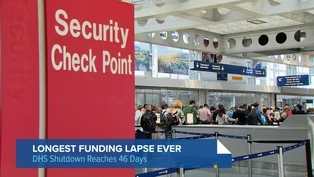
>> A new record for the longest federal funding lapse in U.S.
history.
The Department of Homeland Security has now gone.
46 days without full funding surpassing the previous 43 day shutdown that ended in November.
Partial shutdown began in February after a federal immigration crackdown in Minnesota left to U.S.
citizens dead.
Democrats say they won't from the Department of Homeland Security without reforms to Immigration and Customs Enforcement.
Republicans argue the proposed changes would endanger ice agents and the public.
Joining us via zoom to discuss the negotiations are Congresswoman Delhi Ramirez, a Democrat representing parts of Chicago's West side.
We also invited all the Republican members of Illinois's congressional delegation, but they either declined or did not respond.
Congresswoman Ramirez, thank you for joining us again.
We appreciate it.
Thanks for having me.
So as we mentioned, this partial shutdown of DHS now the longest in the country's history, both chambers of Congress and 2 week recess around the Easter holiday.
Do you think lawmakers should return to DC things just that such a stalemate that it might not make a difference?
>> Look, I think we absolutely should return to the sea and do everything in our power to make sure the for TSA workers are Coast Guard.
FEMA.
see some cyber security funded.
But the reality is that our speaker has no interest in doing that.
There's a think it's really important.
Clarify for people sent Donald Trump 44 days ago could could have issued his executive order to workers should never have to what they're going through right now.
already gone to the stuff before in November and have him go through this again is pure evil from the president.
The executive order that money he has the money to do this.
He just wanted to put enough pressure so that he can get more money for eyes at the expense federal workers.
>> mention TSA workers who finally started receiving pay this week.
But of course, there hundreds of thousands of DHS employees, you know, many of whom aren't being paid.
Are you concerned about those, you know, employees outside of TSA simply leaving and finding other work?
>> Yeah, look.
And are the president and under Christine on the uncertainty see the difference coming in to Mark moment.
DHS workers left in House, though conditions for a very long time being the mandate to do things over to redirect their money to other departments instead of actually funding or cybersecurity.
I committee hearings serve and Homeland Security where we've had the interim supervisor or administrator for TSA as well as a director for and FEMA.
There.
And they have admitted sent their money for their funding, their mission has been redirected to ICE and CBP for more ice enforcement.
The reality is that there's been a lot of instability for a very long time.
And this obsession with getting more money for ICE, the spite of the 150 billion of taxpayer dollars that were funded in July.
It's not just.
Inappropriate, unacceptable.
It's criminal to the workers.
They need to get paid into the contracts that we should be honoring specially.
We're talking to FEMA.
>> The Senate very early this past Friday morning passed a proposal to fund DHS except for ICE in parts of Customs and Border Protection.
All the Senate Republicans supported it.
But Speaker Mike Johnson and Republican leadership in the House rejected it.
Would you have supported something along the lines of the Senate plan?
>> Look, into interesting.
They are asking a question.
I think that the intention of the bill was good.
But I read every line in the bill and unfortunately, indirectly there were there was language in that Senate bill that would allow procurement for more CBP funding and would give Milan emergency authority to be able to move money ice and CBP if there was some form of emergency protests, that one back or the president decides that a particular state is in a state of emergency in all of a sudden he needs to more agents.
to be able to terrorize that community.
So the answer is I would not have voted for that bill because there were some concerns with some of the language.
That's usually what happens when put together a bill in very last short minute.
And there's an incentive things within the bill itself.
The intention of not funding ice and CBP.
I applaud and the urgency of funding TSA Coast Guard and see ice a pond as well.
And I hope to have a clean, though that does just that.
It just can't be at the expense.
The secretary who also operates in the same way as the former secretary that the agency is running as a corrupt agency.
You can't give them the kind of authorities allow them to move money.
>> House Majority Leader Steve Scalise said this weekend called the Senate's proposal week.
Meantime, on the Senate side, no GOP senators have appeared interested in taking up a stopgap proposal out of the house.
Are you surprised to see some tensions are rising between House and Senate Republicans?
>> not surprised because you also see some tensions within Democrats in the House and Senate.
mean, we've been asking senators to hold the line specially around what we have seen with ice enforcement up around the country, especially in Chicago, please many Apple, But the reality is the Speaker Johnson works for just one person, not the House of Representatives and constituents is Donald Trump and Donald Trump wants to create all the conditions of pressure to fully fund and fund more ICE and CBP because he wants this paramilitary pulleys also be able to show up just like nothing.
Airports, maybe at polling locations and around the country, terrorizing people at a time where I think that they're really afraid that they may lose the majority come November.
Speaker Johnson has no real reason for not moving something.
A tough and TSA workers to fund FEMA to fund cybersecurity and Coast Guard except that he wants to make sure he does whatever Donald Trump wants Donald Trump sent.
I got 150 billion for I want more.
Get me more.
So Johnson caved as Johnson tends to do every day in Congress.
>> Another major issue.
I want to make sure we touch on over the weekend.
President Trump said us around negotiations were going extremely well.
Iranian officials have denied any such negotiations today.
The U.S.
bombing another Iranian city is for Do you think there are any sort of negotiations actually under way?
>> Look, we're hearing from the news not from our own briefings in Congress, which we should be briefed every But we're hearing that Pakistan is trained to engage in negotiation between Iran and the U.S.
However, there's nothing shows us that there's really a pathway and a plan for Donald Trump to get us out of this morass.
But this possible with that said, Gas is $4.
$4 right now.
In some cases you're seeing that for 24 and some of smaller gas stations around the country.
Donald Trump is telling other partners and allies get your own oil because this has always been about him, profiting his family profiting and its owners profiting.
And the reality is that Donald Trump is also talking about a potential ground invasion where that doesn't actually help us get closer to some kind of negotiation.
The peace deal that talks about the full-on war, the regional war that would put more service members that people in this country truly at risk.
So I'm very concerned.
And I think that we need to go back to Congress as soon as possible.
We need to actually pass a war powers resolution because the president should not be calling all the shots specially when it comes to war.
And Speaker Johnson have to stand up for Congress, not for the president and say enough is enough.
>> All right, Congresswoman Debbie Ramirez, that's where we'll have to leave it.
Thank you very much for joining us.
We appreciate you.
>> Thank you for having me.
>> Up next, how prediction markets have become mainstream?
How warm will it be in Chicago tomorrow?
Well, U.S.
forces enter Ron next month.
How many tweets will Elon Musk post this week?
If you think, you know the answers prediction markets like Polly Market and Cal, she will let you put your money where your mouth is.
Users win or lose money depending on how their real world predictions pan out once a niche interest prediction markets have broken through to a wider audience.
Now the public and lawmakers are trying to adapt to a world where people can bet on almost anything.
Joining us to talk about it all are Todd Henderson, a professor of law at the University of Chicago, Carla Lockhart, professor of law at DePaul University.
And doctors, a noun EA and addiction specialist at Rush University.
Gentlemen, thank you all for being here.
Very interesting topic to dig into.
>> Okay.
So tight.
Take us through it.
How exactly did these prediction markets work?
So the idea is just to simply capitalize on the wisdom of the crowds.
You've probably seen a game show or someone asio.
>> Can we ask the audience for their opinion?
And the audience helps out and what we found is that if you pull a large number of people, you can get surprising accuracy on complicated things.
Us one person how much the space shuttle ways you're not going to get the right answer.
Even if that person an expert.
You asked millions of people and take the average are likely to get it.
So it's capitalizing on that.
And the simple setup is company will like Cal share Polymarket.
We'll set out a contract.
How many tweets will Elon Musk next tomorrow?
And they'll say if he makes more than 1000, this contract pays one dollar.
If he makes less than that, it paid 0.
And then those contracts are traded in the market.
And if you the contracts trading for $0.52 and you're sure that he's gonna make more than 1000 tweets tomorrow you'll buy that at $0.52 because that contract will pay you a dollar.
So it's a simple contract for a prediction of the future and then let those trade the market and capitalize on the wisdom of crowds.
I'm not sure it's possible to count how many to that?
it can be determined be about to the world that it's You know, so, Karl, these prediction markets become much more widespread since you know 2024.
So what changed from a legal standpoint that led to this?
>> Yeah, from a legal standpoint.
So back in 2024, and May the Biden administration put out a rule trying to ban prediction markets?
>> For sports and political related that rule never it was just proposed.
It never became a final rule.
And in.
Later that year in the summer, Cal, she tried to offer its first contract on the presidential election and who would win the presidential election?
And the CFTC tried to stop them from offering that contract.
Cal.
She litigated that and they won in a district court in the District of Columbia.
And so that allowed them to House prediction markets on the election in 2024.
And that was a big publicity boost for Cal.
She and once they've done they moved on to sort of the next thing, which was sports related contracts for the 2025 Super Bowl.
They started offering prediction market contracts on the Super Bowl and have expanded to all sorts of sports related contracts.
Now.
>> So even if for example, your state has legalized sports betting, you can sort of work around that with Something like polymarket or county, perhaps.
>> That's absolutely I'm originally from Texas, Texas says no sports gambling allowed in at all.
if you're 18 or older in Texas, now you can use callous your point market to place bets on sporting events.
>> You know, doctor Manny, when it comes to the public health risk are the, you know, personal potential personal problems.
Is there a difference between say traditional gambling and predicting on a market like this?
Yeah, I think that from an actual public health standpoint and a medical standpoint, the way that affects your brain is pretty much the exact same.
So while the semantics of its policy nature may be different.
The approach of how kind of we take from like doctor is.
Your action is basically the same as us being done in different way.
But the way it's an affect, your brain is the same exact way.
So I think biologically biologically, it's the same.
So, for example, if someone is aware that they have, you know, a gambling issue, this is the kind of thing that they should be staying away from, even though it's technically something are, you know, referred to as something different.
Definitely will activate the same parts of brain as any other You know, Ted, prediction markets, they offer bets on everything from, as we just said, sports games.
2 things far more consequential like military strikes.
What types of things do you think are appropriate for these prediction markets?
>> So what's amazing is this came out of research that was inside of companies.
Hewlett Packard wanted to project how many printers they would sell.
And you could you could ask salespeople you could ask the executives you could pull your customers.
It turned out making a market of just those same people was very good at predicting much better than any other method predicting what printers will be sold.
Something as prosaic is that but really important for Hewlett Packard and then other companies, Google, lots of companies have deployed prediction markets to predict any number of internal things that bled out of companies into things like politics.
And now they're used for everything.
I think personally, I'm a huge fan of prediction markets in the sense that they mobilize the wisdom of crowds to predict things that are hugely consequential, whether it's foreign policy or elections or how much it's going to rain in Illinois this spring, something very impactful for farmers.
So I think they can be used in a whole range of things where I would probably agree with.
My colleague is the realm of sports, the realm of securities prices like what the price of Nvidia is going to be tomorrow.
We already have markets for those.
The stock market predicts the value of Nvidia.
They're are gambling markets already with rules.
I just got back from Las Vegas.
There's a world of gambling.
Some states have legalized them.
That seems like a separate category.
So I think we should be in favor of prediction markets for the power.
They have to predict things.
But for areas that aren't the stock market that are in sports betting.
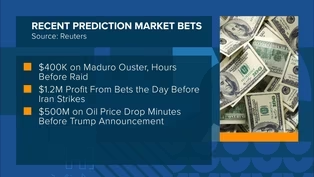
And focus on because it is a hugely powerful tool that will several bets with unusual timing have raised questions over insider information that includes $400,000 bets.
Nicolas Maduro's ouster in January hours before it happened.
>> 6 accounts made 1.2 million dollars on bets placed hours before strikes on Iran and also 500 million dollars in total bets on oil prices.
Minutes before a Trump tweet, the delay a tax on Iran's energy assets.
You know, Karl, do do we think there's in insider information being used as markets?
>> Oh, absolutely.
I mean, I think without a doubt, these markets, house insiders that are trading on them.
And I think that what we're seeing is calcium pulling market and the federal government and states trying to regulate them and trying to figure out the best way to make sure that insiders aren't being able to profit off of information that they have essentially taken wrongfully from their companies that employers are from their government position.
that's something that is an evolving issue.
And it's something that the markets themselves are trying to work on SoCal.
She, for example, is proposing, you know, rooted out some insider trading and they're also proposing certain bans on people placing by contracts on these markets of them inside information.
So it's definitely involving issue.
So it seems like they feel like they have at least some incentive to try and regulate insider information on their own.
>> I think they do because if you have only insiders if markets that have the potential for inside information to be used.
One thing that could worry, people who are just, you know, ordinary citizens trying to use these markets is that if they're all being essentially rigged, if they'll have insiders that are going to make better bets than they can, why would you participate in those markets?
And so there is sort of a self-regulatory feature to them that if people begin to see these markets as being completely dominated by insiders, they're not going to want to place money on them.
How about that?
Supreme Court justice once said that no one with willingly.
>> Playing a loaded dice game.
And I think that captures, you know what he was saying.
Self-regulation has its role.
It's not a panacea.
And so maybe there's some role for the government regulate.
Also, if people, if insiders and think he captured the idea right that the information about what the U.S.
is plans are in Iran or a company's.
now it's a security markets.
What a company's plans are.
That information really belongs to that company or the American people and having insiders profit from that might be able violation of their sort of ethical obligations to be a member of the Pentagon or a public servant.
We've seen legislation in Congress to restrict Congressional insider trading.
Something like that might make sense here, too.
I would just note, though, there's a paradox which is.
If we really want to know.
Weather events going to happen.
If the insiders who have the information about that event, who we want to encourage to reveal that information.
So we don't want someone bombing Card Island because they made a bet on Cal.
She that they're going to profit from.
But if you know that the United States is going engage in some kind of activity and it's publicly good to reveal that maybe more plans would not be an example of Then having the insiders trade would be a good thing.
So I think it's a delicate balance to strike.
And and there's a bunch of bets on these public markets now that called prop bets like, you know, we'll Elon Musk's tweet about to be a rock.
The Iran war tomorrow.
Well, you and Musk is perfect is 100% in control of that.
And those are particularly bad bats.
in this regard.
And so I think we should be especially leery of those doctor.
Now need is does whether you win or lose money, change of the risks of participating in these prediction markets for folks?
I don't think so.
And I think the best way compare it to is just kind of how the brain reacts to sports betting.
>> We have seen that in situations you would think that yes, like losing would be something that make you not want to partake anymore.
It's actually not the actual act of winning or losing.
It's the thrill and the reward seeking mechanisms that act that are in the brain that are activated.
So, for example, even though you know, you lost $1000, for example, your brain still gets the same thrill of, you know, having that like ratification, whether it be and the moment to having a win or having the last but thinking, okay, I can make up the the difference was with my next book, you know, and what the risks change.
If regulations make prediction markets harder to access or if there are more card bills.
>> I'm not sure if the risk itself which change in the moment, but I think that what it would do is it would help us as a society.
not reach the younger adults who are a particular target who are not developed yet mentally to the point where they can make those decisions for themselves.
So maybe the moment the person has already been affected in wouldn't necessarily change things, but it would help to really take that risk away from the people who more vulnerable.
We've got just under a minute left.
I want to come back to something that you brought up earlier, though, the idea of election predictions.
>> Are there any concerns that big bets on elections might sway voters?
I mean, it's always a issue that comes up and when they're used to be these old prediction markets that we're just about politics and the liquidity, that is the dollar amount at stake was very low on the probability of.
>> A big, you know, Elon Musk or George Soros really affecting the price.
It was a real thing.
But we saw that a couple of times where the probability of say Mitt Romney winning sky-high and not.
Just was profit opportunity for everybody who knew that Obama was going to win.
And so it pretty quickly went down.
So these markets, if their liquid enough, I correct themselves a little bit.
But I just want to say one thing about that point about the young people.
What I think interesting is we want these to predict the future based on people who have actual information 18 year olds.
Don't have great information about what the weather in is or what things are going to happen in Iran.
So I think the regulation could align with the public health but still serve the public purpose of the commission a lot of questions with ease as they become so widespread.
Thank you for helping us answer some of Todd Henderson Carlock Heart and doctors say Nia, thank you.
Appreciate it.
>> And that's our show for this Tuesday night.
Stay connected with our reporters and what they're working on by following us on Instagram at W T Tw Chicago.
Join us tomorrow night at 5, 30 10.
One on one with the Republican candidate running for U.S.
Senate in Illinois, Don Tracy.
Now for all of us here in Chicago tonight.
I'm Lumbered.
Thank you for watching.
Stay healthy and safe and have a good night.
>> Closed captioning is made possible by Clifford and Clifford Law offices, a Chicago personal injury, wrongful death.
That is a multi leaving office providing
 New
NewUS Rep. Delia Ramirez on DHS Funding, War in Iran
Video has Closed Captions
The U.S. Department of Homeland Security has gone 46 days without funding. (8m 25s)
 New
NewWhat to Know About Prediction Markets
Video has Closed Captions
Prediction markets let people bet on almost anything. Some lawmakers are pushing for regulations. (12m 41s)
Providing Support for PBS.org
Learn Moreabout PBS online sponsorship
- News and Public Affairs

Top journalists deliver compelling original analysis of the hour's headlines.

- News and Public Affairs

FRONTLINE is investigative journalism that questions, explains and changes our world.












Support for PBS provided by:
Chicago Tonight is a local public television program presented by WTTW
WTTW video streaming support provided by members and sponsors.