
Remembering 9/11: South Carolina Reflects
Special | 28m 46sVideo has Closed Captions
South Carolina reflects on the 25th anniversary of 9/11.
September 11, 2026 commemorates 25 years since the 9/11 attacks occurred in New York, City, Pennsylvania and in the nation’s capital of Washington, DC. South Carolinians look back on their personal accounts and the impact of that day on their lives, sharing their personal observations and experiences.
Problems playing video? | Closed Captioning Feedback
Problems playing video? | Closed Captioning Feedback
SCETV Specials is a local public television program presented by SCETV
Support for this program is provided by The ETV Endowment of South Carolina.
Remembering 9/11: South Carolina Reflects
Special | 28m 46sVideo has Closed Captions
September 11, 2026 commemorates 25 years since the 9/11 attacks occurred in New York, City, Pennsylvania and in the nation’s capital of Washington, DC. South Carolinians look back on their personal accounts and the impact of that day on their lives, sharing their personal observations and experiences.
Problems playing video? | Closed Captioning Feedback
Where to Watch SCETV Specials
SCETV Specials is available to stream on pbs.org and the PBS app.
More from This Collection
Find content produced by SCETV.
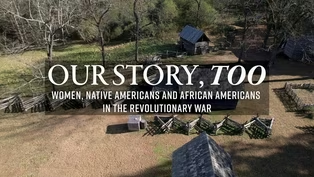
Our Story, Too: Women, Native Americans and African Americans in the Revolutionary War
Video has Closed Captions
Uncover the often-untold contributions of women, Native Americans and African Americans. (56m 46s)

Weathering The Flood: South Carolina 10 Years Later
Video has Closed Captions
Revisit the "thousand-year" flood of October 2015. (26m 46s)

Video has Closed Captions
Front Porch Carolinas takes viewers to important Civil Rights locations in the state. (27m 2s)

SC On Display: The Murals of Rock Hill
Video has Closed Captions
"'The Murals of Rock Hill'' spotlights this vibrant art community. (26m 46s)
Graceball: The Story of Bobby Richardson
Video has Closed Captions
At nineteen years-old, Bobby Richardson, became the starting second baseman for the Yankees. (54m 51s)
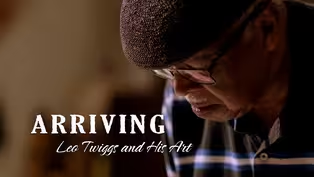
Arriving: Leo Twiggs and His Art
Video has Closed Captions
Dr. Leo Twiggs is an artist and educator in South Carolina. (56m 46s)
Video has Closed Captions
The Cleveland School fire of 1923 influenced building and fire codes nationwide. (56m 46s)
Video has Closed Captions
Explore the relationship between Reconstruction and African American Life. (56m 46s)

Video has Closed Captions
Part two continues the examination of the life of Cecil Williams. (56m 46s)

Video has Closed Captions
Explore the life of acclaimed civil rights photographer, Cecil J. Williams. (57m)
A Conversation With Will Willimon
Video has Closed Captions
William Willimon is an American theologian and bishop in the United Methodist Church. (27m 46s)

Providing Support for PBS.org
Learn Moreabout PBS online sponsorshipHey, baby, I'm... baby, you have to listen to me carefully.
I'm on a plane that's been hi-jacked.
I want to tell you I love you.
Please tell my children that I love them very much.
There's three guys who hi-jacked the plane.
I'm trying to be calm.
We're turned around, and I've heard that there's planes that been flown into the World Trade Center I hope to be able to see your face again, baby.
I love you.
Bye.
♪ dramatic music ♪ ♪ ♪ Tim Miller> September 11, 2026, commemorates 25 years since the 9/11 attacks that took place in New York City, Pennsylvania, and our nation's capital, Washington, DC.
SCETV and Public Radio will share stories from notable South Carolinians, as they reflect on the events of 9/11 and the everlasting changes that took place in our country.
My name is Frank Culbertson.
I've been fortunate enough to be an astronaut on three missions to space.
I was a pilot on STS 38 Atlantis, a classified mission for the Department of Defense.
I was a commander of STS 51 in September of 1993.
We deployed two satellites and then made the first night landing at Kennedy Space Center 10 days later, which was a real treat and a nice challenge for a Navy pilot.
I also was a commander of Expedition Three on the International Space Station in the fall of 2001.
I'd like to tell you some stories about some of the experiences I had on those missions.
My 3rd mission was on board the International Space Station.
We were supposed to launch in July of 2001.
We delayed a little bit, finally launched in August, August the 11th, we'd been in space for 30 days, and one of our tasks after that amount of time is to, do physical exams on each other, and take, you know, heart rate, blood pressure, temperature, things like that.
As the crew medical officer and commander, my job was to call the ground on a secure loop, we had to give them the results of those examinations.
So on the morning of September the 11th, 2001, I called the ground and my flight surgeon, Steve Hart came on and I said, "Hey, Steve, how's it going?"
He said, "Well, Frank, we're not having a very good day down here on earth."
And he began to describe to me what was happening in New York, the airplanes that were flown into the World Trade Center, the airplane that was flown into the Pentagon.
As we were talking, they said, we just lost another airplane somewhere in Pennsylvania.
We don't know where or what's happening.
And they told us all they could, which wasn't very much.
We didn't have live TV or live internet, so that was the only way for us to find out about that event.
Now, of course, that got our attention.
Just like it did everybody here on Earth.
My name is Jack Kuenzie and for the better part of 34 years, I was 1st the reporter, then senior reporter, and then later senior investigative reporter for WIS TV, the NBC affiliate in Columbia.
In those days, our work shift, my work shift, ran from 10 o'clock in the morning to 7 pm, which was the time of our primary newscast at the time, the 7 o'clock report.
So, I typically had a lot of time in the morning to kind of get caught up on the day's events and so forth.
So, I was sitting in my duplex out in the Columbia, Harbison area.
Watching the Today Show, eating my breakfast when I saw the first report of an explosion or fire at one of the towers of the World Trade Center.
I think like a lot of people, we were thinking, okay, did something blow up there?
Was there something happening on the top floor or one of the top floors of the tower?
And I was thinking, "Oh, you know, a small plane off course, pilot has a crisis."
I was home that day, scheduled to leave the flight of Brussels that night.
I wasn't a captain at the time.
I was a first officer on the 767 and I was getting crew rest.
You had to get the crew rest prior to leaving flight, sign in like 5 o'clock that afternoon.
And another friend of mine, coworker pilot, he called me and said, "Are you watching TV?"
I go, "No."
"You need to turn it on."
So we turn it on, and we see an airplane go into the Twin Towers in New York.
And we're both trying to figure out what was going on because we knew, we'd flown into JFK and also LaGuardia, the two airports there.
And they're nowhere close to downtown.
So, we were trying to figure out how could another airplane fly into this?
And while we were talking about it, we see it happen again.
And we go, "Are they replaying what happened earlier?"
And he goes, "No, that looks like another small airplane, like a little Cessna."
That's what we were thinking.
And we go, "No, that's not a small airplane.
That's a large plane."
And then we saw that happen.
And then, of course, a couple of minutes later, the DC one happens.
And that's when we knew something's going on really bad.
And the whole world, not just the airlines, the whole world changed at that point.
And of course, they had the other one that went around in Pennsylvania on the field.
I knew the co-pilot on that one.
Leroy Homer.
And that's the one that the passengers got up and they tried to overtake the guy.
They still crashed and everybody died, but, That's when everything just stopped.
Good morning.
I'm Debi Chard.
I was actually getting my haircut.
Because I work nights and I remember seeing it on television right away.
And at first, I was in denial.
I didn't think that it was an attack.
I thought it was a mistake.
I thought, "Oh, the poor pilot," until the impact happened.
And then, the most emotional thing that I remember to this day, 25 years later, was the audio of a woman whose voice was quivering.
It just touched my heart, and really, I understood the seriousness of the situation, the tragedy, because she was crying, and the second tower was coming down, and I think it was coming down where she was standing.
So, that's what I remember.
I was actually at work that day at our headquarters station.
I walked upstairs and the chief at the time, he said that a plane just went into the tower.
So, I looked at it.
You know, they were repeating it.
And I looked and I was like, wow, that's strange.
But when that second plane hit, I was like, whoa, this is very serious.
What's going on?
Well, you will not believe this, but, so, I was actually in the Army Operations Center, and then I went into this small office or area within the Army Operations Center called DOMS.
Director of military support.
And I happen to be in this area we call "the foxhole."
The foxhole is essentially where we get all our information.
It's a mini operations center within the army's larger operations center.
And the phone started ringing.
I picked up the phone, and it was our liaison officer at the FBI, telling me that there were four planes in the air that were unaccounted for, and that we may have a bad day.
Frank Culbertson, Jr.> Ironically, I was halfway through a Tom Clancy novel called "The Sum of All Fears," which has terrorist activities and attacks in it.
So it was kind of like I was halfway in the book and halfway in reality.
My Russian crewmates were gathered around the speaker with me listening and asking, what's going on?
What does this mean?
They were concerned because they had already been attacked by terrorists in Moscow several times before that.
As we were talking, I looked at the laptop that has our world map on it and I saw that we were coming across southern Canada.
And in a minute, we were going to be over New England.
And so I raced around and I said, "I'll be back to you in a minute," to the ground, and I race around, found a video camera and a window facing in the right direction, which was in the Russian segment, and got in the window and looking out the window from over Maine, about 400 miles away from New York City, I could clearly see the city.
It was a perfect weather day all over the United States.
And the only activity I could see was this big black column of smoke coming out of New York City, out over Long Island and over the Atlantic.
And as I zoomed in with a video camera, I saw this big gray blob, basically enveloping the southern part of Manhattan.
And what I was seeing was the second tower come down.
I didn't know exactly what I see, and I just assumed it was more explosions.
I assume 10s of 1000s of people were being hurt or killed.
And it was just horrible to see my country under attack.
So I made some comments about what I was seeing, expressed my condolences to the victims and expressed the hope that they would soon bring the people to justice who were responsible for this.
Ernest Irick> Moments later, when we were kind of looking, it was a huge crash.
But it sounded like, because the Pentagon was undergoing construction.
So initially I took it as the construction workers are just dropping things again and all that.
I didn't look at it as a terrorist attack or airplane hitting the Pentagon.
And then all of a sudden, I'm seeing it on the news that the Pentagon's been hit.
And they started evacuating people.
And so with that, the position that I was in, I could not evacuate.
I did not see it, until about three or four days.
Been in the operations center, we kind of stayed there.
People were calling, trying to get in contact with me, but when they finally got through, they would say, "Hey, he's still working."
So, I want to say we work roughly about three days straight, getting sleep when you could, but I didn't, we didn't leave the building for, third or fourth day, and then I went home and kind of showered, got myself together and came back on shift.
Jack Kuenzie> I had this feeling of existential dread that just washed over me.
And I thought, this is extraordinary.
There's something horribly, dreadfully wrong here.
And I thought, if this is what I think it is, I have to get to the station as fast as possible.
So I've lived about 12 miles away from the station.
I dressed as quickly as possible, got in my car and drove at high speed down to the station without even talking to anybody there.
And when I got there, that's when the day began for all of us.
When the second plane hit, I don't think that there was direct video of the impact, but it was clear that a second strike had happened on the next tower, and that just, to me, just added up to, this has to be not an accident.
This has to be deliberate.
And of course, that's what happened.
Marx Davis> There was no flying anywhere in the world.
I have several friends and coworkers that were flying at the time, and we were talking about diversions.
They had to divert to wherever.
They just said, wherever you can land, land.
Guys were coming back from Europe, Asia, all over the place.
Alaska, Canada, wherever, just, they put because they didn't, no one knew what was going on.
Jack Kuenzie> I was dispatched out to the Columbia Metro Airport.
Because air travel at that point was completely disrupted.
It was shut down.
There was a big story out there, not only stranded travelers, but people who were responsible for keeping the airport facility safe.
And at some point, Military vehicles were being sent out to the airport and after a while, it looked like a war zone out there because you had vehicles blockading the front of the terminal building there.
Of course, all the air traffic at that point was shut down so all of the planes were grounded.
But there was still this question of, when the airspace was going to reopen again, if it was, to what extent would people have to try to adapt to that, who had travel plans and business plans and all the other things that were being affected?
Now, there were people who were still, you know, somehow unaware that the airspace had been closed and that there were no commercial flights being allowed.
I recall talking to a few people out there who were arriving and were like, what's happening?
They didn't understand, you know, exactly how this impacted Columbia.
They were thinking, well, you know, it's in New York City or it's in Pennsylvania.
Why is my flight being canceled?
And they didn't quite understand it.
This was going nationwide.
All air traffic around the country was called off and we have the ability today on our cell phones to look at things like FlightAware and some of the apps now that track aircraft in the air around the country in real time.
We didn't have that back then.
So they were mystified, I think, about why Columbia was being impacted at that point.
Debi Chard> I think that we felt the vulnerability of, not knowing exactly what happened, why it happened, and knowing that the Air Force Base went on lockdown right away and went into war mode, actually.
And essential personnel had to leave the base.
The base was locked down.
And essentially, because we are a military community, we knew so many people's lives would change and were changed at that moment.
And I think that we learned that the sensitivity and the fact that there were so many emotions and vulnerabilities that people were feeling at the time.
We felt like we were at war.
It was very surreal.
Could this be happening?
And then where is that going to take us?
It was a feeling of uncertainty for us all in the newsroom, and obviously, people calling in asking what's going to happen next or what they can do to help.
I knew what we needed to do.
We had 90 minutes to get set up for the next pass across the United States, which was started in the Midwest.
And so we set up every camera we could looking through windows facing downward.
And I said, guys, we're going to take pictures of everything we can see as we come across the U.S.
So an hour and a half later, we crossed Chicago, we went across Indiana.
I had a daughter who was at Purdue at the time.
I'm looking all around for any evidence of further attacks.
I can see all the way to Houston, where part of the family was into North Carolina, where some were living.
And in a few minutes, we crossed Washington, DC, directly over the Pentagon.
And I could look straight down and see the gash on the side of it.
I could see the lights of the rescue vehicles, the smoke of the fires.
We took as many pictures as we could.
And then as we crossed the eastern shore of Virginia, looking north, I could clearly see New York City and the column of smoke and I took as much video as I could facing in that direction, some of which showed up on the evening news, I heard later.
So every orbit, we kept trying to see more of what was happening.
One of the most startling effects was that within about two orbits, all the contrails that are normally crisscrossing the United States had disappeared, because they had grounded all the airplanes, and there was nobody else flying in the U.S.
airspace, except for one airplane that was leaving a contrail from the Central U.S.
towards Washington, and that was Air Force One headed back to DC with President Bush.
It was a very sobering time for us.
We had very little information initially.
We did monitor what was going on and it turned out that they moved the Houston, Michigan Control Center to an undisclosed location because they did that with a lot of federal facilities.
So we were mainly in contact with Moscow and getting information from them.
Jack Kuenzie> We didn't have some of the technological advances you have today where you can send somebody out into the field by themselves and take advantage of cell phone signals.
We had to set up, you know, the equipment.
But, everything would be live, even if we were downtown and we were just putting a camera out on the sidewalk from the studio, everything would be fronted live because we needed to give people the latest information, and we didn't, and things were moving so fast.
We didn't know what we might, you know, know right now as opposed to what we would know half hour from now.
I was wondering, how did they overtake the airplane?
And then, after they got deeper into it, it talked about how these guys had gone to train to be pilots so they could talk the lingo and they knew where to hide stuff, equipment, tools or weapons on the airplane, and that's how they took over the airplane.
You put yourself in their position and I was just thinking, what would I have done if somebody had come in and how would I have reacted?
First, it's something that you never think of happening.
So, you would been shocked.
And then once you regain your composure, you know, you don't have much time because there's always something happening up there.
When you're traveling at 500 miles an hour, it's not a whole lot of time to think.
But our main goal is to, for the safety of the passengers.
You know, we put the passengers first and, of course, crew and then ourselves.
So, I'm pretty sure, I'm positive, they were thinking, how can we get this situation under control so we can save the people in the back?
And you're thinking if they hit New York, are there any other planes out there that are scheduled to hit what I would call capital cities or major cities?
And so you start thinking about, is this going to happen to us?
Are we prepared to deal with something like this?
And all those things race through your mind, especially in my role as a battalion chief at that time because I would be the one to go out and managed that incident as a battalion chief.
So you start preparing in your mind and just say, hey, if this happen here, what are we going to do?
How are we going to do it?
I think that 9/11 made journalists more sensitive to the impact on victims, especially families who've lost people.
People who've lost everything, essentially their jobs.
And, so it's really important that we understand the impact on other people, not just our own selves, but also we have feelings, too and memories.
And I used to worry about our videographers who would be on the scene right away before first responders were of serious incidents and those images that they had to look at and edit.
So the public didn't see.
They have essentially P.T.S.D.
So, I used to worry that they needed to get some kind of help.
And I think that people need to understand that going into this business that's going to happen.
And unfortunately, you may learn the hard way.
I got a picture of a building on my wall in my office.
It's called Scrivens Alley.
It was on Gervais and Huger.
The reason why I keep that picture on my wall because it wasn't a high rise, but it was a two-story building.
And we had fire blowing out that building.
And then I had a partner of mine, we were inside, and we didn't realize they called what is a code red.
Code red mean everybody get out.
He had to leave out because his mask malfunctioned which was the first mistake I made by letting him go out and I didn't go out with him.
When he went out, they called a code red, and I didn't even know.
I'm in there by myself still putting water on the fire, trying to get it out.
All of a sudden everything just started collapsing on top of me.
So I keep that picture on my wall as a reminder because nobody knew I was in there, I had all the debris on top of me, and I had to make my way out of that structure.
I just thank the Lord I was able to get out.
But I said that, to say this.
Imagine when that building fell.
Where were them firefighters gonna go?
And even the ones that survived the collapse, they were trapped inside, but perished because they couldn't get out.
That is not a good feeling.
Marx Davis> Always tell people, pilots fly airplanes, commercial pilots fly people.
Our goal is to get that person there safely and happily, that's the biggest part about that.
Because of that change, we couldn't do a lot of the things, but it's gotten better over the years, again, that was 25 years ago.
But the first 5 to 10 years, it was really, really, really hard.
And of course, the industry went down.
A lot of layoffs and a lot of guys lost their jobs and a lot of guys quit because of it too, the mental stress, because it's just, it's pretty, could be pretty demanding, especially after something like that happened, especially if you knew someone, it was affected by it, which I did.
Frank Culbertson, Jr.> In about four weeks after the attack, I was looking out the window, and I always looked at Afghanistan, which was easy to find at night in the Middle East because there was no lights.
Everywhere else was very well lit.
And I was hearing rumors from email and stuff about who was responsible for this and what our response was going to be.
I actually had three classmates who were fleet commanders at the time in the Indian Ocean.
And I was looking out one night and I saw these flashes of light in the area of Afghanistan.
And what I was seeing for the first time was combat from space, and it was the attack of the third fleet on the Taliban, and the cruise missiles and the B 52 bombs and the smart bombs from the aircraft carrier airplanes.
So it was somewhat gratifying to see that we were responding appropriately to this.
It's heartbreaking that we're still there, and we still haven't resolved all of this, and that we're still having issues with terrorists around the world and it's not a safe place in a lot of parts of the world.
And we've had to sacrifice a lot of, young American men and women because of it.
A lot of whom are friends of mine.
Marx Davis> Every year, September 11, we always do something, a dedication to it.
For the longest we had a memorial, we would do something for my friend that passed in the crash.
We would always come back that year of it.
Prior to it, you know, all year long you would think about it, but as time progresses, you know, you sort of goes in the back of your mind, but it's still hard to believe that was 25 years ago because when you asked me where I was, I know exactly where I was that day and what I was doing and what I was thinking, who I was talking to, and I will never forget that.
And most people won't because it was so impactful.
Frank Culbertson, Jr.> Now, I assumed that with all the pilots I know, the people in the military, people who work in New York, that I know someone who was affected by this in some way.
And T.J.
described to me what had happened with the flight into the Pentagon, and it turned out that the command, captain of that flight was a classmate of mine from the U.S.
Naval Academy named Chic Burlingame.
He and I had both been aero majors, we both flew F4s, we knew each other very well from school and from flying.
And he, of course, lost his life in that part of the attack, and it became very personal to me at that point.
And coincidentally, we were getting ready to have our 30th class reunion in about 10 days, and so it became a memorial to Chic and to his service to the country.
He was still a reserve pilot flying F4s and flew for American Airlines at the time.
And so I sent a message down to my classmates and to his family that they used at the football game where the reunion was occurring.
And I also played Taps for Chic because I had my trumpet up there and he and I both had played in the drum and bugle corps at the Naval Academy, and I thought it was a fitting tribute to him.
♪ Taps playing ♪ ♪ Taps playing ♪ My takeaway and how it affected me is that, first of all, you know, you never get over the shock because I know it's been 25 years, but that's something you always think about anytime you see, any kind of tragic.
I think sometimes people think that, you know, a fireman is supposed to be real tough.
And I get it, the firemen are tough, but that stuff sticks with you.
It sticks with you, and it sticks with you for a long time.
Debi Chard> I think that you hold it in.
You hold your emotions because until later, until you process it because it is news and it's something that you see over and over again.
But, I do remember talking to a friend who worked at NBC at the time was an editor, and later, I asked him, you don't talk to the people right away as the incidents because we're all busy, but after the fact, said, "how are you doing?"
And he said, "Well, I walk by the fire station every morning and today I stopped."
And there are lots of candles out in front.
And he said, "I walked in and said, how are y'all doing?
How many did you lose?
And they said, everyone."
And I started crying.
But that's the kind of release that you have months, days later.
And you realize that what you're talking about is real, it's real.
The thing that I learned flying in space, and I related this story to a young man who was walking on two prosthetic legs, was that it's very difficult for people to get along sometime, but things like the space station are a great example of how people can come together, from different cultures, different languages.
You take this hardware up there.
It fits the first time going 17,500 miles an hour in space in a vacuum because people learn how to work together and overcome their differences.
And in talking to this young man that I met at Williamsburg, who was a veteran and had been, had lost his legs to an I.E.D.
He didn't complain about anything, he didn't talk about, what a bad scene he was having to deal with.
He said, "Oh, you are in a great place.
You doing exactly what we need to do.
We need to communicate better and solve the problems rather than fight about them."
This is an American hero.
Space program is trying very hard to maintain that type of international cooperation and keep people working together, learn from each other, and build a foundation where we can go further and further out into the solar system, as a team, as a group of nations, to do great things for the next generations that are going to follow us, which I think is extremely important.
♪ somber music ♪ ♪ ♪ closing music ♪ ♪ ♪











Support for PBS provided by:
SCETV Specials is a local public television program presented by SCETV
Support for this program is provided by The ETV Endowment of South Carolina.