
WEDU Arts Plus
1506 | Episode
Season 15 Episode 6 | 27m 43sVideo has Closed Captions
Ladies Rock Camp | Unconventional Landscapes | Stained Glass | 40 Years of Photography
Created by students at St. Petersburg College in partnership with WEDU | Experience the empowering energy of Ladies Rock Camp | Explore artist Ed Valentine’s unconventional landscapes | Discover a mother-daughter stained-glass studio | Meet photographer David Humphreys after 40 years behind the lens.
Problems playing video? | Closed Captioning Feedback
Problems playing video? | Closed Captioning Feedback
WEDU Arts Plus is a local public television program presented by WEDU
Major funding for WEDU Arts Plus is provided through the generosity of Charles Rosenblum, The State of Florida and Division of Arts and Culture and the National Endowment for the Arts, and the Hillsborough County Board of County Commissioners.
WEDU Arts Plus
1506 | Episode
Season 15 Episode 6 | 27m 43sVideo has Closed Captions
Created by students at St. Petersburg College in partnership with WEDU | Experience the empowering energy of Ladies Rock Camp | Explore artist Ed Valentine’s unconventional landscapes | Discover a mother-daughter stained-glass studio | Meet photographer David Humphreys after 40 years behind the lens.
Problems playing video? | Closed Captioning Feedback
Where to Watch WEDU Arts Plus
WEDU Arts Plus is available to stream on pbs.org and the PBS app.
Providing Support for PBS.org
Learn Moreabout PBS online sponsorship- This is a production of WEDU PBS Tampa, St.
Petersburg, Sarasota.
[music] - Funding for WEDU Arts Plus is provided by Charles Rosenblum, Hillsborough County Board of County Commissioners, the State of Florida, and Division of Arts and Culture, and the National Endowment for the Arts.
In this edition of WEDU Arts Plus a journey of musical expression and self-confidence.
- Ladies Rock Camp is complete magic and it is a transformational experience for adult women.
- Contemporary landscapes.
- The landscape is built through intentionality, which is the lace.
And then a little bit of planning the way I place the birds.
- A mother-daughter artistic duo.
- We like to focus on pretty much anything, really.
I think we do repairs and customs and hangings to candleholders to big installed windows.
- And making photographs.
- But I've always been an artist and so I've always created artwork.
It's across the board.
I would say 70%, 30%, 70%.
My creativity and what I want to shoot and 30% might be client based.
- It's all coming up next on WEDU Arts Plus.
[music] Hello, I'm Dalia Colon and this is WEDU Arts Plus.
This first segment was produced by students at St.
Petersburg College in partnership with WEDU.
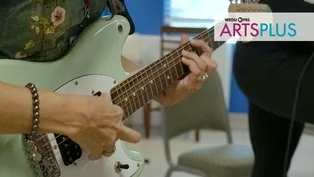
Ladies Rock Camp is a weekend crash course in forming a band that includes learning an instrument, writing a song, and performing with new bandmates, but these rock stars get more than just musical experience.
It's also a journey of self-confidence.
- You rock!
[applause] - Ladies Rock Camp is complete magic, and it is a transformational experience for adult women who want to step into their power and reclaim their voice.
You come in, you learn a new instrument, you're forming bands, you're writing original songs, you're attending workshops, you're doing silly games and activities.
And it all culminates in a final concert at the end of the weekend.
- My name is Christy Carpenter.
It's my first time singing ever.
Should I hear myself through this?
- Yes.
I'm here.
Okay.
[music] ♪ You're a dirty, dirty man ♪ [music] ♪ And you ain't got a burden ♪ [music] - What?
I hope this camp will help me learn about myself is reservation in all capacities of my life.
I'm going straight at it, headstrong.
I'm the boss.
Everybody has to do what I say.
We all even my boss.
And in this capacity, I'm hoping that I learn more of being able to hear other people and then let that, you know, not just be the one that is leading everything.
- I feel like Christie became a little bit softer through the camp experience, because she was already seemingly so brave and so forward and so confident.
But I think that we got to see a side of her that was a little bit softer and a little bit, or quite a bit, less of a facade of strength.
And I just thought that she really embraced what it meant to be a ladies rock camper.
♪ Was a son of a preacher man, the only boy ♪ - In my world.
People are very critical of people singing.
Doesn't matter how good you are in my world or in my culture, they are very, very critical.
And so that's the biggest nerve wracking is that after I got done a little while ago with singing for my first time, everybody said it was awesome.
My child was there recording it, she said it was awesome.
But I still can't shake the idea that it wasn't.
And I think that's probably the scariest thing.
- No, no baby.
- Having my mom here at camp has been a very wholesome experience.
She's my biggest fan.
She comes to all of my shows.
It's one of her favorite things to do.
So seeing her get up on stage and do the same things that I do and understand what that feels like, and then look at me and say, I understand how hard it is, and I'm sorry for being so hard on you.
Felt really good because she understands and we have like this extra connection now.
- Two three.
- We all have to write our own song as an exercise for this.
So this is all original songs, and for me, they do kind of say that the-the vocalist is the one that kind of really, you know, writes the song.
I didn't want to just run with whatever I thought, you know?
So that's what we were doing.
We were all coming together with what the ideas for the actual song would be.
[music] [music] [music] [music] Fantastic.
- Ladies Rock is curated specifically to be a very short amount of time in which these women have this big challenge in front of them, and ultimately, it is to avoid them from second guessing themselves or creating doubt.
[music] No one gives you like.
- The space or really the freedom to mess up, to make mistakes, to learn.
And that's all this is.
It is literally designed for these women.
Well, not just these women, for everyone in this, in this to fail so that we can do it together.
We can laugh, we can dust ourselves off, and we can do better next time.
[music] - It's important to have community.
It's important to have friends even at an older age.
Um, and that you can do things that you've never thought about doing out of your wheelhouse.
Just give it a try and understand that it can be fun and try to maintain these relationships even after camp.
[music] Well, I think.
- The camp changed the sense that about myself, that I feel like I am a singer and I've never felt like that before.
[music] - I am so excited to announce Maiden Mother Crone.
Give it up.
[applause] [music] ♪ Here we go!
Oh, dear ♪ [music] ♪ I shall not be moved ♪ [music] Come, I don't hear you.
[music] ♪ I shall not ♪ [music] Let's do it again.
[music] ♪ I shall not be able to ♪ Say it with me.
[music] ♪ I shall not be moved ♪ - I feel like an absolute rock star.
Absolutely.
It's nice to have everybody to give such great feedback and to know that it moved people.
It's a weekend straight of craziness, but the reality is it was life changing.
I've had so many ladies that have told me their experience was life changing, and it's no different for me either.
This was, you know, very it was amazing.
[applause] [music] - Learn more at girlsrockstpete.org Artist Ed Valentine mixes intention with chance to render contemporary landscapes.
He uses lace like patterns, stenciled birds and splatters of paint as he builds the creations in his own studio.
[music] - I grew up in what is now known as Franklinton, but when I was a kid it was the bottoms.
[music] My twin brother and I and our best friend would just leave in the mornings, and sometimes we'd end up on the railroad track.
[music] I started probably in about 1989, putting birds in a lot of things.
[music] I think maybe because I just hungered for some sort of nature.
We lived on Bowery in New York.
We had a fire escape that was probably only 15 by five feet.
I had tomato plants, I had basil, I had oregano, and I had morning glories and it would attract birds.
And it reminded me of how much I missed nature growing up in the bottoms, hanging out on the railroad tracks.
It was all about nature.
So the birds just sort of found their place.
And I guess my subconscious.
[music] [applause] My mother-in-law lives in Bryan, Ohio, and she used to have for the longest time about 20 years in Bryan, Ohio.
She had this thing where she would get together with a bunch of older women.
And she, her business was called Nancy's Afternoon Tea.
And they would just get together and they would play mahjong, and she would make little sandwiches, and they would sit around and talk about Victorian stuff and share little bits of lace that they found in thrift shops or antique stores.
[music] Well, the inspiration did come from lace.
I knew I wanted them to be landscapes.
So lace sort of made sense to me because the lace really does sort of, uh, invite man sort of intrusion into nature.
[music] The idea of a chalkboard writing on a chalkboard is just something that I think everyone can sort of relate to.
[music] And then the idea of that sort of basic rock on rock, because that's what we're doing when we're drawing with chalk on a chalkboard.
So go to the opposite end of that, and it's definitely spray paint.
It's chemicals.
It's, it's a lot of technology.
And then I had to find something in the center, in the middle.
So I just thought it would be the drips and spatters, which are sort of accidental.
So in other words, the landscape is built through intentionality, which is the little ace.
And then a little bit of planning.
The way I place the birds, I sort of analyze where I want them according to design.
And then the drips and spatters just sort of imply accident.
So you got those three sort of psychological levels, which is why I call them a landscape.
[music] - Yeah, that's it right there.
Just look around.
- And then once the lace is drawn, I definitely have to take the thing outside and just layer it with spray fix.
So that's done.
I can't go back to that.
And when I come back in, and this is what I've always told my students too, I say, walk in with your back against the painting, walk 10-15 ft away, spin around quickly.
And the first thought you have go with it.
So that might be putting a bird someplace that might be starting with the spatter.
The spatter is sort of important to put down, especially the two big white drips, because I don't want it to ever drip over one of the birds.
One reason is because the spatter is gesso and that's water based.
And the spray paint is oil based.
So eventually it will just peel off.
The other reason is, is I don't want the two to ever overlap, because then it kills the idea of three vertical planes.
And let me open this, get this out of the way.
Nature has a pattern.
There is a pattern.
There is a rhythm.
But the thing of it is, is sometimes those patterns sort of overlap, and then it creates something that looks like chaos, but it might just be just might be the intersection of two patterns.
[music] I do like the idea and I do it in my portraits, and I do it in the still lives as well.
The idea of, and it's almost like I'm giving away a secret recipe when I say this so, but I will say it, the idea of the paradox between intentionality and accident, it's I mean, it just works.
[music] I have this idea that art should be just a little bit over people's head, but not so much over their head that they just look at it and they're confounded.
But if you're going to invent a language, which is what we're doing, when I finish one of these paintings, the thing that-that I always pleases me is I've brought something new into the world, something that never existed before.
So when you're doing this, you're sort of creating a language.
And if you create a language that only you understand because it's so elevated, it's like so ethereal, what's the point when somebody's standing in front of that painting?
I just want them to accept the fact that it's going to come at them like, all at once, and then don't try to figure anything out.
It's just it's there.
It's like listening to music or smelling food coming out of a kitchen.
I mean, you don't really think that much about it.
Most people overthink painting.
I just want people to react to them.
[music] - See more of Valentine's work at edvalentineart.com.
Meet the mother-daughter duo behind the Nevada stained glass studio, A Glass Fantasy.
Originally started by Vanessa and Amanda in 1987.
Her daughter has now joined the business where they create custom pieces together.
[music] - A Glass Fantasy is a mother daughter stained glass studio.
We like to focus on pretty much anything, really.
I think we do repairs and customs and hangings to candleholders to big installed windows.
[music] - I started the business in 1987.
Officially, I was doing glass in like 78, so I've been doing it a long, long time.
I come from a family of artists.
My dad was a photographer.
One of my aunts had her masters from UCLA and Art.
Growing up, it was normal to be doing art.
And so actually I grew up thinking, everybody could do this, everybody could do everything I can do.
But I've found over the years that's not the case.
It is a special thing.
And I do believe it's genetic that because it runs so strong in in our family.
And I think like there's families of doctors, there's families of lawyers and there's families of artists, it's amazing what comes out of these fingers.
And it's nice to be able to make a living on our own, doing things I like, I like what I do, I like being able to be around to raise our kids.
I did art projects in the schools.
- She was always out here when we were little.
We had a bunch of her pieces hanging in the house.
The studio has been in this garage, which is the house that I grew up in for the last 35 years.
So I've always been around glass.
It's just always been a part of my life, and I never thought that I would do it.
- I didn't really think about whether the kids would want to do it or not, because I'm a firm believer in them doing what they want to do.
But they're so artistic.
All three of my girls are so artistic that I'm not surprised that Amy came in the business.
- I started around two and a half or three years ago.
I went part time at my day job to focus on my button making business, and then decided I had all this free time and my mom needed help revamping the business for the 21st century and getting online in exchange for doing social media and website stuff, she started teaching me.
- Obviously, she thinks the same way I do because she learns so fast.
And it just made sense to her.
[music] - It's a big process.
[music] Each piece kind of starts differently.
Sometimes I get an idea and find reference photos and draw them.
I like to-to do my designing in illustrator.
- Make up a design.
Make a pattern.
The pieces have to be cuttable, so it can't be any inside right angles, because the break is going to want to keep going straight.
So you have to be conscious of making cuttable pieces.
[music] Picking the glass is really important and it is time consuming.
- I feel very fortunate that I joined my mom who has 40 years worth of glass.
So I just look slowly through all the pieces, trying not to cut myself.
Pull them out, hold them up to the light, hold them up next to each other until I find what looks right.
Then you take a glass cutter and you score the glass.
Then you pull it apart and down and it breaks.
[music] - So then you start cutting and grinding.
- Foiling and then solder.
[music] And then I usually edge my pieces and lead came and then solder it again, and then clean it and add chain and then photograph.
[music] - It's a process.
It's a long, arduous physical process.
[music] - I really do love working with my mom, and I feel very fortunate to have joined her in this business endeavor.
[music] - She helped me clean 30 years worth of mess in our studio and get it organized to where we can actually find the glass we want, so that's really awesome.
And she has brought me kicking and screaming into the 21st century with Instagram and having a website, and she's made this a real business.
[music] - I feel very lucky to have joined her and one get to spend this time with her, but to suck up all the knowledge that she has, she has 40 years of experience.
She's self-taught, which means that she's still constantly learning too.
So we're learning together.
But then I feel like I have a leg up over a lot of my peers my age who are teaching themselves or learning off the internet.
Just having this relationship with my mom has been really special.
[music] - For more information, visit aglassfantasy.com.
For over 40 years, Louisiana multimedia artist David Humphreys has been creating images from fine art to portraiture to advertising and commercial photography.
Humphreys brings his vision to each work he produces.
[music] - I started out as a photographer.
I'm now a fine art reproductionist, fine art printer, and I've photographed everything from food to jewelry to people, corporate type work.
But I've always been an artist and so I've always created artwork.
It's across the board.
I would say 70%, 30%, 70%.
My creativity and what I want to shoot and 30% might be client-based portraits, that type of thing.
The artwork has become more accepted and it sells.
It is important to make a living, and it's a challenge to be an artist and make a living at it.
So when you find good representation and you find galleries that really love your work and appreciate you, that's a really a plus.
Because unless you find somebody that's really concerned about selling your work or putting it in front of clients, nobody knows you're here.
As far as fine art, one of my first pieces would be that artichoke.
So many people have fallen in love with the artichoke.
The blue crab.
The blue crab is a very popular image.
The rose.
That's another one that's been very well received.
This piece is actually in the LSU Museum of Art's collection as an eight-foot-by- eight-foot piece of artwork.
The pieces behind me were probably about four years of work.
[music] A gallery came to me and said, we want to create some artwork for a local hotel.
Three big flowers that float on the walls of the conference center at Renaissance Hotel on circular pieces of polycarbonate.
Polycarbonate is really plexiglass, a stronger, more substantial piece of plastic, and so it's thicker.
I've never done anything like that before.
So the process becomes more unusual and difficult because you're working on a different type of substrate.
Everything starts with an actual true photograph, but then taking that into the computer, scaling it to the size of the final piece of artwork you want, then actually cutting it apart in the, in the computer so that you know that it's going to fit when you get back to the actual handwork.
I had to figure out a way to actually create the skin of the art.
I create the skin on a specific type of material.
Once it's printed, all the work is done by hand.
And so each individual piece is an original because nothing comes out the same every time.
[music] A lot of mathematics go into it because you're dealing with a fixed scale of a piece of board or plexi or whatever.
One of the printers over here is a 60-inch printer.
I could print 60 inches wide by whatever length, but ever since I started doing fine art, I've always worked in grids, in sections and segments.
It's afforded me the ability to work very, very, very big because I could print 4 or 5 boards with images like quadrant, quadrant, quadrant, quadrant, cut those pieces out, and maybe the pieces are 8in or 10in square.
And so you have maybe a multiple of 200 pieces.
Well, you're ending up with a piece of artwork that could be ten feet by twelve feet high.
I started out in analog, using film, working with 35, two and a quarter, four-by-five cameras, shooting big sheets of film Polaroids to test.
And then I put in a dark room here where I would process the film, process the negatives.
And then I had a darkroom where I would print as well.
I took courses at LSU, but I ran out of money to go back to LSU.
So what I did was I bought Time-Life books.
I would buy one book every two weeks, and I would read it from front to back.
And then I turned my living room into a studio and started shooting images for my portfolio and slowly but surely taught myself everything about photography.
I would go around and show my work.
I'd go back to my apartment and I'd wait for the phone to ring.
The phone wouldn't ring, so I had plenty of time to just continue to create artwork and create imagery.
And so my portfolio got stronger.
And finally, I had a couple of agencies call me and take a chance on me doing some work for them from my portfolio.
They could tell that I felt like everything I created should be art.
And I think that's what set me apart in some respects.
They would tell me, well, you're more creative than some of the photographers, but they're more technical.
But in essence, they like the creativity.
It was an important part of it.
So slowly but surely, I started building up more and more clients.
Raising Cane's, Tony Chachere's, Izzo's, walk-ons.
We shot for just about every food manufacturer in the South over the years.
I've also done jewelry for a lot of different jewelry companies.
I did almost the entire starting collection for the LSU Museum of Art when they were opening, which includes silver, Inuit sculptures, beautiful paintings, which was was incredible for me to have all that artwork come through the studio.
[music] - Discover more at fabphotos.com.
And that wraps it up for this episode of WEDU Arts Plus.
To view more, visit wedu.org/artsplus or follow us on social.
I'm Dalia Colon.
Thanks for watching.
[music]
Video has Closed Captions
Clip: S15 Ep6 | 5m 49s | The life-changing power of music and community at Ladies Rock Camp (5m 49s)
Providing Support for PBS.org
Learn Moreabout PBS online sponsorship New Episode
- Arts and Music
The Best of the Joy of Painting with Bob Ross
A pop icon, Bob Ross offers soothing words of wisdom as he paints captivating landscapes.
 New Episode



 New Episode



Support for PBS provided by:
WEDU Arts Plus is a local public television program presented by WEDU
Major funding for WEDU Arts Plus is provided through the generosity of Charles Rosenblum, The State of Florida and Division of Arts and Culture and the National Endowment for the Arts, and the Hillsborough County Board of County Commissioners.