Hello, Mr. Chuck!
Colors
Season 2 Episode 2 | 27mVideo has Closed Captions
Mr. Chuck teaches kids about colors.
Mr. Chuck teaches kids about colors.
Problems playing video? | Closed Captioning Feedback
Problems playing video? | Closed Captioning Feedback
Hello, Mr. Chuck! is a local public television program presented by WKNO
Support for WKNO programming is made possible by viewers like you. Thank you!
Hello, Mr. Chuck!
Colors
Season 2 Episode 2 | 27mVideo has Closed Captions
Mr. Chuck teaches kids about colors.
Problems playing video? | Closed Captioning Feedback
How to Watch Hello, Mr. Chuck!
Hello, Mr. Chuck! is available to stream on pbs.org and the free PBS App, available on iPhone, Apple TV, Android TV, Android smartphones, Amazon Fire TV, Amazon Fire Tablet, Roku, Samsung Smart TV, and Vizio.
Providing Support for PBS.org
Learn Moreabout PBS online sponsorship[birds chirping] [doorbell ringing] (children) ♪Hello!
Hello!♪ ♪Won't you be my friend?♪ ♪Hello!
Hello!♪ ♪Let's say it again.♪ ♪Hello!
Hello!♪ ♪Won't you be my friend?♪ ♪Hello!
Hello!♪ ♪Now you are my friend.♪ ♪♪♪ ♪H-E-L-L-O♪ ♪That's a word we all should know.♪ ♪H-E-L-L-O♪ ♪You can say it.♪ ♪Just say hello.♪ ♪♪♪ Hey!
There's Mr. Chuck!
Well, hello, friends!
Hello, Mr. Chuck!
Hello, friends.
Do you ever just look around at things and enjoy the different colors ?
Green grass, blue sky, yellow flowers.
There are colors everywhere you lo ok. You can have lots of fun with colors, too.
And that's just what we're going to do today.
Have fun with colors.
We'll take a look at some different ways you can draw or paint a picture.
But first, won't you take a look at this.
You know, it's really fun just to mix different colors together and see what you come up with.
I've got some paper, a couple of brushes, some water to clean them with and some paint.
Oh, this is watercolor paint so I need to get it wet in order to paint with it.
Let's see.
Let's see what we get when we mix different colors together.
I think I'll start with red.
♪♪♪ And I'm going to put some right here on the paper.
♪♪♪ There.
That's red.
Now let's try mixing red with yellow.
♪♪♪ And I'll put a little dab of red he re.
♪♪♪ And with a clean brush I'll wet it and brush on some yellow.
♪♪♪ What color is that?
That's right.
Now what will I get if I mix red and blue?
Let's see.
I'll clean off my brush, and brush on some more red.
♪♪♪ Then I'll take another brush, get it wet and paint over the red with a little blue.
♪♪♪ Well how do you like that?
What color is it?
It's purple.
Here's red and here's where we mi xed the colors red and yellow and made orange.
I think brush on a little yellow so you can compare.
Red and yellow, mix them together and you have orange.
Red and blue make purple.
Now here's a little plain blue so you can compare that.
You see?
Red and blue, mix them together and you get purple.
You can try this, too, and have lots of fun experimenting with new and different colors.
♪♪♪ (male #1) It's time to play Name That Color.
Take a look at each of these juicy delicious fruits and then...
The first one's easy.
If you know the name of the fruit, you know the color.
Okay?
Name that color.
Orange.
Did you say orange?
You're right!
Next up is a delicious berry.
You've had them in muffins.
You may have had them in pie.
Tell me can you name that color?
Blue.
Blue is right!
These blueberries are blue berries.
Okay.
Pick a lemon.
Pucker up and name that color.
Yellow.
Did you say yellow?
You're right!
This next fruit is shaped like a le mon, but the color let's us know that it's a lime.
It's the color of grass.
It's the color of money.
Tell me, can you name that color?
Green.
Green!
You're right!
Okay.
Here's the last one.
You've seen yellow ones.
You've seen green ones, but not th is time.
What color are these juicy delicious apples?
Red.
Did you say red?
Congratulations!
You are absolutely right.
♪♪♪ Well that's all the time we have fo r now.
So long for... [drum roll] [applause] (Mr. Chuck) Do you know what this is?
It looks like a bunch of dots doesn't it?
Well, that's what it is but it's mo re.
Let's step back a bit.
Now what is it?
It's a picture of a butterfly.
Did you know you can make art using dots?
I'll show you how.
You'll need paper and markers.
Crayons or even a plain old pencil will work.
If you've never done this before you might want to use a pencil and very lightly draw in the outline of your picture.
Can you see what I've got drawn here?
Well, it's so light you might even have some difficulty making it out.
But it's an outline of an ice cream cone.
Yes.
Now when you're finished drawing you can choose a color and start making dots.
Lots and lots of dots.
♪♪♪ Lots and lots of dots.
♪♪♪ You know you have to have patience with this kind of art because it takes a while to make all these dots.
♪♪♪ You know you want your dots to be kind of random.
That means not exactly lined up in a row.
This will make a more natural looking picture when you're finished.
♪♪♪ You know, you could use as many colors as you want to.
If you get tired of doing this, you can always rest a while and come back to it later.
I'm going to make lots more dots.
While I'm doing that why don't you take a look at this.
My name is Ryan Hoskins.
That's my family.
This is my sister.
Her name is Allison.
This is my other sister Coleoca.
My mommy.
Me and my daddy.
This is my house.
♪♪♪ Okay.
Just a few more dots and I'll be done.
There.
How does that look?
I like it.
Remember, start with a very light outline of the picture you want to make and of course you can trace a picture from a book if you'd like.
Then select your choice of colors and start making dots.
You also want to remember this: It takes a lot of dots and lots of patience.
Use your imagination and have lots of fun with dots.
♪♪♪ Okay, everybody get ready for the blues here.
♪I said scooby dooby dooby.♪ ♪The colors talking to me.♪ ♪Now I can see red.♪ ♪You say scooby dooby dooby.♪ ♪The colors talking to me.♪ ♪Now I can see red.♪ ♪Scrapple dapple dapple it looks li ke an apple♪ ♪hit me on my head.♪ ♪I said scooby dooby dooby the colors talking to me.♪ ♪Now I can see blue.♪ ♪You say scooby dooby dooby the colors talking to me.♪ ♪Now I can see blue.♪ ♪Squeeby deeby die it looks like th e sky.♪ ♪It's where the little birdie flew.♪ ♪I said scooby dooby dooby the colors talking to me.♪ ♪Now I can see green.♪ ♪You say Scooby dooby dooby.♪ ♪The colors talking to me.♪ ♪Now I can see green.♪ ♪Clickety clickety cleef it looks like a leaf.♪ ♪It looks like a leaf.♪ ♪Or maybe like a green bean.♪ ♪I said scooby dooby dooby the colors talking to me.♪ ♪Now I can see yellow.♪ ♪You say scooby dooby dooby the colors talking to me.♪ ♪Now I can see yellow.♪ ♪Shamma damma damma just like a ba nana.♪ ♪Makes me feel so mellow.♪ ♪I said scooby dooby dooby the colors talking to me.♪ ♪Now I can see orange.♪ ♪You say scooby dooby dooby the colors talking to me.♪ ♪Now I can see orange.♪ ♪An orange is a fruit that you're bound to see♪ ♪and it sure tastes good to me.♪ Wasn't that fun.
I love to do all of these scat songs like squeeby deeby die, so have some fun.
Now you know all of your colors in the rainbow.
♪♪♪ ♪♪♪ I want to be a ballet dancer.
I want to be a basketball player.
I want to be a princess.
I want to be a bear.
[drum roll] Art can help young children develop a sense of pride and accomplishment, but it's important to realize that for very young children the value of the creative experience is the enjoyment of doing, not the finished product.
Each child is unique and brings his or her own creativity and experiences into each art project.
That's what we're going to talk about today on Parent's Corner.
My guest is Samantha Gimanco.
She's a child life specialist and art therapist.
Welcome to the program here on Parent's Corner.
I'm glad to be here, Mr. Chuck.
Let's talk about parent's expectations for a minute.
As I said earlier, the value of art for preschoolers may lie more in the doing than the finished product.
That's exactly right.
The process of creating, the process of communicating through the art is the most important thing.
It's not the end product or something that looks really good.
The most important thing is the time spent with the child.
The most important thing is in the process.
That's what you're really looking for is the process of creating.
What a parent can sometimes discover just by observing.
Exactly.
Your looking at what the child sees through their eyes.
How they see their world and how they see their environment.
That's what you're looking at when you look at a child's drawing.
How about help?
How important is it for mom or dad to sort of step back and let the child lead the way in an art project?
It's very important for the parents to step back.
The parent's role in the creation of art work with the child is to help the child with the tools.
To help them with the actual process of working with the paint and learning how to use paint and learning how to use glue and glitter and things like that.
That's the parent's role, but what the child chooses to put into his or her picture or what the child chooses to model in the clay should be up to the child because it's actually their communication with you.
It's what they want to say through the art.
What is the value of this?
The value is that you get all of their thoughts and all of their emotions and all of their communication and it's uncensored by you so you get purely what they feel in their hearts and minds through their art and you can see that.
It's just a beautiful thing.
It gives them the opportunity to de velop the skill Exactly.
Exactly.
And it helps them to organize their thoughts and to build their thinking process.
It really helps them to make choices.
Can you give us some insight about how a preschooler might approach drawing as opposed to an older child?
I sure can Mr. Chuck.
In fact I brought some examples with me.
Children, no matter where they come from all over the world, they go through certain development with their drawings and it goes along with their thinking process.
First a child when they're about two to four, that's when you usually see them start to draw, start to create art, start to get interested.
The first stage in scribbling is a disordered scribble.
And what I mean by that is things are just - the paper's turned and they don't care if they go off the page.
This is the time when you might se e your child start to color on the walls because they're really getting the pleasure out of moving their arms.
They're holding their crayon or their marker with their hand or their fist, not with their fingers yet so they're really getting the pleasure out of moving their arm around and scribbling.
Motor skills, exactly.
Exactly.
And the next stage in scribbling is a more organized scribble.
And that's when a child just starts to make circles and lines, longitudinal lines and they're getting more control.
It's at this point in the child's drawing development that you will see them start to stay within the page and not go off the page.
They're starting to really think about what they're putting down on the page.
Next your child will move into the naming part of scribbling.
And by that I mean the child will make marks on the page and then they will say: This is mo m and dad or they'll say this is me at school.
They actually have a name to this drawing and a title to it which before you wouldn't see in the child's drawings.
And they have a purposeful way of making these little marks on the page.
This is - all of these little shapes here are pre-figural which means this is how their little figures will grow out of these little shapes that they make.
They're actually at this point holding the pencil or the crayon with their fingers and not with their fist so they're really concentrating harder on this drawing and their attention span is longer at this point.
The pre-schematic stage is the next stage in the drawing development and in this stage it 's usually ages four to seven and in this stage the most important part of this stage is for the child to develop a hu man figure and you'll usually see the head and then you'll see so me arms and some legs start to radiate and then you'll see some eyes and the mouth and the nose start to develop.
And as the child gets older in this stage you'll start to see them add toes and fingers and a nose and some hair.
You'll really see that symbol start to grow into a human figure and they'll be able to say this is mom or this is dad and usually at this point, at this stage, all of their figures are basically the same.
You know, mom is going to look basically exactly the same as dad and brother and sister because they're really trying to develop that human figure.
Then you'll see in the schematic stage, seven to nine, you'll see the child really start to develop a picture.
You'll see them start to get your skyline up here and you'll also have a baseline.
All of the picture will be centered in the center and then it will radiate out from that.
You'll see them start to use color.
The trees will be green and the grass will be green.
Before this color really doesn't mean anything.
It's the closest tool to them and they don't really have any significance but when you get into this stage, age seven to nine, color really starts to take on an emotional meaning and it starts to be a communication of the environment.
And you really see that skyline an d that baseline and you'll also see in the figures here, they'll be more detailed.
You'll have an actual body where be fore you just had the head and feet and you'll have a lot more detail.
You'll start to see clothes on the drawings and mom will look different from dad and brother and sister and also the things in the drawings will take on proportion whereas before things were not in proportion with one another.
So their ideas and their thought pr ocesses are developing and coming together.
That's exactly right and you can see that in the drawings.
The most important thing to remember is that although your child will go through these stages, every child goes through these stages, some of them will go a little bit faster and some of them will go through a little bit slower and all is normal.
Do not be alarmed if your child is not drawing at this stage or pictures like this if they're seven years old.
They may be just a little bit behind but that's okay.
That's normal.
Nothing to get alarmed about.
Each child is an individual.
That's right.
You have been most informative this morning and we thank you very much for being with us.
Well thank you for inviting me.
Our guest today has been Samantha Gimanco.
She's a child life specialist and art therapist and we hope you've enjoyed all of this valuable information.
Well friends, today we had fun with colors.
Do you remember what you get if you mix red and yellow?
You get orange.
How about when you mix red and blue?
You get purple.
And we also learned to draw with dots.
Oh, you could try all of these things and have fun with color and your imagination.
Well that's all the time we have for today so until next time, so long.
♪♪♪
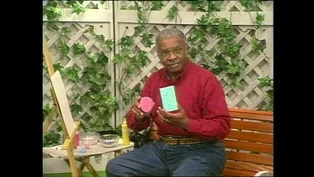
Video has Closed Captions
Clip: S2 Ep2 | 5m 15s | Mr. Chuck teaches painting with different shapes. (5m 15s)
Providing Support for PBS.org
Learn Moreabout PBS online sponsorship

- Arts and Music
The Best of the Joy of Painting with Bob Ross
A pop icon, Bob Ross offers soothing words of wisdom as he paints captivating landscapes.












Support for PBS provided by:
Hello, Mr. Chuck! is a local public television program presented by WKNO
Support for WKNO programming is made possible by viewers like you. Thank you!