
Henry Lawrence Faulkner
Clip: Season 31 Episode 17 | 7m 49sVideo has Closed Captions
A look into the colorful world of renowned artist Henry Faulkner.
Lexington has long been a city of vivid personalities – from Belle Breezing to Adolph Rupp, the city is home to figures who defied expectations and left their mark on its history. Among them was one man who didn’t just stand out, but he stood up for a community that did not have a voice. Let’s meet Henry Faulkner.
Problems playing video? | Closed Captioning Feedback
Problems playing video? | Closed Captioning Feedback
Kentucky Life is a local public television program presented by KET
You give every Kentuckian the opportunity to explore new ideas and new worlds through KET. Visit the Kentucky Life website.
Henry Lawrence Faulkner
Clip: Season 31 Episode 17 | 7m 49sVideo has Closed Captions
Lexington has long been a city of vivid personalities – from Belle Breezing to Adolph Rupp, the city is home to figures who defied expectations and left their mark on its history. Among them was one man who didn’t just stand out, but he stood up for a community that did not have a voice. Let’s meet Henry Faulkner.
Problems playing video? | Closed Captioning Feedback
How to Watch Kentucky Life
Kentucky Life is available to stream on pbs.org and the free PBS App, available on iPhone, Apple TV, Android TV, Android smartphones, Amazon Fire TV, Amazon Fire Tablet, Roku, Samsung Smart TV, LG TV, and Vizio.
Providing Support for PBS.org
Learn Moreabout PBS online sponsorshipLexington has long been a city of vivid personalities.
From Belle Brezing to Adolph Rupp, the city is home to figures who defied expectations and left their mark on its history.
Among them was one man who didn't just stand out.
He stood up for a community that did not have a voice.
Let's meet Henry Faulkner.
Henry would tell me stories that sometimes, as a youngster, I thought, “Well, I'll bet that's not true.” But I eventually found out that everything Henry ever told me, for the most part, was true.
So, Henry Faulkner is probably amongst the most well-respected of Kentucky's artists.
So, known for his lively compositions, his paintings.
But of course, if you talk to anyone, if you ask anyone about Henry, of course, they're gonna talk about his artwork.
But almost immediately, they're gonna talk about Henry as a person, who Henry was.
Lively, vibrant, more so than even his beautiful use of color in his paintings.
He's born in Southern Kentucky to an agricultural, fairly poor family.
Quite large.
His mother dies when he's just a little boy.
And then, his father, the younger children, he sends off to the orphan home.
And eventually, it is the Whittemores in Clay County in Eastern Kentucky who become Henry's adoptive parents.
So, he is raised in Clay County.
He's raised in the mountains of Eastern Kentucky.
That is where he, of course, has some of his first experiences with drawing, painting.
Henry would sneak off to the woods and paint and create art out of mud and clay.
And he would hide his art.
He was kind of an outcast.
He stayed in trouble as a youth.
He was a vagabond.
You'll find him leaving Clay County pretty early on.
And he becomes somewhat itinerant for most of his young adulthood.
I mean, he's everywhere.
It's kinda hard to keep track of him.
As he starts to enter his teen years, he starts to run away.
We know he's going to Key West.
We know he's going to San Francisco.
We know he's going to Los Angeles.
In the late ‘40s, right after World War II, he's in New York.
And there, he is mostly hanging out with artists.
Henry is entering this world pretty early on as a young man.
And he wanted to be a poet.
He wanted to be a writer.
And he was both indeed.
Early work was drawing sketches.
And that was the era where abstract expression dominated.
And he felt the movement in his mind.
And he got a break in a consignment gallery.
And they sold a couple pieces of Henry's art.
And there was no looking back.
When he's in Florida, he gets a gallery show there.
And he meets who will be one of his most prominent early patrons, and that's Alice DeLamar.
She was a wealthy heiress.
It will be Alice who sends Henry to Europe for the first time.
And to Taormina, Sicily, in particular.
When he went to Taormina, it fueled and rocketed his color palettes, his imagination.
There was a way he mixed color that nobody can duplicate.
Henry's spirit is in the compositions.
Henry could turn out a whole lot of paintings very quickly.
He wanted to swing and splash the colors.
Henry's spontaneity was deeper than you can imagine.
Henry was before his time in many ways.
He did settle in Lexington.
And certainly, a character about the streets.
And everybody knew Henry and his goat Alice.
And wherever Henry was, there was a commotion.
It seems as though he becomes more consistent in terms of spending time in Lexington in 1955.
So, his life has gone through some of the darkest chapters he'll experience.
He was an openly gay man in a time when it was extraordinarily dangerous and of course illegal to be so.
And a huge advocate for freedom of expression, freedom of sexuality.
He was incarcerated in St.
Elizabeth in Washington, D.C.
for his homosexuality.
It was punishable in those days.
He preached about the gay community and did not shy away from that topic at a time when it was not real acceptable.
He really felt like he could change the world.
And Henry knew Tennessee Williams.
Tennessee took a lot of joy in being inspired by Henry.
Tennessee wrote books of poetry as well.
Henry would take him places in his mind that he was unable to go.
He would be inspired by Henry's stories and Henry's poetry.
He frequently would depict poems in the paintings.
If you read Henry's poetry, there's some very dark poetry as well.
There were dark places that Henry went in his life that never escaped Henry his entire life.
By the end of his life, he was very tired because he had lived a lean and rugged, often tormented existence.
Henry came back and was in Lexington in ‘80 and '81.
And that's when he died in a fiery car crash there at Broadway.
And it was a huge shock.
So, what does Henry mean in the future?
He means not to go away.
He means to have his presence emboldened and blazed and burning brightly.
Henry's story is extraordinarily important, I think, in a few ways, despite the many ways that a society would try to sort of knock that out of him.
And boy, they tried really, really hard.
Despite all of this, he creates this thing of beauty.
And this thing of beauty, I think, is his life.
Henry is and was a cultural icon of Kentucky.
That encompasses more than just being a painter, a radical politician, and a gay man.
There were these eccentric characters who went against the grain, who survived and triumphed.
And even in their demise, the revitalization of their story in their biographies is triumph.
He was a fighter for individual rights and freedoms.
He was a passionate lover of art and nature.
And he was a spiritual man.
He lived a life in often a spiritual war, hoping and praying that good would prevail.
[music playing]

Video has Closed Captions
Clip: S31 Ep17 | 5m 54s | Lexington's 250-year history can be observed on a walk down its Main Street. (5m 54s)
Video has Closed Captions
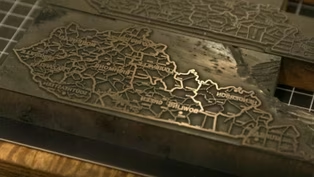
Clip: S31 Ep17 | 8m 25s | A history of mapping the Commonwealth of Kentucky. (8m 25s)
Providing Support for PBS.org
Learn Moreabout PBS online sponsorship













Support for PBS provided by:
Kentucky Life is a local public television program presented by KET
You give every Kentuckian the opportunity to explore new ideas and new worlds through KET. Visit the Kentucky Life website.