Here and Now
Here & Now for July 3, 2026
Season 2500 Episode 2501 | 26m 44sVideo has Closed Captions
Watch the entire episode of Here & Now for July 3.
Watch the entire episode of Here & Now for July 3.
Problems playing video? | Closed Captioning Feedback
Problems playing video? | Closed Captioning Feedback
Here and Now is a local public television program presented by PBS Wisconsin
Here and Now
Here & Now for July 3, 2026
Season 2500 Episode 2501 | 26m 44sVideo has Closed Captions
Watch the entire episode of Here & Now for July 3.
Problems playing video? | Closed Captioning Feedback
Where to Watch Here and Now
Here and Now is available to stream on pbs.org and the PBS app.
Providing Support for PBS.org
Learn Moreabout PBS online sponsorshipPBS Wisconsin Original production.
>> Blistering temperatures take over the state as extreme heat warnings leave people finding relief outdoors and in.
I'm Frederica Freyberg tonight on "Here& Now" a dive into primary election races with political panelists Bill McCoshen and Scot Ross.
[MUSIC] stewardship fund could carry weight into November.
As vaccine misinformation spreads.
We look at the state's numbers over time and the end of an era for Schlitz beer brings reflection and nostalgia.
It's "Here& Now" for July 3rd.
>> Funding for Here and Now is provided by the Focus Fund for Journalism and Friends of PBS Wisconsin.
>> Along with the weather, the heat is also on in Wisconsin's primary election campaigns.
With just about six weeks to go before the August 11th runoffs.
There are congressional races like in the seventh and Third districts to watch, and the race for governor, where six Democrats are still vying to be chosen to take on the leading Republican in the race.
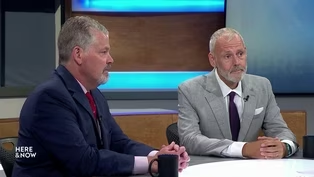
As the campaigns heat up, we turn to political panelists Republican Bill McCoshen and Democrat Scot Ross.
And thanks for being here, guys.
>> Thanks for having us.
>> So first to you, Scott.
With absentee ballots going out and now being arguably into the final stretch, who is breaking through on the Democratic side for candidates for governor and why?
still could be anybody's ball game.
There's a lot of spending going on right now.
I guess, you know, they say it's not a sprint.
It's a marathon.
But we have crossed the 20 mile marker and we're getting to the point where people are going to have to start making up their minds about who their candidates are going to be.
I think the Democrats have an think they are fighting.
You know, they're they're running down downhill because the Republicans are so in trouble because of the record of, of, of Donald Trump and the fact that their nominee, Tom Tiffany, is a radical extremist who is completely and totally tied to Trump in every single way.
>> So, Bill, do you want to respond to that?
>> I don't agree that there's it's anybody's ballgame.
1 has already dropped out.
Missy Hughes I wouldn't be surprised if two more dropped out in July.
We got 38 days to go.
I think it's really three people who are seriously in contention to win this.
It's Francesca Hong legislator from Madison, Mandela Barnes, former lieutenant governor and current Lieutenant governor Sarah Rodriguez.
I think those are the only three who have a legitimate shot to win at this point, based on all the polling.
We will have a new Marquette poll out in about ten days here in Wisconsin that will sort of tell give everyone the picture of where things are at.
But what we know from private polls and some other publicly released polls is those are the top three.
And Hong is the one that's surging at this point.
Hong Scott, what do Democratic strategists make of Democratic socialists?
>> I mean, listen, for the last 50 years, when a Democratic elected wants to spend money that's not on tax cuts for rich people or corporations.
Bill's party calls them socialists.
They call them welfare.
They call them worse.
I mean, for God's sakes, they were calling his old boss, Tommy Thompson, signature achievement BadgerCare here in Wisconsin Welfare.
That's what the speaker of the Assembly was calling it.
So, you know, we're a big tent.
And the fact is, is that when it comes to people's expenses, when it comes to gas prices, Republicans are a failure for Wisconsinites, a failure for America.
That's why Democrats are going to win this election in the fall, not because of labels that Republicans have been putting on us for 50 years.
Anyhow.
that label on her.
>> Well, I mean, Democrats.
>> Are owning it and proudly owning it.
And I think that's actually worked to Francesca Hong advantage.
I mean, she's gone on national podcasts with a guy named Hassan Piker, who's got several million followers, and she raised 100 grand in one day.
Why?
She's the boldest progressive in the race.
She's willing to say what others are not willing to say, and she's willing to be a democratic socialist.
And and none of the others have attacked her for that.
I can guarantee you, Tom Tiffany is going to contrast with her if she ends up getting through the primary in 38 days.
>> I mean, Tiffany has been attacking Barnes and Hong the entirety of his campaign and again.
>> Which I think is smart.
>> Yeah, of course.
But, you know, let's let's not kid ourselves.
Tom Tiffany was on a podcast last week with a book burner who says that foreign governments are turning our kids trans.
So like, if we want to, if we want to talk about the internet and who is appearing on internet fight that Democrats.
have 13 Democrats in the Congress who have signed up to sort of fight the Democratic Socialists.
That's less than 10% of the Democratic members of the So it is a it is a tough line to hoe right now for Democrats.
They're not sure if they should be with the socialists.
Guys like J.B.
Pritzker have come out in favor.
Said, we need more socialists in our party.
That's stunning to me.
>> I think the thing you think about that is that all the all the candidates who are calling themselves Democratic socialists and the ones who have been elected are all younger, they're all millennials.
They're all the ones who are staring up, standing up to the gerontocracy that is the Democratic Party with our 75 year old Senate Majority Leader, Chuck Schumer, Senate Minority Leader Chuck Schumer.
So I think it's you know, ideologically, Democrats are all in the same, are all in the same camp, which is we want fully funded schools.
We want access to affordable health care.
We want to protect our clean air and water.
We want our civil liberties.
And we don't want ICE Gestapo, you know, disappearing 38 people in Wisconsin yesterday.
up in two words.
They want bold progressivism.
And that's why Hong's in the game.
Eight years ago, when Tony Evers won this primary with 42%.
By the way, the winner of this will not come close to that number.
She would have been a fringe candidate today.
She's got a chance to win it.
>> Super interesting.
So Bill, who would Tom Tiffany most want as a general election opponent and who would he be afraid of?
>> I think he would have been most concerned about those that are not going to make it to the finish line.
Believe it or not, I think Democrats decided that the sort of more moderate who can appeal to trade union guys or sort of the moderate old school Democrats, they're not going to make it to the finish line in this race.
So all three of those who we've both agreed are sort of in the front of the pack are pretty progressive.
And that's a good contrast for Tiffany.
So I don't think he has a problem with any of the three top tier candidates.
>> Tom, Tiffany's biggest problem is not who he's going to face, but the fact that he's on the ballot at all.
This is a guy who took money out.
He took food out of the mouths of children to give billionaires tax breaks.
He wants a national abortion ban.
He took $300 billion from rural health care.
So rural Wisconsin, when your hospitals are closing, you can thank Tom Tiffany for that.
And he he supports the $2 billion payoff for the January 6th terrorist terrorist insurrectionists.
So this is a guy who is radically out of touch with where Wisconsin folks are, especially now when prices are higher than they've ever been.
Gas prices are higher than they've ever been because of the war of choice in Iran.
And the fact that Trump is making billions of dollars while people can't afford food.
>> The landscape is challenging for a sitting congressman in this cycle.
There's no question about that.
But I think Tom Tiffany can easily make the contrast between common sense and crazy.
And I think most Wisconsin voters will side with common sense.
>> He's trying a makeover.
It's not going to work.
He scrubbed his website before he got in the race.
And you know, he can't hide from his record.
He can't run from it as much as he ducks the media.
He cannot run from it.
third and seventh congressional races, will carry the day?
Of course, in the primary, presumably.
But in the general.
>> Both of those seats lean red.
Remember, our congressional maps were not changed.
These are the same ones that have.
We've run on for the last couple of cycles, which means Derrick Van Orden should be considered the favorite.
He's the incumbent, and it means that the Republican.
Whomever comes out of the primary in 38 days should be the favorite in the seventh.
I think Donald Trump is going to help Derrick Van Orden.
I think he's going to be in western Wisconsin once or twice.
I think.
JD.
Vance will be.
I think Donald Trump will ultimately help in the seventh.
But I think they also don't want to have to spend too many resources up there.
That's kind of a messy primary, which is unfortunate.
On our side between Kevin Herman and former Iranian hostage and successful businessman and and young man Michael Alfonso, who did get the president's endorsement.
You know, my hope is that Republicans sort of put down their arms and stop the circular firing squad that's going on on that, because I think either would be ultimately a great congressperson.
But but right now, it's pretty messy for the Republicans.
>> Scott, what are the next six weeks look like in these races?
>> I think the next six weeks are in the third and the seventh day.
I think you're going to see Republicans ducking the media.
Derrick Van Orton is just terrified of going before any sort of camera.
You know, that's not, you know, some right wing podcaster.
I think that he is the one who is in the most trouble, you know, whoever comes out of the primary.
And obviously, you know, there's Rebecca Cooke who has a massive fundraising advantage, and Emily Berg, who's who's the councilman up in Eau Claire.
I think either one of them contrasts great against the record of of Derrick Van Orden.
I mean, he's been, you know, if Tom Tiffany wasn't in Congress, he'd be our most extremist member of Congress.
So I think that he's got a lot of he's got a lot to answer for.
And I think the voters are going to hold him accountable for that.
>> All right.
We need to leave it there.
We'll circle back with you both before the primary and after, of course, Bill McCoshen Scot Ross.
Thank you.
>> Thanks for having us.
>> A long standing state conservation program expired this week for more than 35 years, Wisconsin outdoor recreation and land projects have been created and maintained by a program called the Knowles Nelson Stewardship Fund.
Created in 1989 by then Governor Tommy Thompson and the state legislature.
It has been a successful bipartisan fixture for protecting natural areas.
However, recent changes to who can veto new projects led to the Republican decision to not renew its funding in the last budget.
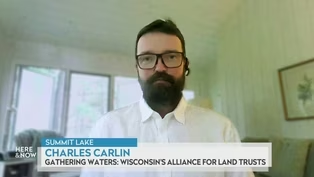
Charles Carlin of Gathering Waters Wisconsin Alliance for Land Trusts is hoping the next legislature can still make it happen.
>> The Wisconsin landscape and the outdoor recreation infrastructure that we have in Wisconsin simply wouldn't be here today without the successes of the Knowles Nelson Stewardship Program.
The program has been operating for over 35 years, has helped us permanently protect more than 650,000 acres of land, most of which is open for public recreation.
Getting out there, bird watching, going hunting, going for a hike with your family, and every single neighborhood in the state has been touched by Knowles Nelson.
It's not an exaggeration.
You know, are within a mile of a Knowles Nelson investment.
So these are the trails that we walk and bike on, the beach fronts where we go swimming, the wheat harvesters that help keep our lakes clean, the playground equipment that our kids play on at local parks.
All of this is made possible by the Knowles Nelson Stewardship Program, land that has been protected with Knowles Nelson is permanently protected.
Nothing is going to undo that.
What it means, however, moving forward is if we need a new segment of the Ice Age trail or the North Country Trail, there's no state money to make that happen.
And then all of that stuff that we need to get out and enjoy the places that make Wisconsin special.
So a trailhead to park your car at, a kiosk that shows you the map of where you're going to go walk the boat launched, put your kayak or your fishing boat in the water as that stuff ages and needs to be repaired.
We have now shot ourselves in the foot and taken away.
Really our only significant source of funding to to do that, to take care of that infrastructure.
This doesn't have to be Knowles Nelson is done forever.
So what's happened is the money has run out, but the program stays on the books.
So all of the laws that guide it are there.
The DNR staff who administer the program are still there.
What we need is for the legislature to come back and invest money in the program so that it can get moving again.
Knowles Nelson costs each Wisconsin resident about $11.
So I took my kid to fish fry at Culver's the other week, and I think it was about $15 each.
This is a value we can afford.
Our November elections are going to have really real consequences for what kind of latitude the legislature has to fund Knowles Nelson again, and what priorities they'll choose.
>> Turning to health news, a new Kaiser Family Foundation survey shows adults with a higher usage of AI chatbots are more likely to believe false information about vaccines.
Overall, child vaccination rates have decreased globally since the pandemic.
But as “Here& Now” student journalist Elijah Pines points out, vaccination rates have been decreasing and Wisconsin parents seeking waivers increasing since the mid 80s.
>> Wisconsin student immunization law mandates that any student wanting to enter the public school system must have the required vaccines.
If a student doesn't meet the requirements, parents may be charged up to $25 per day.
Their child is noncompliant, but no one in Wisconsin has been fined under the statute that mandates compliance since at least 2018, which is as far back as court data tracks charges.
Children can instead get a waiver and be exempt from vaccination if there is a medical or religious reason, or for reasons of personal conviction.
A personal conviction waiver is when a parent believes their child should be exempt from a vaccine.
Wisconsin is one of 19 states that allow for personal conviction waivers, and their popularity has been steadily rising over the past couple of decades.
At the same time, the number of students up to date on required vaccines has gone down.
For public health advocates, the numbers are concerning, but vaccination rates in public health is more nuanced than numbers alone.
For starters, despite personal conviction waivers going up, the vast majority of students get the required vaccines 86.4% in the last school year.
Still, fewer students are meeting requirements than they used to.
One reason is because there are more required shots than there were when the law was first introduced from three required vaccines in 1975 to 7 required vaccines.
Today, any time there has been a change in requirements, compliance goes down.
These numbers also track all required vaccines, both who's waiving some and who is waiving them all.
Last year, only 1.3% of students had waivers exempting them from all vaccines, and that's lower than it was in the previous year.
Ultimately, the state's job to control public health has to respect individuals decisions, and a parent can only control what's best for their own child.
So how can parents make the best choice when there's fewer vaccines?
Protecting the public?
According to Wisconsin DHS, the best answer is talking with the child's doctor, saying public health and health care providers across the state are here to help families break down these barriers to keep families safe from vaccine preventable diseases.
Reporting from Madison.
I'm Elijah Pines for "Here& Now".
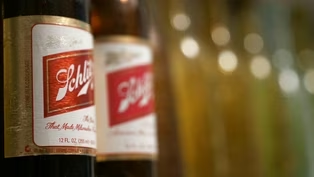
>> It's a bittersweet start to summer for beer lovers as Pabst Brewery taps out on production of one of its most iconic brands.
Schlitz.
Some of the founding family continue to have ties to Wisconsin.
Tonight, Murv Seymour takes us inside their private collection and to a southwestern Wisconsin brewery that has gone back in time to honor Schlitz as it ends production.
>> It is a long history that almost 180 years old.
>> To learn the story of Schlitz, we went to the Milwaukee neighborhood blocks from its earliest beginnings.
>> The Schlitz story actually starts with anybody named Schlitz was a young German immigrant.
August Krug.
publicly seen Schlitz archives.
>> What we have in the Schlitz archive is really an amazing collection of artifacts, advertising, photographs.
>> Old films, cassettes, original Schlitz artwork.
It's all part of the private collection of the Uihlein family who helped give birth to the Schlitz brand.
>> It was the largest lager brewing company in the world, and definitely the largest company in the United States.
>> John Eastberg oversees this rare collection.
>> This is one of the earliest photographs taken of this neighborhood, where the Schlitz Brewing Company originally started.
This would be where the Fiserv Forum is and where the bucks play today.
August Krug had hired a bookkeeper by the name of Joseph Schlitz, and when Krug died in 1856, his widow, Ana Krug, married the bookkeeper and became Ana Krug Schlitz.
>> Artifacts along the walls and on the shelves of this 2500 square foot space chronologically pieces together a story.
>> This is one of my favorite pieces in our archive.
spreadsheet from 1889, made by then bookkeeper and largest Schlitz shareholder Auguste Uihlein Ana Krug Schlitz nephew.
>> So he took two pieces of Joseph Schlitz Brewing Company letterhead, glued them together, and then detailed the output of all of his local competitors, but also his national competitors.
He is listing all the different breweries across America, and then Schlitz is at the very bottom.
>> Just over a decade later, Schlitz would rise to the top of the list.
>> Each piece is another piece to the puzzle of a company that essentially started in 1849 and is run in one way, shape, or form all the way to 2026.
>> There are original ads used during prohibition, when beer companies were simply trying to survive.
Schlitz launches its own brand of nonalcoholic beers, sodas and candies.
>> Their idea was to produce high quality chocolate, and they built a specific plant for it.
They created very attractive packaging and advertising.
Pabst went into a processed cheese product, and the Uihlein created the Uihlein, spelled phonetically.
ELINE candy company.
>> You have to have a mission in life.
>> If you think the Uihlein Schlitz collection is sweet.
>> In my case, I'm reserving the the past of Schlitz.
>> Wait until you see the Schlitz that sits 35 miles to the west.
>> Each one is a specific category on the history of the brewery.
I believe there's close to a thousand bottles in this room.
I don't know of any other collection of Schlitz bottles that is this large.
1902 Schlitz became the largest brewery in the world, brewed the most beer, sold the most beer, and then they created this piece of advertising.
This is what we call a fat man.
And the caption is I rule the world.
In other words, they control the market in the world.
>> He owns one of only a few of the original fat man figures.
>> This is probably 1905 1910.
Best of my knowledge, there's only 3 or 4 surviving.
>> 85 years.
>> Jung outdoor saloon sign, probably 1870 1875.
>> Collector Leonard Jurgensen admits.
>> That's a stained glass window out of a saloon in Chicago.
>> He has a problem.
>> Plate glass window right out of the general offices.
The front window collecting is an addiction.
If I've never seen it before, I have to have it.
>> What started out as one simple piece of Schlitz memorabilia has grown into thousands in almost 50 years.
>> I just started to collect out of curiosity.
>> And counting.
>> First known beer case Schlitz bottle beer.
There's not a piece that I have here that I can't tell you why it was created, when it was created and what was the reason for it?
This room really demonstrates is the evolution of the label.
The evolution of bottles.
>> Bottles led to worldwide distribution in Vos.
Labeling prevented piracy while enhancing worldwide branding.
>> And all the competition had to do was remove the labels, clean the bottles, and then put their brand of beer in it.
And what they soon discover is that if you had a bottle and it's embossed with your name on it, Blatz or Pabst or Miller's could not use it.
Every bottle here is is a container for Schlitz beer.
Some of them are 1877.
Some of them are are 1999.
Some of them still have the beer in them.
This is paper label bottle from 1893 Chicago World's Fair.
I'm preserving the past.
A lot of these things could have end up in a dumpster, in a landfill.
A lot of these things I rescued the beer that made Milwaukee famous after it was acquired by Stroh's Brewing Company.
They dropped that famous slogan, and for years they called it a great American beer.
And a year later they went back to the famous slogan.
The slogan was created in 1893 by Alfred von Klotzhausen, who made lithographs for them.
He shared it with them.
They used it, and they incorporated in almost everything they did after them 135 years.
They still look at that slogan as key to the word Schlitz.
>> This has got to be the coolest brewing day of my life.
>> Inside the glass and concrete walls of Wisconsin Brewing Company.
>> The history of Schlitz in itself is amazing.
>> Something special is brewing.
>> Schlitz is an amazing brand, an amazing partner of Wisconsin's heritage.
>> It's standing room only with brewmaster Kerby Nelson.
Center stage.
>> Beer bottles.
What color are they?
>> With almost 50 years of beer brewing experience.
>> So brown glass evolved as a way to protect beer, to keep it fresher and more representative of what's supposed to be.
on a masterclass in beer making.
>> These can just get in there and party to their heart's content and turn it into beer.
>> And Schlitz history.
>> For me to have the chance to brew.
An example of the beer that made Milwaukee famous from its golden era was absolutely irresistible.
detailed recipe from Schlitz Logs dating back to the 1940s.
>> The Schlitz that we produce is based on when Schlitz was on top of the world.
permission from Pabst, the owners of Schlitz, Kerby and the team used today's brewing technology to make yesteryears beer.
>> In 1950.
These.
They were selling 5 million barrels.
this tiny control room, every phase of the beer making process is monitored.
They meticulously test and taste until the mix is just right.
We were there on day one.
>> We're making wort this liquid yeast food that will be fermented in that beloved, into that beloved liquid we know as beer.
>> Kerby says.
For him, this part of modern beer making.
It's like watching a giant video game back on the barroom floor.
See the man in that jacket?
>> Oh, I'm experienced and I'm, well, I like beer.
In fact, if you look at it, I love beer.
>> That's Mark Holzman, sporting his rarely seen but hard to miss beer jacket.
>> It's 25 years of collecting patches.
I've scoured every antique shop I could find, and I look for patches that would fit in specific places.
>> He and everyone else here wants to be part of what might be the most important chapter of >> I try every kind of beer I can try, and I. Everyone has its own flavor.
>> About a month after we were in the control room, in two months since paps announced that Schlitz is shutting down, Wisconsin Brewing pumps out about 200 barrels of what they call commemorative Schlitz beer.
When it's all said and done over the next 6 or 7 hours, this production line will spit out enough beer to make 3000 cases, which is about 167,000 cans.
>> Hi Miss Christine, this is Sadie with Wisconsin Brewing Company.
How are you doing?
>> From the brewery's warehouse, Sadie Nelson works to update callers from all over the country, even Canada, on the status of this seeming liquid gold for so many customers and this brew master their journeys with making and getting a can of Schlitz.
It's personal.
>> Because working for Schlitz for 20 years and surprising an 88 year old man with a four pack signed by the Brew master.
I think that there's nothing better.
>> Folks at Wisconsin Brewing tell me that those that are lucky enough will get at least a case of beer, but to help make sure others get a taste, they're also offering four packs.
When asked why the Schlitz brand has faded, Kerby Nelson and others say it's because Schlitz changed their recipe and people changed their drinking habits.
>> I bet you I've seen ten breweries going to auction in the last two weeks, and a lot of it has to do with there is too much.
But again, changing habits.
People are really pulling back from alcohol and beer is in a downward trend right now.
It'll be back.
>> But will Schlitz be back?
>> I'm hopeful that Wisconsin Brewer will pick up the label and be able to brew small batches through maybe a least option with the Pabst Brewing Company.
It would be a shame to let such a legacy brand kind of fade away.
>> Fade away is not just the beer that made Milwaukee famous, but the beer in Milwaukee that will never be forgotten.
Reporting from Verona, Milwaukee, and Oconomowoc.
I'm Murv Seymour for Here and Now.
>> For more on this and other issues facing Wisconsin, visit our website at PBS wisconsin.org and then click on the news tab.
That's our program for tonight.
I'm Frederica Freyberg.
Have a good weekend.
[MUSIC] >> Funding for "Here& Now" is provided by the Focus Fund for Journalism and friends of PBS Wisconsin.
 New
NewCharles Carlin on Knowles-Nelson Stewardship Funds Expiring
Video has Closed Captions
Clip: S2500 Ep2501 | 3m 17s | Charles Carlin on a halt to funding for the Knowles-Nelson Stewardship Program. (3m 17s)
 New
NewA Farewell Toast to the Beer that Made Milwaukee Famous
Video has Closed Captions
Clip: S2500 Ep2501 | 10m 30s | A business archive, breweriana collector and craft brewery preserve the memory of Schlitz. (10m 30s)
 New
NewHere & Now opening for July 3, 2026
Video has Closed Captions
Clip: S2500 Ep2501 | 1m 4s | The introduction to the July 3, 2026 episode of Here & Now. (1m 4s)
 New
NewMcCoshen & Ross on Candidates in Wisconsin's 2026 Primaries
Video has Closed Captions
Clip: S2500 Ep2501 | 8m 43s | Bill McCoshen and Scot Ross on how Wisconsin's 2026 primary elections are taking shape. (8m 43s)
 New
NewHow Personal Waivers Impact Wisconsin's Vaccination Numbers
Video has Closed Captions
Clip: S2500 Ep2501 | 2m 43s | The number of families seeking personal waivers for vaccination of children is increasing. (2m 43s)
Providing Support for PBS.org
Learn Moreabout PBS online sponsorship New Episode
- News and Public Affairs

Top journalists deliver compelling original analysis of the hour's headlines.
 New Episode
- News and Public Affairs

Today's top journalists discuss Washington's current political events and public affairs.
 New Episode
 New Episode
 New Episode
 New Episode
 New Episode
 New Episode

 New Episode
 New Episode
Support for PBS provided by:
Here and Now is a local public television program presented by PBS Wisconsin