
June 11, 2026
Season 4 Episode 406 | 26m 30sVideo has Closed Captions
FCPS puts its superintendent on paid leave.
FCPS Superintendent Demetrus Liggins is placed on paid administrative leave after a confusing couple of days. Gov. Beshear says the gas tax will likely return for all Kentucky communities. Data centers are being debated in more Kentucky cities. High school students are learning about career opportunities during the summer. U.S. Rep. McGarvey goes 4/4 in the Congressional baseball game.
Problems playing video? | Closed Captioning Feedback
Problems playing video? | Closed Captioning Feedback
Kentucky Edition is a local public television program presented by KET
June 11, 2026
Season 4 Episode 406 | 26m 30sVideo has Closed Captions
FCPS Superintendent Demetrus Liggins is placed on paid administrative leave after a confusing couple of days. Gov. Beshear says the gas tax will likely return for all Kentucky communities. Data centers are being debated in more Kentucky cities. High school students are learning about career opportunities during the summer. U.S. Rep. McGarvey goes 4/4 in the Congressional baseball game.
Problems playing video? | Closed Captioning Feedback
How to Watch Kentucky Edition
Kentucky Edition is available to stream on pbs.org and the free PBS App, available on iPhone, Apple TV, Android TV, Android smartphones, Amazon Fire TV, Amazon Fire Tablet, Roku, Samsung Smart TV, LG TV, and Vizio.
Providing Support for PBS.org
Learn Moreabout PBS online sponsorshipmusic If he's leaving with the shape that that current school system is in, there shouldn't be a buyout.
>> Is the head of the class about to change in Kentucky's second largest school system?
[MUSIC] >> We've been learning how to braise copper pipes, solder them.
We've been gluing together PVC pipes.
>> Students are getting their hands dirty in search of a future career, and which Kentucky politician is covering all the bases?
[MUSIC] Production of Kentucky Edition is made possible in part by the KET Millennium Fund.
[MUSIC] [MUSIC] Good evening and welcome to Kentucky Edition for this Thursday, June 11th.
I'm Christy Dutton in our KET studios here in downtown Louisville.
Filling in for Renee Shaw.
Thank you so much for joining us.
Fayette County Public Schools Superintendent Demetrus Liggins is now on paid administrative leave.
Last night's decision by the Fayette County School Board was unanimous.
The decision was announced during a special called board meeting that lasted for more than 2.5 hours behind closed doors.
The board also voted to hire a law firm to review Superintendent Liggins employment and named Assistant Superintendent Bill Bradford as acting superintendent.
The news comes after confusing couple of days, the Lexington Herald-Leader reports.
Liggins emailed board chair Tyler Murphy on Tuesday, saying he was ready to leave and was requesting a year's salary plus benefits.
Tuesday night, Liggins sent another email saying his first email was mischaracterized as a resignation letter.
He went on to request that last night's special, called board meeting, be canceled.
It was not, and Liggins was a no show.
Following last night's vote, Chair Murphy had this to say.
>> I will say for the record that the board is not entertaining any motions for a separation package, and the board is united in our support for doctor Bill Bradford, and we're focused on ensuring stability for our students, staff and families and ensuring that Fayette County Public Schools remains focused on its core mission of supporting student success.
>> Acting Superintendent Bradford has 23 years of experience in education.
He's a graduate of Transylvania University and began working in the classroom as a Spanish teacher at Lafayette High School.
Bradford also served as principal and assistant superintendent in three Northern Kentucky school districts before returning to FCPs.
As for Liggins, it's unclear how long a review of his employment will take.
The next scheduled school board meeting is June 22nd.
Governor Andy Beshear talked about the Fayette County Public School situation this afternoon.
>> Let me say this I've worked with Superintendent Liggins while he's been here.
And if if he's leaving with the shape that that current school system is in, there shouldn't be a buyout.
That's not a knock on him.
It might or might not be his fault, but you don't leave a school system that is in a difficult place and expect it to pay you more when you're already laying off teachers.
>> The governor also talked about extending his gas tax cut by 30 more days in communities that wanted the extension.
He says 37 communities have now asked for it, but he says it probably won't go any further.
>> It will be really hard to extend this.
Another month.
You will hit the point where where government is done, almost all the government can do, and I've tried to give this president more time to resolve it.
He keeps saying it's really close.
I keep hoping it's really close because lower gas prices are good for everybody around the country.
But then we're now seeing new, new strikes at a pretty significant level, and we're seeing threats by the president.
So I just I don't have confidence that it's ending anytime soon.
And I want to make sure gas is lower here than in other places to help our people as as well as we can.
>> The governor again responded to Republican critics of his decision, noting that President Donald Trump had asked for the same gas tax suspension on the federal level.
We have data center news today in two Kentucky communities, w n KY reports, Edmonson County's fiscal court approved a one year moratorium on new data centers and other high intensity computer based businesses.
While the county studies the impact those centers could possibly have.
Meanwhile, a company is suing Cave City because of its one year moratorium.
Spectrum one reports the City Council approved the one year ban last month, and now the Kentucky Industrial Alliance is challenging the ordinance, arguing it submitted its data center development plan before the council passed the moratorium.
The company says the city should review its proposal using the zoning laws in place at the time was the data center issued the key to some counties races in last month's Kentucky primary, and some eastern Kentuckians are doing more than complaining about high electric bills.
Our Toby Gibbs explains in this look at headlines around Kentucky.
>> New polling shows Americans turning against data centers in their communities, an issue that appears to have had a major impact on county races in Kentucky's May primary.
A poll from The Economist and YouGov shows 60% of Americans opposed to building a data center in their community, and it's bipartisan, with a majority in both major parties opposed.
KMA.
S radio at Murray State University notes that anti data center candidates won their primary races in Oldham, Simpson and Meade counties.
[MUSIC] Some Kentucky Power customers want a full, transparent audit of the utility as customers deal with bigger electric bills.
[MUSIC] Kentucky Power serves 162,000 customers in far Eastern Kentucky.
[MUSIC] W EKU reports.
The average power bill there is the second highest of any service area in the state, even though it's the state's poorest region, one leader of the audit movement says.
Kentucky Power's parent company, American Electric Power, made $3 billion in 2025.
[MUSIC] While some customers are going without food.
[MUSIC] Also from EKU, a housing nonprofit, is celebrating some new high ground homes in Knott County.
The Housing Development Alliance is one of four groups building homes in the community of Chestnut Ridge, on a reclaimed mining site donated by a coal company.
[MUSIC] The GA just built 17 homes and plans ten more.
Together, the four groups planned 200 houses.
[MUSIC] The project was inspired by devastating Appalachian floods in 2022.
Hopkinsville says Salvation Army is getting a federal grant of $705,000.
The Hoptown Chronicle says the money will go to programs that address homelessness.
The money from the Department of Housing and Urban Development is twice as big as last year's $313,000 grant.
[MUSIC] The Salvation Army will use this year's money to help people get into stable, permanent homes.
[MUSIC] With headlines around Kentucky, I'm Toby Gibbs.
[MUSIC] >> As students get closer to finishing high school, it can be difficult to decide what comes next.
But education leaders say summer is the perfect time to explore career options.
And that's been happening all month long at Gateway Community and Technical Colleges career camps.
Our Emily Prince takes us to Northern Kentucky to explore this free learning experience.
>> Our focus is helping students figure things out before they graduate high school.
>> One of the first steps in figuring things out is getting hands on experience of what a potential career might look like, especially when it comes to skilled trades.
And that's exactly what some Northern Kentucky students are doing this summer as part of Gateway Community and Technical Colleges career camps.
>> Students are craving those experiences.
>> We started with auto and it was we thought if we get five kids, that will be fantastic.
We had a wait list within a day, so we knew we were on to something.
>> The career camps have expanded to include nine different programs, including allied health, computer manufacturing, welding, and more.
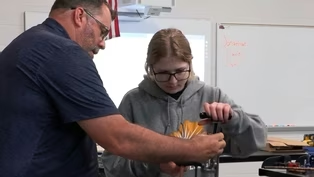
Jocelyn Henninger, a rising high school junior, participated in this year's Hvac and plumbing camp.
She said many of her family members work in the trades, and she wanted to try her hand at the skill.
>> We've been learning how to braze copper pipes, solder them.
We've been gluing together PVC pipes.
>> This year's camp gave Henninger an up close exposure to Gateway Community and Technical College, where she plans to continue taking classes next school year.
>> I've kind of been leaning towards like a trade route, and I'm going to be taking gateway classes here in the Apprenticeship Academy, which has some welding and Hvac focus.
So it's like, why not prepare?
This is pretty interesting.
So why not?
>> Another interesting part of the camps is the cost, which is totally free to students.
>> We never want it even $10 to be a barrier for a student participating in gaining the confidence that they too can be a college student.
So through the generous support of the Charles Shaw Foundation and the Bosch Foundation, we were able to expand the camp to what we have now.
>> The community college provost said.
Gateway is very intentional with their program offerings, focusing on the jobs Northern Kentucky needs.
>> The programs that we offer here are aligned with the high wage, high demand industry sectors, or they fulfill a social need in the community.
>> One of those high demand jobs is information technology and cyber security.
Rising senior Jordan Man said he's confident he wants to pursue a career in cyber security, but his exposure to the field has been limited.
>> It's not like one of those fields you learn in high school.
I watched a couple videos, gotten a couple certificates from it, so that's helped a lot.
But this is like the first time I've actually been learning learning about.
>> It.
Over the course of the four day concentrated camps, students learn directly from Gateway Professors, a local nonprofit, learning Grove also sends mentors to help the students learn soft skills and answer their career questions.
A director with Learning Grove said, sometimes students need these experiences to find out what they don't want to do.
>> These camps are a way for those students to kind of dip their toe in.
I can think of one student that went to a camp that was like, oh, I really want to be a welder.
And they got in the booth and all the stuff and they were like, okay, no, no, I'm feeling claustrophobic.
This is.
But what a great way to figure that out at a free camp where you're not starting classes somewhere and kind of investing in an education for a path that may not work.
>> After this camp experience, students may have spent time in their future college classroom or gained skills that can last a lifetime.
>> Gateway offers half off through NKU for two years here.
So out of high school I'm going straight here.
Two years NKU finishing and then straight into the workforce.
>> And I changed my mind.
I have these skills that I can apply anywhere and get go far in life.
>> For Kentucky Edition, I'm Emily Prince.
>> Nearly 170 high school students participated in this year's career camps.
Well, summer break can mean sleeping in vacations and relaxation for students.
Remember those days?
But it can also mean the summer slide.
And that isn't an actual slide that you see on playgrounds.
Students can lose up to two months of learning from the previous year.
KET Kelsey Starks talks with a panel of experts about what exactly the summer slide is and what parents, students, and teachers need to know to help in preventing the summer slide.
Education matters.
>> First, let's get a good handle on this problem.
What exactly is the summer slide?
I'll start with you, Doctor Menche.
Just mentally.
Developmentally.
What are we talking about here.
>> So with summer slide this is a term we've kind of given a phenomenon that we see with children when they kind of regress from developmental and academic milestones that they've met previously in that school year.
We know that the biggest areas affected can be reading and writing.
So English, as well as mathematics, and sometimes losing up to 20% or almost 30% in those skills areas.
We also can sometimes see that even younger children can have developmental milestones, whether it's socially impaired social regression of skills that they previously have learned as well to.
>> And Kathleen, I know your organization has a lot of statistics on this, a lot of data and research.
How widespread is it and is it something that affects everyone or certain groups more than others?
>> Yeah, absolutely.
Well, it definitely impacts everyone.
We actually just released a report with the After School Alliance Kentucky after 3 p.m.
really highlights that two out of three children whose families want them to have access to summer program don't have access to summer program.
We also know in our rural communities there's less access.
And when we think of access, it's also transportation issues.
And so there is that huge impact.
And there's that impact of the Stem and the literacy piece.
And there's all these enrichment programs that summer programs offer that look a little different than what the school day provides.
But it's still that matching that gap that's there.
So it's something that impacts everyone.
And we're seeing it more in our low income, but also middle income families.
That's been there's a greater number of middle income families that aren't being able to afford summer programing than in the past years.
>> Yeah.
And we're going to get into the cost and access.
That is absolutely a barrier.
I'm curious, Mr.
Crocker, your perspective as a teacher, you're the one there with these kids when they're leaving for the summer break and when they come back in the fall?
>> Absolutely.
It's it's one of those things that you notice, you know, from the day one, when they come in and they start work, I'm asking them to engage in some specific writing or reading skills.
It's almost as if they're rusty or have forgotten.
And it teaching high school myself, it is one of those things that it doesn't just affect our younger children.
It affects our our adolescents as well, even those that are moving on to post-secondary options.
>> And we, we do focus on those younger students as well.
But you're right, it affects high school students and even post-secondary.
So what what are these kids doing if they're not involved in a summer program?
What do we know that's happening at home?
>> Well I'll speak.
I know that that 2 to 6 is a really impactful time during the year, but also during the summer time, we see kids who are getting involved in activities we might not want them to get involved in.
There's a great organization called Invest in Kids Fight Crime.
That is from our law enforcement perspective, because kids do get more involved in activities that put them in the juvenile justice system, and that's something we want to avoid.
I often talk about to how, you know, some of us might have been watching, you know, Jerry Springer.
We were at home for the summer, which wasn't great, but it wasn't the same as having access to the whole World Wide Web.
And we're seeing a lot of research come out about the negative impacts that screen time and scrolling has on our youth, so that that's a part of what they're doing.
If they don't have access to these enrichment programs.
>> Yeah, absolutely.
And Danielle, I want to go to you from the KDE perspective.
You know, in an era after Covid when we're already talking about these Covid era learning losses, how how is this problem now exacerbated by that?
Or where are we?
>> Well, it certainly has been exacerbated.
We're seeing great gains in literacy and numeracy here in the state of Kentucky, and we're really excited about that.
So we want to ensure that our students still engage in vibrant learning at home during the summer break.
One recommendation that we have is to visit our summer support pages at the KDE website.
Those pages can provide wonderful activities for students and ways for families to engage with their students to continue learning during the summer break.
>> You can find those resources and see the full program@ket.org.
[MUSIC] A Kentucky politician is a regular Louisville Slugger.
Details in tonight's look at sports.
Morgan McGarvey, the congressman for the Louisville area, was the Democratic star of the congressional baseball game last night.
He went four for four at the plate and even hit a ground rule double in a major league ballpark.
McGarvey was also catcher for the Democratic side, and he played well.
But the Republicans still won 11 to 2.
>> That was going to be.
>> The FIFA World Cup kicked off today in Louisville, soccer lovers, including many Mexican Americans, gathered for the first match.
Mexico versus South Africa.
The Community foundation for Louisville's professional men's and women's soccer teams is helping host local watch parties throughout the tournament.
[MUSIC] >> So this is called the Festival de Futbol.
We're celebrating the big tournament this summer and to really bring this free community, family friendly event, to watch the game and really celebrate what unites us all, which is food, music, dance, soccer and community.
>> I love everything about it.
The the atmosphere where everyone comes around to enjoy the game, the teams that are playing, me and my cousin, we've been fans of soccer.
We've played soccer like ever since we were small, so we've always liked watching the World Cup playing FIFA.
My parents are from Mexico.
I support them.
That's like, that's my number one team, Mexico, because our family is Mexican, but I think Spain will win the World Cup.
So yeah, that's my prediction.
>> For me.
I played soccer from a very young age, so soccer has been a part of my life.
I actually joined soccer because I felt like it culturally represented me.
So I've been watching the World Cup since I was a young girl.
And with the LouCity and Racing Foundation, what we try to do is bring soccer to all youth in our communities.
And so with this event was a perfect bridge to make sure kids get to see their role models on the big screen.
Even if it's not.
I'm going to play like that person, but I want to be like that person.
I want to be kind.
I want to represent my nation.
I want to represent my community.
And so we're taking all of those values and showing them to the kids and showing them that they can do whatever they want.
>> Team USA plays its first game against Paraguay tomorrow at 9 p.m.
Watch parties in Louisville are planned at the Lin Family Soccer Stadium and Fourth Street Live.
Louisville's professional men's team will host the national Trinidad and Tobago team in a friendly exhibition match in late July.
[MUSIC] KET is celebrating America's 250th by illuminating Kentucky's chapter within that history.
That includes how Two Rivers created one of the most biologically diverse regions in Kentucky, KET explores how land between the lakes came to be in this Kentucky Origins episode, as we celebrate America's founding.
[MUSIC] >> Nestled between two Kentucky rivers is a landscape that did not exist before the mid 20th century.
The dramatic landscape change began when the rivers were reshaped into Kentucky Lake and Lake Barkley.
This now protected area spans more than 170,000 acres of forests, wetlands and open land.
It's also home to managed herds of bison and elk, but the landscape we see today didn't form on its own.
It's the result of sweeping changes that reshaped this entire region.
[MUSIC] This is land between the lakes, a narrow corridor that's become one of the most biologically diverse regions in Kentucky.
It all starts with the geography of two major rivers in the eastern United States, the Tennessee and the Cumberland.
[MUSIC] [MUSIC] Their lower courses turn north and empty into the Ohio River just a few miles apart.
Here those rivers were dammed, forming two long lakes, Kentucky Lake and Lake Barkley.
They run side by side for more than 50 miles, separated by a single ridge.
[MUSIC] This inland peninsula is known today as land between the lakes.
By the early 20th century, this landscape had been heavily mined for iron and cleared for timber.
[MUSIC] Catastrophic flooding during the 1937 Ohio River flood devastated communities across western Kentucky and revealed critical vulnerabilities throughout the entire Ohio Mississippi River system.
The same storm system also caused major flooding along the Tennessee and Cumberland rivers, underscoring the need for basin wide flood control rather than isolated local measures.
[MUSIC] In response, federal authorities intensified efforts to regulate the Tennessee River as a major tributary, contributing to downstream flooding.
From 1938 to 1944, the Tennessee Valley Authority built Kentucky Dam to manage floods, generate power and improve navigation.
[MUSIC] This project required the relocation of entire towns, farms and homesteads in the Tennessee River Valley.
[MUSIC] When the dam was completed in 1944, the backed up water formed what is now Kentucky Lake.
By the early 1960s, remaining families on the peninsula were displaced for a second federal project.
The construction of Barkley Dam, in 1963.
While Barkley Dam was still underway, the federal government named the land between the two waters, land between the lakes and designated it a National recreation area.
[MUSIC] The dam construction was completed in 1966, creating Lake Barkley on the east side of the ridge.
[MUSIC] These projects reshaped the river valleys and established the peninsula that now functions as a managed public landscape.
What was once a corridor of industry and agriculture is now a protected area of oak and hickory forest, grasslands and wetlands.
It's a modern reflection of how this area may have looked hundreds or even thousands of years ago.
Today, two herds of North American bison live here.
[MUSIC] One herd is visible from the south bison range along the Woodlands Trace Scenic Byway.
The other occupies the 700 acre elk and bison prairie, a managed tallgrass habitat with a drive through loop.
In late spring, bison calves begin appearing, followed by elk calves.
[MUSIC] Summer and early fall bring the bison rut, and in the fall, elk can be heard bugling across the grasslands, most often at dawn or dusk.
More than 250 bird species have been documented here, from warblers and herons to wintering waterfowl in mid-winter, bald eagles gather along the lakeshore, and the nature station hosts eagle viewing programs.
[MUSIC] Each late summer.
The nature station gardens attract hundreds of ruby throated hummingbirds preparing for migration.
[MUSIC] The area also supports white tailed deer, beavers, armadillos, foxes and numerous reptile and amphibian species.
[MUSIC] Forests and caves provide habitat for protected gray.
Indiana and northern long eared bats.
[MUSIC] The landscape is actively managed, prescribed fire and native grass plantings help maintain prairie conditions, and in 2024, land between the lakes relocated 43 elk to West Virginia to support population restoration efforts.
Today, land between the lakes functions as a large public recreation and conservation area shaped by rivers.
Federal policy and the dramatic landscape changes that have contributed to the region's modern biodiversity.
[MUSIC] Where two lakes meet and wildlife now moves across restored habitats, this corridor represents a unique chapter in Kentucky's history.
>> It's fascinating, beautiful to.
To see the rest of this story, just log on to ket.org/250 where you'll find programs, educational resources, events, and much more.
Well, you've heard of driverless cars, but what about driverless tractors?
We'll take you to a Nelson County farm that's outfitting farm equipment with automation technology.
Now, that's going to be tomorrow on Kentucky edition, and we hope you will join us tomorrow night at 630 eastern, 530 central for Kentucky edition, where we inform, connect and inspire.
You can subscribe to our KET Kentucky edition email newsletter and watch full episodes and clips@ket.org.
Thank you so much for joining us.
Have a wonderful evening.
 New
NewSummer Career Camps Help Teens Explore Future Paths
Video has Closed Captions
Clip: S4 Ep406 | 4m 2s | Kentucky high school students learn about career opportunities during the summer. (4m 2s)
Providing Support for PBS.org
Learn Moreabout PBS online sponsorship New Episode
- News and Public Affairs

Top journalists deliver compelling original analysis of the hour's headlines.

- News and Public Affairs

Today's top journalists discuss Washington's current political events and public affairs.
 New Episode
 New Episode






 New Episode
 New Episode
Support for PBS provided by:
Kentucky Edition is a local public television program presented by KET